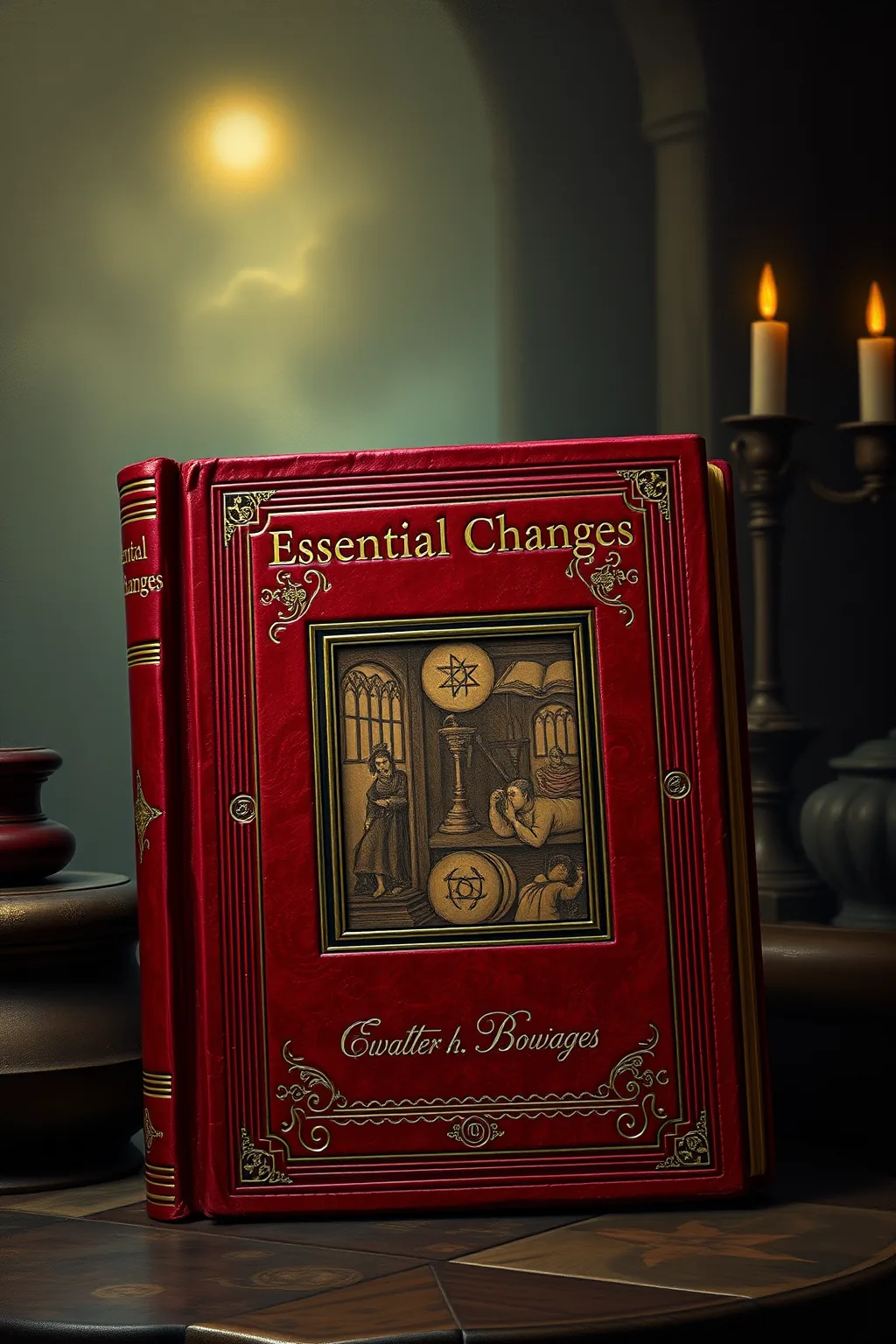
Essential changes
 61
61

Essential changes



Walter H. Bowart’s 'Essential Changes' stands as a beacon for those seeking a profound connection with the I Ching. Sophia Crane, Associate Editor, praises Bowart’s ability to distill the complex philosophical underpinnings of this ancient oracle into a comprehensible and deeply resonant guide. He masterfully bridges the gap between arcane symbolism and practical application, offering readers not just methods of consultation, but a framework for spiritual growth. The book excels in its clarity, its reverence for the source material, and its gentle encouragement for self-discovery. It is an indispensable resource for practitioners of divination, students of Eastern philosophy, and anyone yearning to understand the subtle energies shaping their lives. A truly illuminating text.
📝 Description
61
Walter H. Bowart's 'Essential Changes' (1970) deciphers the I Ching for contemporary understanding.
Published in 1970, Walter H. Bowart’s 'Essential Changes' examines the I Ching, the ancient Chinese Book of Changes. Bowart breaks down the complex symbolism of the 64 hexagrams, making the text accessible to a modern audience. He argues the I Ching functions as more than a divinatory tool, serving instead as a philosophical guide for life's uncertainties. The book explains how to interpret the hexagrams for practical application and self-reflection.
Bowart connects the I Ching's principles to concepts of interconnectedness and cyclical existence. He guides readers to recognize universal patterns that influence events and personal destiny. The text aims to foster deeper self-awareness and a more intuitive understanding of the world. It is written for those interested in esoteric studies and personal growth.
This book situates itself within the Western esoteric tradition's engagement with Eastern philosophical systems. Bowart's work follows a lineage of interpreters who sought to extract practical and spiritual wisdom from ancient texts like the I Ching, adapting them for Western seekers. It shares common ground with psychological approaches to divination, viewing symbolic systems not just as predictive tools but as mirrors for internal states and life processes. This interpretation aligns with a broader interest in consciousness studies and holistic worldviews that emerged in the mid-20th century.
💡 Why Read This Book?
Unlock the ancient wisdom of the I Ching for profound personal insight and guidance. 'Essential Changes' offers clear pathways into complex symbolism, empowering seekers and scholars alike to understand life's patterns. It’s ideal for those who desire a deeper connection with universal truths and seek tools for intuitive decision-making and spiritual growth.
⭐ Reader Reviews
Honest opinions from readers who have explored this book.
❓ Frequently Asked Questions
What is the I Ching?
The I Ching, or Book of Changes, is an ancient Chinese divination text and philosophical classic, revered for its profound insights into the cyclical nature of existence and the forces that shape destiny. It uses a system of 64 hexagrams to offer guidance and understanding.
How does the I Ching work?
The I Ching operates through a process of casting coins or yarrow stalks to generate hexagrams, which are then interpreted using the text's rich symbolism and commentary to reveal insights into a given situation or question.
Who was Walter H. Bowart?
Walter H. Bowart was an author and researcher known for his work in exploring consciousness, parapsychology, and esoteric traditions, including his significant contributions to the understanding and dissemination of the I Ching's wisdom.
Is this book suitable for beginners?
Yes, 'Essential Changes' is highly recommended for beginners. Bowart’s accessible approach breaks down the complexities of the I Ching, making its wisdom approachable for those new to its study and practice.
What makes this edition special?
This edition by Esoteric Library is curated for its depth and fidelity to the original esoteric intent, offering rich annotations and contextualization that enhance the reader's understanding of the I Ching's mystical dimensions.
🔮 Key Themes & Symbolism
The Art of Hexagrammatic Interpretation
This theme examines the intricate symbolic language of the I Ching's 64 hexagrams, exploring how each combination of yin and yang lines represents a fundamental cosmic state or process. Bowart illuminates the dynamic interplay between these archetypal figures, revealing their profound connection to human experience and the universal flow of change. Readers will learn to discern the subtle nuances of each hexagram, understanding its inherent tendencies, potential challenges, and auspicious outcomes, thereby transforming abstract symbols into practical wisdom for navigating life's myriad circumstances.
Synchronicity and Cosmic Resonance
Central to the I Ching's oracular power is the concept of synchronicity – meaningful coincidences that align internal states with external events. 'Essential Changes' posits that the I Ching acts as a conduit, revealing these resonant patterns. Bowart guides readers to recognize how their questions, when posed with sincere intent, can manifest in hexagrams that mirror their inner reality and the subtle currents of the universe. This understanding fosters a deeper appreciation for the interconnectedness of all things and the subtle ways in which the cosmos communicates.
The Philosophy of Flow and Transformation
Bowart masterfully extracts the core philosophical tenets of the I Ching, emphasizing its profound understanding of change as the only constant. The book explores the cyclical nature of existence, the balance of opposing forces, and the wisdom of adapting to evolving circumstances. Readers are encouraged to embrace flux rather than resist it, to find harmony in apparent contradictions, and to cultivate a resilient spirit capable of transforming challenges into opportunities for growth and evolution. This theme offers a timeless perspective on life, encouraging acceptance and proactive engagement with the unfolding present.
💬 Memorable Quotes
Direct passages from the work, attributed to the author.
“Within every question lies the seed of its answer.”
— This highlights the I Ching's oracular principle, suggesting that the act of posing a sincere question opens a channel to receive divinely guided insight.
“Embrace the flow, do not fight the current.”
— A powerful reminder to practice adaptability and acceptance, aligning oneself with the natural unfolding of events rather than resisting them.
“The hexagrams are mirrors of the soul and the cosmos.”
— This speaks to the symbolic depth of the I Ching, portraying its hexagrams as profound reflections of both inner states and universal patterns.
💡 Key Ideas
Editorial paraphrase of the work's core concepts — not direct quotes.
The universe is a ceaseless dance of transformation.
This quote captures the I Ching's central teaching: change is the fundamental nature of reality, and understanding its rhythms is key to navigating life.
Wisdom is found not in certainty, but in understanding change.
This quote emphasizes the I Ching's focus on process and evolution, suggesting that true wisdom lies in comprehending the dynamic nature of life.
🌙 Esoteric Significance
Tradition
The I Ching belongs to the Taoist and Confucian traditions of ancient China, deeply rooted in cosmology, philosophy, and divination. Its esoteric significance lies in its portrayal of the Tao, the fundamental cosmic principle of the universe, and the interplay of Yin and Yang as the generative forces of all phenomena. It serves as a spiritual map, guiding practitioners towards harmony with the natural order and the attainment of inner balance through understanding universal patterns.
Symbolism
The core symbolism of the I Ching resides in its 64 hexagrams, each composed of six lines that can be either solid (Yang) or broken (Yin). These lines and their combinations represent archetypal situations, forces, and transitions in nature and human life. The trigrams (three-line figures) are foundational, representing elements like Heaven, Earth, Water, Fire, and so on. The Book of Changes is a vast repository of metaphorical language, numerological correspondences, and philosophical insights that unlock the profound meanings encoded within these visual and conceptual symbols.
Modern Relevance
In an age of rapid change and uncertainty, the I Ching, as presented in 'Essential Changes,' offers profound modern relevance. Its emphasis on adaptability, understanding cyclical patterns, and finding balance in duality provides invaluable tools for navigating personal and societal challenges. The book's teachings foster intuitive decision-making, encourage mindfulness, and promote a sense of interconnectedness with the universe, empowering individuals to live with greater wisdom, resilience, and a deeper sense of purpose amidst the complexities of contemporary life.
👥 Who Should Read This Book
This useful text is essential for a broad spectrum of readers. For the **beginner** curious about ancient wisdom, 'Essential Changes' provides a clear and accessible entry point into the profound world of the I Ching. **Students of Eastern philosophy and comparative religion** will find a rich source for understanding this a core part of Chinese thought. **Spiritual seekers** yearning for deeper self-knowledge and guidance will discover a powerful tool for introspection and divination. **Practitioners of divination and esoteric arts** will appreciate Bowart's insightful interpretations and his ability to connect the I Ching to broader metaphysical principles, enhancing their practice with timeless wisdom.
📜 Historical Context
Published in an era marked by a burgeoning interest in Eastern philosophies and esoteric studies in the West, Walter H. Bowart's 'Essential Changes' emerged as a significant contribution to the popularization of the I Ching. The late 20th century saw a widespread cultural exploration of consciousness, spirituality, and ancient wisdom traditions, fueled by figures like Carl Jung, who recognized the I Ching's psychological depth. Bowart’s work tapped into this zeitgeist, offering a structured yet accessible interpretation that resonated with seekers looking for meaning beyond conventional frameworks. It bridged the academic study of classic texts with the lived experience of divination and personal growth, solidifying its place as a foundational text for many Western practitioners of the Book of Changes.
📔 Journal Prompts
Reflect on a recent challenge; which hexagram best represents its essence and what wisdom does it offer for navigating it?
Consider the concept of Yin and Yang in your daily life. Where do you see imbalances, and how can you find greater harmony?
How does the idea of 'change as the only constant' resonate with your personal journey? What fears or opportunities does this bring?
If the I Ching is a mirror, what aspect of yourself or your situation does the most frequently occurring hexagram reflect?
Explore the synchronicity between your inner state and external events this week. How might the I Ching offer insight into these meaningful coincidences?
🗂️ Glossary
Hexagram
A symbol in the I Ching composed of six lines, each either solid (Yang) or broken (Yin), representing a specific situation or cosmic state.
Trigram
A basic building block of the hexagram, consisting of three lines (Yang or Yin), representing fundamental elements or forces.
Yang
In I Ching philosophy, the active, masculine, bright, and creative principle, often represented by a solid line.
Yin
In I Ching philosophy, the passive, feminine, dark, and receptive principle, often represented by a broken line.
Tao
The fundamental, ineffable principle of the universe in Taoist philosophy, representing the natural order and the way of things.
This book appears in 3 collections
🔮 Readers Also Liked
Browse all →









From the “I Ching” Collection
View all →







More Free Divination & Tarot Books
View all →