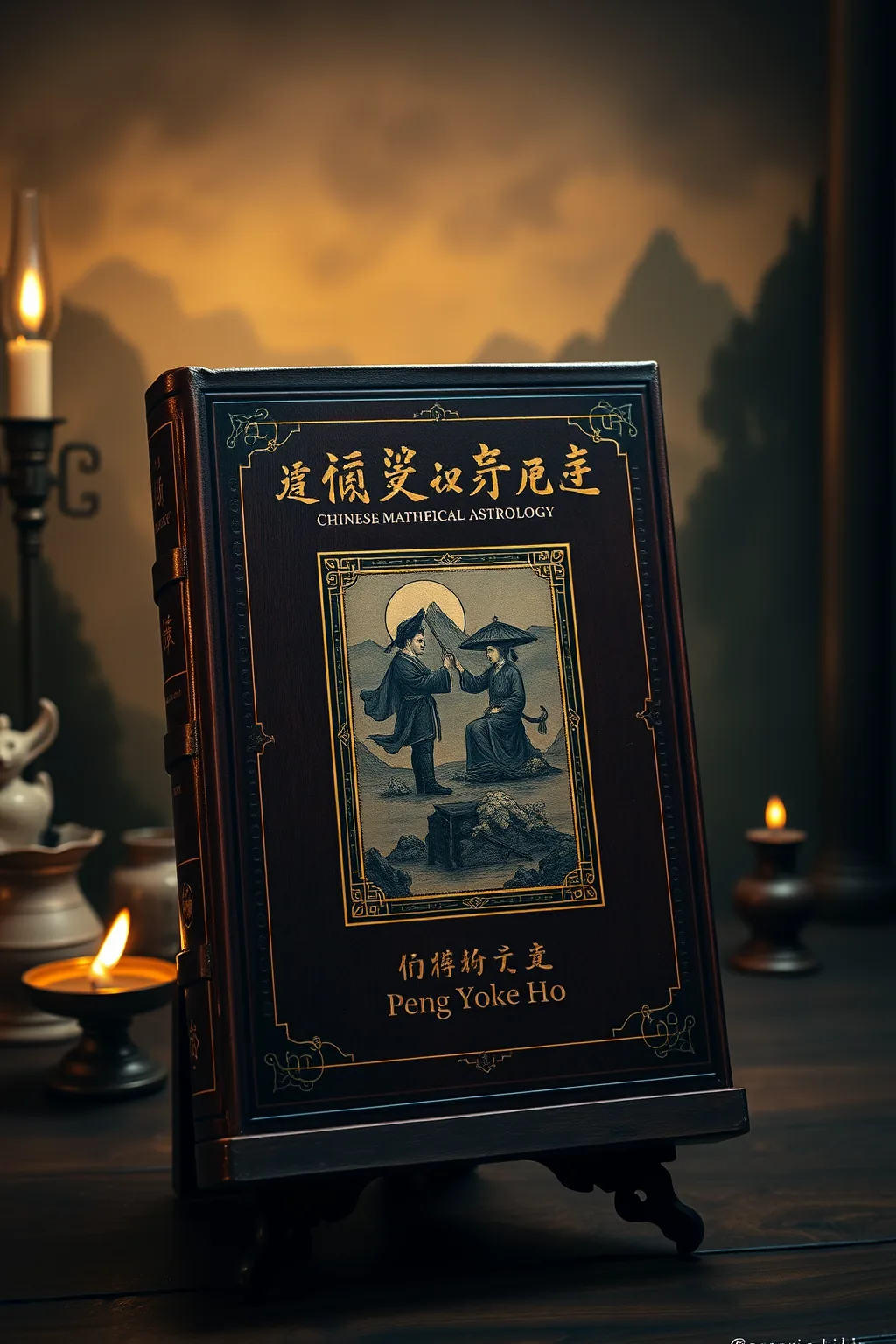
Chinese Mathematical Astrology
 61
61

Chinese Mathematical Astrology


By Aurelia Blackwood (Occult Philosophy Critic) — Peng Yoke Ho's 'Chinese Mathematical Astrology' is a revelation for any serious student of esoteric sciences. This text masterfully deciphers the complex interplay of numerology, astronomy, and divination within the Chinese tradition. Ho's scholarship illuminates the profound philosophical depth, revealing how ancient Chinese sages perceived mathematical principles as the very architecture of the cosmos. The book offers unparalleled insights into the symbolic language of the stars and their influence on human affairs, making it an indispensable resource for practitioners and scholars alike. Its clarity and depth make it a cornerstone for understanding a sophisticated astrological system.
📝 Description
61
Peng Yoke Ho's Chinese Mathematical Astrology (1977) examines the numerological and astronomical roots of Chinese divination.
Peng Yoke Ho's 1977 study, Chinese Mathematical Astrology, details the sophisticated numerological and astronomical systems underpinning traditional Chinese divination. The book moves beyond a simple recounting of astrological practices to analyze the philosophical and mathematical frameworks that gave these systems their authority. It shows how numbers were not merely tools for calculation but held symbolic meaning, and how celestial events were interpreted as significant pronouncements on earthly affairs.
The work discusses the historical use of these astrological methods by Chinese rulers and spiritual advisors. It provides insight into a worldview where mathematical principles served as a channel for understanding the divine and the cosmos. Ho's research offers a specific look at how a culture perceived the connections between the universe and human existence, using precise calculations and symbolic interpretations.
This book sits within the tradition of Chinese esoteric cosmology, specifically the integration of mathematics and divination. It follows scholars who have sought to understand the conceptual frameworks behind practices like I Ching divination and the Chinese calendar, which rely on complex numerical and cyclical patterns. Ho’s work connects these practices to a philosophical understanding where celestial phenomena and human affairs are interwoven through numerological principles, reflecting a worldview common in many ancient cultures but uniquely developed in China.
💡 Why Read This Book?
Unravel the ancient wisdom of Chinese cosmology. Discover how mathematics and celestial cycles intertwine to reveal profound truths about destiny and the universe. Ideal for seekers of esoteric knowledge, astrology enthusiasts, and scholars interested in comparative metaphysics. This book offers a unique lens through which to view the cosmos and our place within it, promising a deeper understanding of ancient wisdom.
⭐ Reader Reviews
Honest opinions from readers who have explored this book.
❓ Frequently Asked Questions
What is the fundamental principle of Chinese Mathematical Astrology?
It posits that celestial bodies, through their movements and mathematical relationships, exert a discernible influence on earthly events and human destinies, viewing numbers and cycles as sacred cosmic language.
Is this book suitable for beginners?
Yes, while comprehensive, it provides a structured approach that can guide newcomers through the foundational concepts of this complex system.
What makes this approach different from Western astrology?
It integrates numerology, I Ching principles, and a unique calendrical system, offering a distinct philosophical framework and predictive methodology.
Does the book explain how to cast charts?
The book lays the groundwork for understanding chart construction by explaining the underlying principles and symbolic meanings of the components.
What is the role of numbers in this system?
Numbers are not merely quantitative but are imbued with symbolic, energetic, and divinatory significance, forming the very grammar of cosmic communication.
🔮 Key Themes & Symbolism
The Celestial Numerology
Look at the profound belief that numbers are not merely abstract concepts but fundamental building blocks of the cosmos. This theme explores how specific numerical sequences and their relationships, derived from astronomical observations, are interpreted as divine pronouncements, dictating the ebb and flow of universal energies. It reveals how the ancients saw a sacred geometry in the heavens, where each celestial body and its cycle corresponded to particular numerical vibrations, offering a framework for understanding destiny and cosmic order.
Cosmic Cycles and Human Destiny
This theme investigates the intricate relationship between the grand cycles of celestial bodies – the sun, moon, planets, and stars – and the unfolding range of human life. It explores how the Chinese astrological system maps these cosmic rhythms onto individual destinies, suggesting that birth moments are imprinted with the energetic signature of the heavens. Readers will uncover how understanding these cycles can offer insights into personality, potential challenges, and auspicious timings for various endeavors, connecting personal fate to the grand cosmic dance.
The Language of Symbols and Divination
Explore the rich symbolic language that underpins Chinese Mathematical Astrology, where every element – from planetary positions to animal signs – carries layers of meaning. This theme uncovers how these symbols, when combined through mathematical calculations, form a complex system of divination. It highlights the use of these symbolic interpretations to gain wisdom, navigate life's complexities, and understand the subtle forces at play, bridging the gap between the visible and the invisible realms.
💬 Memorable Quotes
Direct passages from the work, attributed to the author.
“Each star whispers a secret of time and fate.”
— Suggests the profound connection between astronomical bodies and the unfolding of individual and collective destinies.
“In the dance of planets, we find the rhythm of our lives.”
— Emphasizes the harmonious relationship between cosmic movements and the temporal progression of human existence.
“The numerology of the cosmos is the key to earthly understanding.”
— Highlights the central role of numerical symbolism in unlocking the mysteries of the physical world and human experience.
“Wisdom lies in seeing the patterns the stars have drawn.”
— Encourages the reader to seek knowledge by observing and interpreting the celestial order.
💡 Key Ideas
Editorial paraphrase of the work's core concepts — not direct quotes.
The heavens are a scroll, and numbers are its script.
This quote captures the core belief that celestial phenomena are not random but are governed by a divine, mathematical order that can be deciphered.
🌙 Esoteric Significance
Tradition
This work is deeply rooted in the Taoist and Confucian traditions of ancient China, incorporating elements of cosmology, philosophy, and divination. It represents a unique esoteric lineage that views the universe as an interconnected, living organism governed by precise mathematical and energetic principles. The system seeks to align human life with the Tao, the fundamental principle of the universe, by understanding and harmonizing with celestial patterns.
Symbolism
Key symbols include the Yin and Yang duality, the Five Elements (Wood, Fire, Earth, Metal, Water), the Twelve Earthly Branches (represented by animals), and the Ten Heavenly Stems. These elements, when combined through mathematical calculations and astronomical positions, form a rich symbolic language used to interpret personality, predict events, and understand the energetic forces shaping existence.
Modern Relevance
In an era increasingly driven by data and logic, Chinese Mathematical Astrology offers a profound counterpoint, demonstrating the power of symbolic understanding and holistic interconnectedness. It provides practitioners and seekers with a sophisticated framework for self-reflection, personal growth, and navigating life's challenges with greater awareness. Its principles can be applied to modern contexts, fostering a deeper appreciation for natural cycles and the subtle influences that shape our reality.
👥 Who Should Read This Book
This book is a treasure for the dedicated seeker of ancient wisdom, the seasoned astrology practitioner, and the curious scholar. Beginners will find a clear, yet profound, introduction to a complex system. Advanced practitioners will appreciate the depth of Ho's scholarship and the nuanced interpretations. Those interested in comparative cosmology, Eastern philosophies, and the esoteric links between mathematics and the universe will find it particularly rewarding. It is for anyone who wishes to understand the cosmos not just as a physical space, but as a living, breathing entity imbued with meaning and purpose.
📜 Historical Context
Emerging from the body of ancient Chinese civilization, Chinese Mathematical Astrology flourished during periods of significant intellectual and philosophical development, particularly from the Han Dynasty onwards. It was intricately woven into the fabric of imperial governance, scientific inquiry, and spiritual practice. This system served not only as a tool for predicting auspicious dates for imperial ceremonies and military campaigns but also as a means of understanding the mandate of heaven and the cyclical nature of dynasties. Its development was deeply influenced by Taoist cosmology, Confucian ethics, and the advancements in astronomy and mathematics of the time. The integration of concepts like Yin and Yang, the Five Elements, and the I Ching provided a sophisticated theoretical framework that distinguished it from other astrological traditions, making it a central to traditional Chinese thought.
📔 Journal Prompts
How do the principles of Yin and Yang resonate with your personal experiences?
Reflect on a time when you felt aligned with a natural cycle. What did you learn?
Consider the 'mathematical' patterns in your own life. Where do you see order or chaos?
What celestial body or astrological symbol currently draws your attention and why?
How can understanding cosmic cycles help you approach a current challenge with greater perspective?
🗂️ Glossary
Yin and Yang
The fundamental Taoist concept of complementary, interconnected opposites that form the basis of all existence, representing dualistic yet unified forces.
Five Elements (Wu Xing)
A classical Chinese philosophy that describes the interactions and relationships between five fundamental elements: Wood, Fire, Earth, Metal, and Water.
Earthly Branches
A cycle of twelve symbols, often represented by animals (e.g., Rat, Ox, Tiger), used in the Chinese calendar and astrology to denote time periods and influence.
Heavenly Stems
A cycle of ten symbols that, when combined with the Earthly Branches, form the sexagenary cycle (60-year cycle) used in Chinese calendrical and astrological systems.
Mandate of Heaven
A traditional Chinese political and religious doctrine used to justify the rule of the King or Emperor of China, linking celestial order to earthly governance.
This book appears in 2 collections
🔮 Readers Also Liked
Browse all →




![A Concise Introduction To Tibetan Astrology [Men-Tsee-Khang-སྨན་རྩིས་ཁང་།]](/img/thumb/a-concise-introduction-to-tibetan-astrology-men-tsee-khang-སནརསཁང--419861.webp)


From the “Astrology” Collection
View all →









More Free Astrology & Cosmology Books
View all →