Yeu
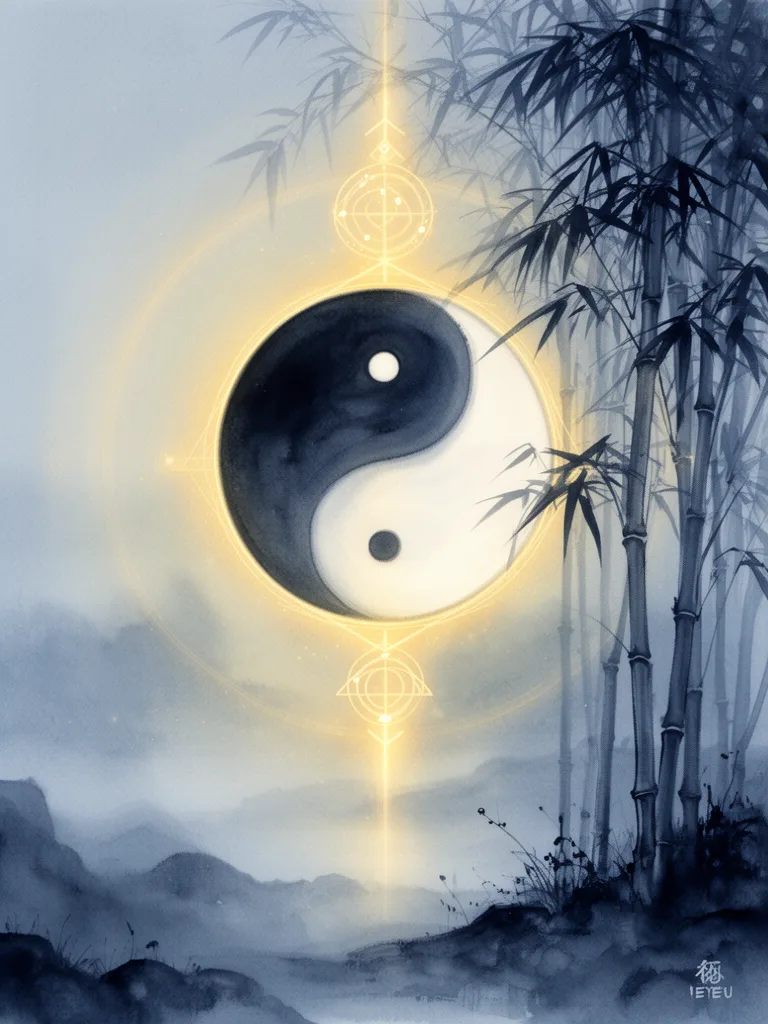
Yeu signifies "being" or "existence" in Taoist philosophy, representing the fundamental substance that gives rise to all phenomena. It is the self-generating essence from which the universe emerges and subsists, a concept akin to a primordial, unmanifest reality.
Where the word comes from
The term Yeu (有) originates from Classical Chinese, meaning "to have," "to exist," or "being." It is often contrasted with Wu (無), meaning "nothingness" or "non-being." This duality forms a cornerstone of Taoist metaphysical inquiry, first articulated in foundational texts like the Daodejing.
In depth
"Being", a synonym of Suhhdva; or "the Substance giving substance to itself".
How different paths see it
What it means today
In the grand unfolding of Taoist thought, Yeu stands as the luminous counterpart to the profound silence of Wu. It is the perceptible universe, the vibrant hum of existence that arises from the unnamable void. Blavatsky's characterization of it as "the Substance giving substance to itself" resonates deeply with the Taoist concept of the Tao as the mother of all things, the inexhaustible source from which all forms manifest.
Mircea Eliade, in his exploration of sacred time and space, would likely see in Yeu the manifestation of the sacred within the profane. It is the world as we experience it, imbued with the potential for meaning and revelation, a realm not devoid of spirit but rather a vibrant expression of it. Carl Jung's understanding of the archetypal psyche might find a parallel in Yeu as the collective unconscious made manifest, the primordial patterns of existence taking on concrete form.
The practice associated with Yeu, within the framework of Taoism, is not one of forceful imposition but of harmonious participation. It is the art of aligning oneself with the natural flow of existence, of acting in accordance with the inherent principles of the cosmos. This is the essence of wu wei, a concept that transcends mere inaction and signifies a profound understanding of how to move with the currents of life, rather than against them. It is in this subtle dance between being and non-being, between the manifest and the unmanifest, that the Taoist sage finds liberation and wisdom. The very substance of our perceived reality, Yeu, invites us to look beyond the superficial forms and apprehend the dynamic, self-generating force that animates all.
RELATED_TERMS: Tao, Wu, Qi, Yin, Yang, Dao De Jing, Ten Thousand Things ---
Related esoteric terms
Books on this concept


No reflections yet. Be the first.
Share your interpretation, experience, or question.
