World
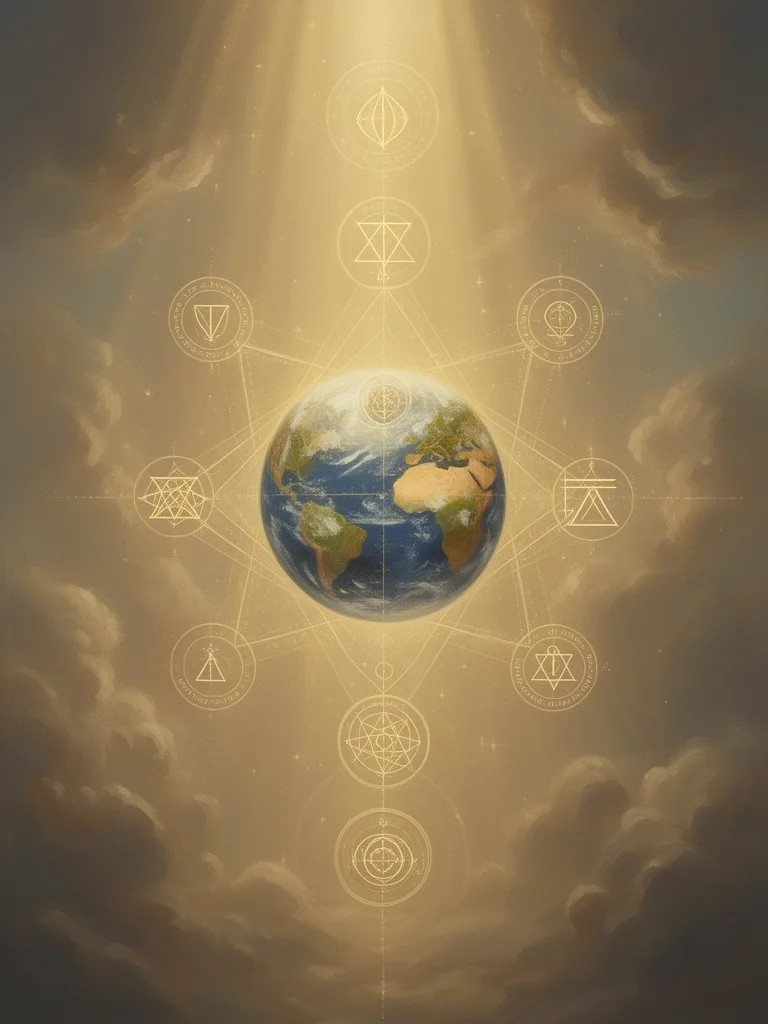
The term "World" in esoteric contexts refers not merely to the physical planet but to a complex, multi-layered reality encompassing cosmic principles, spiritual realms, and the totality of existence as understood within various mystical traditions. It signifies a structured, often hierarchical, manifestation of the divine or the absolute.
Where the word comes from
The English word "world" derives from Old English "woruld" or "werold," meaning "age of man" or "mortal world." It stems from Proto-Germanic roots related to "man" and "age." This etymology highlights an early conceptualization of the world as the domain of human experience and temporal existence, distinct from the eternal.
In depth
As a prefix to mountains, trees, and so on, it denotes a univer.s<il belief. Thus the "World-Mountain" of the Hindus was Meru. As said in Isis Unveiled: "All the world-mountains and mundane eggs, the mundane trees, and the mundane snakes and pillars, may be shown to embody scientifically demonstrated truths of natural philosophy. All of these mountains contain, wdth very trifling variations, the allegorically-exi)ressed description of primal cosmogony ; the mundane trees, that of subsequent evolution of si)irit and matter; the mundane snakes and pillars, symbolical memorials of the various attributes of this double evolution in its endless correlation of cosmic forces. Within the mysterious recesses of the mountains — the matrix of the universe — the gods (powers) prepare the atomic germs of organic life, and at the same time the life-drink, which, when tasted, awakens in man-matter the manspirit. The Soma, the .sacrificial drink of the Hindus, is that sacred beverage. For at the creation of the prima materia, while the grossest portions of it w^ere used for the physical embryo-world, its more divine essence pervaded the universe, invisibly permeating and enclosing within its ethereal waves the newly-born infant, developing and stimulating it to activity as it .slowly evolved out of the eternal chaos. From thf poetry of abstract conception, these mundane myths gradually passed into the concrete images of cosmic symbols, as archaeology now finds them." Another and still more usual prefix to all these objects is "Mundane". (See "Mundane Egg", "Mundane Tree", and "Yggdrasil".) Worlds, the Four. The Kabbalists recognise Four Worlds of Existence : viz., Atziluth or archetypal ; Briah or creative, the first reflection of the highest; Yetzirah or formative; and Assiah, the AVorld of Shells or Klippoth. and the material universe. The essence of Deity concenGLOSS AEY trating into the Sephiroth is first manifested in the Atziluthie World, and their reflections are produced in succession in each of the four planes, with gradually lessening radiance and purity, until the material universe is arrived at. Some authors call these four planes the Intellectual, :Moral, Sensuous, and Material Worlds, [w.w.w.] Worlds, Inferior and Superior. The Occultists and the Kabbalists agree in dividing the universe into superior and inferior worlds, the worlds of Idea and the worlds of Matter. "As above, so below", states the Hermetic philosophy. This lower world is formed on its proto
How different paths see it
What it means today
Blavatsky's definition, particularly when referencing the "World-Mountain" and "mundane eggs," gestures toward an ancient, pervasive cosmological understanding that predates modern scientific reductionism. This is the world as a sacred geography, a concept explored by Mircea Eliade in "The Sacred and the Profane," where the world is not merely space but a hierarchical structure imbued with meaning and divine presence. The "World-Mountain," like the Hindu Meru or the Norse Yggdrasil, serves as an axis mundi, a cosmic pillar connecting the various planes of existence.
The idea of the "mundane egg" further suggests a primordial unity from which all differentiated existence emerges, a concept echoed in various creation myths across cultures. This is not the inert, accidental universe of contemporary materialism, but a cosmos pregnant with divine potential, where the "gods (powers) prepare the atomic germs of organic life." This resonates with Carl Jung's exploration of archetypes and the collective unconscious, suggesting that the structures of the cosmos are mirrored within the human psyche. The "life-drink," like the Soma mentioned, points to sacraments and ecstatic experiences that facilitate this awakening, a theme common in shamanic traditions and the mystical experiences described by thinkers like William James.
The esoteric "World" is, therefore, a living, breathing entity, a cosmic organism where spirit and matter are not antagonistic but inextricably linked, engaged in an eternal dance of creation and evolution. It invites us to see beyond the surface of phenomena, to perceive the underlying spiritual architecture and our own integral role within it, a perspective that can transform our experience of everyday reality into a profound spiritual practice. The universe, in this view, is not something we are merely in, but something we are, in essence, a part of.
RELATED_TERMS: Cosmos, Realm, Plane, Manifestation, Axis Mundi, Cosmology, Sacred Geography, Creation Myth
Related esoteric terms
Books on this concept






No reflections yet. Be the first.
Share your interpretation, experience, or question.
