Tahor
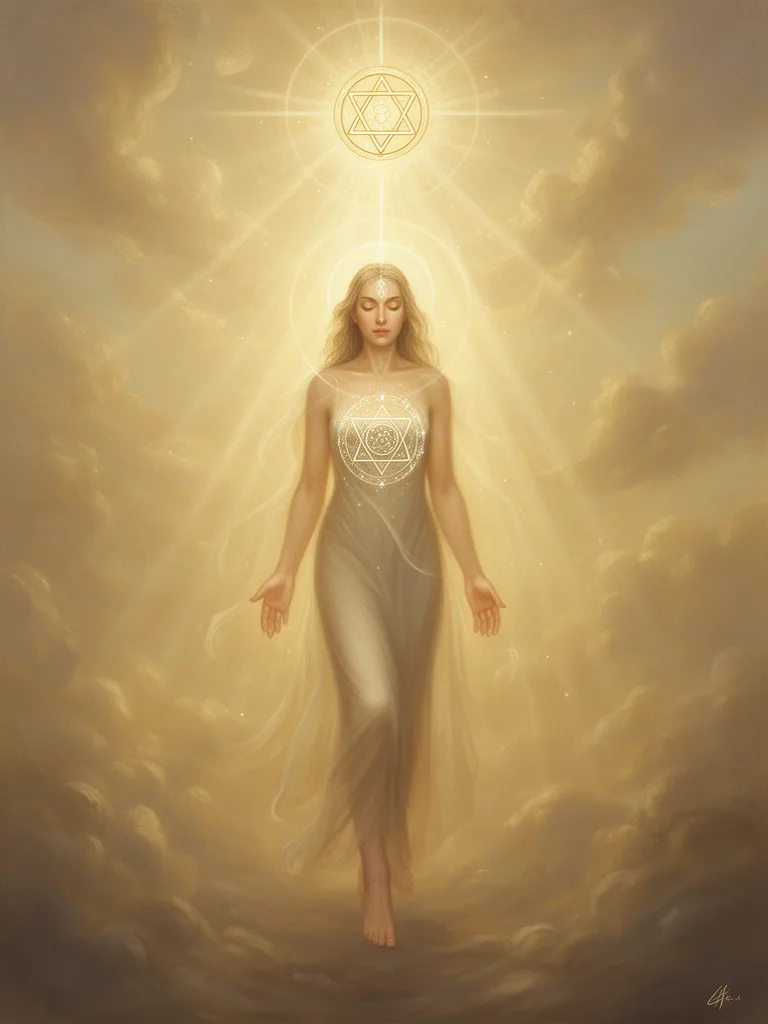
Tahor, a term associated with pantheism, signifies the divine as encompassing all of existence. It suggests a unified reality where the sacred is immanent within the cosmos, rather than transcendent or separate from it. This concept invites contemplation of the divine presence in every aspect of the material and spiritual world.
Where the word comes from
The term "Tahor" is not of a singular, easily traceable linguistic origin in the way many esoteric terms are. Blavatsky's definition links it to "MiokIhs" and identifies it with "the Deity" and "Pantheism." While "MiokIhs" might be a transliteration or a specific term within a particular esoteric school she referenced, "Tahor" itself does not readily map to a common Sanskrit, Greek, or Hebrew root denoting divinity or totality in a way that directly supports Blavatsky's pantheistic association. Its usage appears specific to the context she provides.
In depth
Lit., MiokIhs, the woi-hl ; a name given to the Deity, whose identification indicates a belief in Pantheism.
How different paths see it
What it means today
Blavatsky's brief, almost cryptic definition of Tahor, linking it to pantheism and "the Deity," invites a profound reorientation of how we perceive the sacred. It suggests a universe where the divine is not an architect looking down from celestial blueprints but the very mortar and stone of existence, the animating spirit within every atom. This is a concept that echoes through the ages, from the ancient Vedic pronouncements of "Sarvam Khalu Idam Brahman"—all this is indeed Brahman—to the contemplative silences of Meister Eckhart, who spoke of the Godhead as the "ground of all being."
Consider the implications for a modern seeker. In an era often marked by fragmentation and a sense of separation, the idea of Tahor offers a powerful antidote. It encourages a shift from seeking God in temples or scriptures alone, to recognizing the divine spark in the mundane, in the intricate dance of ecosystems, in the shared humanity of strangers, and in the quietude of one's own inner landscape. Mircea Eliade, in his explorations of the sacred and the profane, highlighted how archaic societies perceived the world as imbued with sacredness, a notion that Tahor seems to re-invoke. It is not about a passive acceptance of a preordained cosmic order, but an active engagement with the immanent divine, a recognition that the universe is a living, breathing manifestation of consciousness. This perspective demands a heightened awareness, a willingness to see the extraordinary within the ordinary, and to understand that our own existence is not a mere accident but a participation in the boundless, sacred whole. The challenge lies in sustaining this vision amidst the clamor of the everyday, transforming mere observation into a form of devotional practice. This is the quiet revolution of recognizing the divine as the very breath we take.
Related esoteric terms
No reflections yet. Be the first.
Share your interpretation, experience, or question.
