Sinai
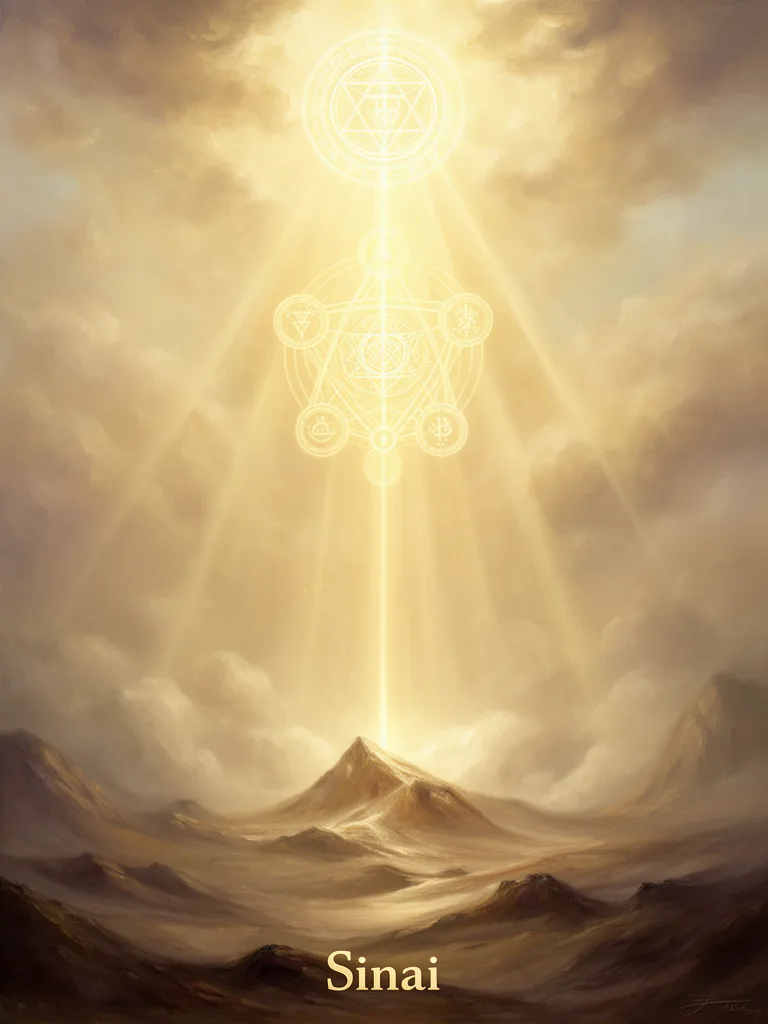
Mount Sinai is a sacred mountain in the Sinai Peninsula, traditionally revered as the site where Moses received the Ten Commandments from God. It represents a profound locus of divine revelation and covenant-making in Abrahamic religions, symbolizing a spiritual summit and the transmission of divine law.
Where the word comes from
The name "Sinai" is of uncertain origin, though it has been linked to the Hebrew word "saneh" (bush) or to the Akkadian "sinu" (mountain). It is also associated with the Mesopotamian moon god Sin, suggesting a possible ancient connection to lunar worship before its appropriation as a site of monotheistic revelation.
In depth
Mount Sinai, the Nissi of Exodus (xvii., 15), the birthplace of almost all the solar fjods of anti(iuity, such as Dionysus, born at Nissa or Nysa, Zeus of Nysa, Bacchus and Osiris, (q.v.) Some ancient i)eople believed the Sun to be the progeny of the ]\Ioon, who was herself a Sun once upon a time. Sin-a'i is the "Moon Mountain", hence the connexion. Sing Bonga. The Sun-.spirit with the KoUarian tribes. Singha CSk.). The constellation of Leo; Singh meaning "lion".
How different paths see it
What it means today
Blavatsky's assertion that Sinai is the "Moon Mountain" and a "birthplace of almost all the solar gods" invites a fascinating transhistorical lens, suggesting that the sacred geography of revelation is often layered with older mythologies. The mountain, a primal archetype of elevation and proximity to the heavens, has long served as a stage for the divine drama. From the thunderous pronouncements on Sinai, where the very air vibrated with divine energy, to the solitary contemplation of hermits on remote peaks, the mountain remains a potent symbol of the human quest to touch the transcendent.
Mircea Eliade, in "The Sacred and the Profane," explored how sacred mountains function as "axis mundi," cosmic centers connecting the earthly realm with the divine. They are places where the ordinary rules of existence are suspended, and where the divine can manifest most powerfully. The experience at Sinai, as described in scripture, is not one of quiet contemplation but of overwhelming, even terrifying, divine presence. This is not a gentle unveiling but a forceful imposition of order, a covenant forged in fire and thunder.
The association with lunar deities, as Blavatsky suggests, hints at the complex syncretism of ancient religious landscapes. Before the singular focus on the divine law of the Hebrew God, the mountain may have been a site of older, perhaps chthonic or celestial, worship. The transition to Sinai as the locus of monotheistic revelation transforms it into a symbol of divine order and moral imperative, a stark contrast to the more fluid, cyclical nature often associated with lunar cults. This transformation underscores how sacred sites are not static but are continually reinterpreted and imbued with new meaning by successive traditions. The mountain, therefore, becomes a palimpsest of human spiritual striving, each layer revealing a different facet of our relationship with the divine.
RELATED_TERMS: Axis Mundi, Theophany, Sacred Geography, Divine Law, Covenant, Archetype, Revelation, Mount Kailash
Related esoteric terms
Books on this concept








No reflections yet. Be the first.
Share your interpretation, experience, or question.
