Pagan
A term historically used to denote inhabitants of rural areas, later evolving to describe non-Abrahamic polytheists, often associated with nature-based spiritualities and pre-Christian European religions. It broadly refers to those outside established monotheistic faiths.
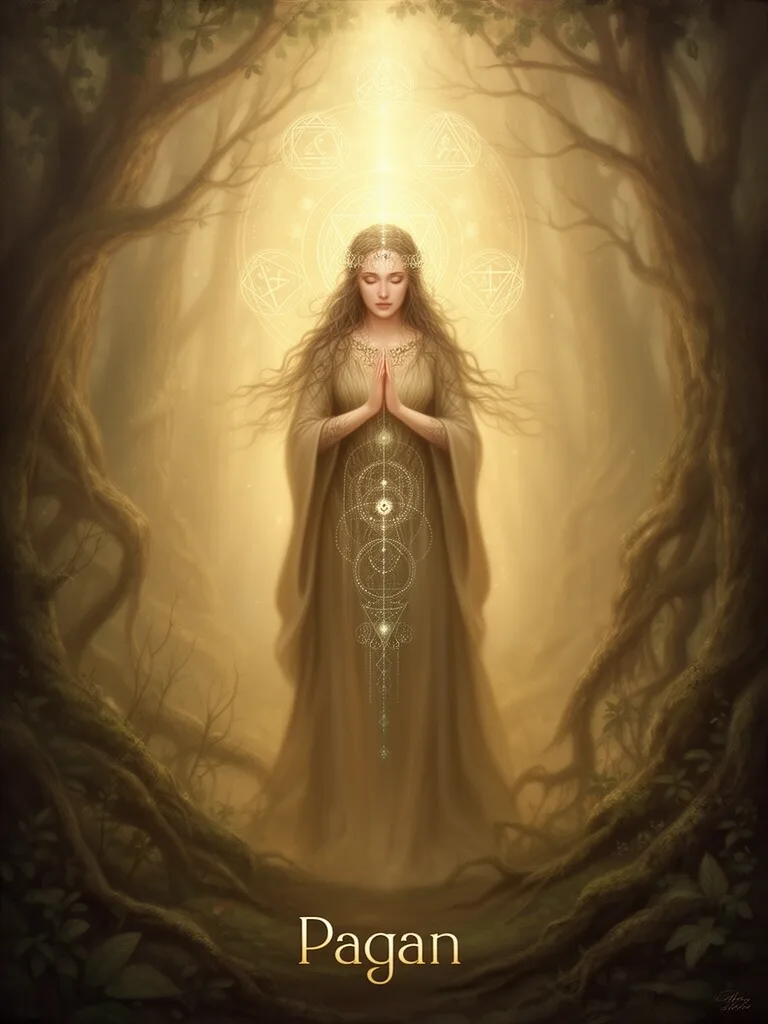
Where the word comes from
Latin paganus, meaning "country dweller" or "villager," originally contrasted with urban dwellers and soldiers. The term acquired religious connotations in late antiquity as Christianity spread, being applied to those who adhered to older, non-Christian beliefs, often in rural areas.
In depth
Meaning at first no worse than a dweller in the country or the woods ; one far removed from the city-temples, and therefore unacquainted with the state religion and ceremonies. The word "heathen" has a similar significance, meaning one who lives on the heaths and in the country. Now, however, both come to mean idolaters. Pagan Gods. The term is erroneously understood to mean idols. The philosophical idea attached to tliem was never that of something objective or anthropomorphic, but in each case an abstract potency, a virtue, or quality in nature. There are gods who are divine planetary spirits (Dhyan Chohans) or Devas, among which are also our Egos. With this exception, and especially whenever represented by an idol or in anthropomorphic form, tlie gods represent symbolically in tlie Hindu, Eg}-ptian, or Chaldean Pantheons — formless spiritual Potencies of the "Unseen Kosmos".
How different paths see it
What it means today
The word "Pagan," as Blavatsky notes, carries a history of misinterpretation, morphing from a simple designation of country folk to a pejorative for idolaters. Mircea Eliade, in his seminal works on the history of religions, understood such terms as markers of a fundamental human impulse to connect with the sacred in the immanent world. The "pagan" worldview, often characterized by a deep attunement to the cycles of nature, the sacredness of place, and a pantheon of diverse spiritual forces, stands in stark contrast to the abstract, transcendent divinity often emphasized in monotheistic traditions. This is not merely a matter of geographical isolation but a profound difference in the perception of the divine. For the "pagan," the sacred is woven into the fabric of existence, residing in the rustling leaves, the flowing river, the turning of the seasons, and the archetypal figures that embody natural forces. These are not necessarily "idols" in the crude sense, but rather symbolic representations of potent, often immanent, divine energies. Carl Jung's exploration of archetypes resonates here, suggesting that these seemingly "pagan" deities can be seen as personifications of universal psychological patterns, deeply embedded in the human psyche. The term, therefore, invites us to consider how different cultures have historically perceived the divine, whether as a singular, distant power or as a manifold presence immanent in the world. It challenges us to look beyond the label and understand the underlying spiritual orientations it attempts to categorize, often with imperfect and biased lenses. The persistent appeal of nature-based spiritualities in contemporary times suggests a reawakening to these older modes of experiencing the sacred, a reclamation of the immanent divine.
Related esoteric terms
Books on this concept





No reflections yet. Be the first.
Share your interpretation, experience, or question.
