Oyges
The Oyges, a figure from ancient Lydian myth, represents the discovery of a transformative, invisible power through an underworld descent. His story, recounted by Plato, involves finding a ring on a skeleton within a bronze horse in an earth chasm, a ring that grants invisibility.
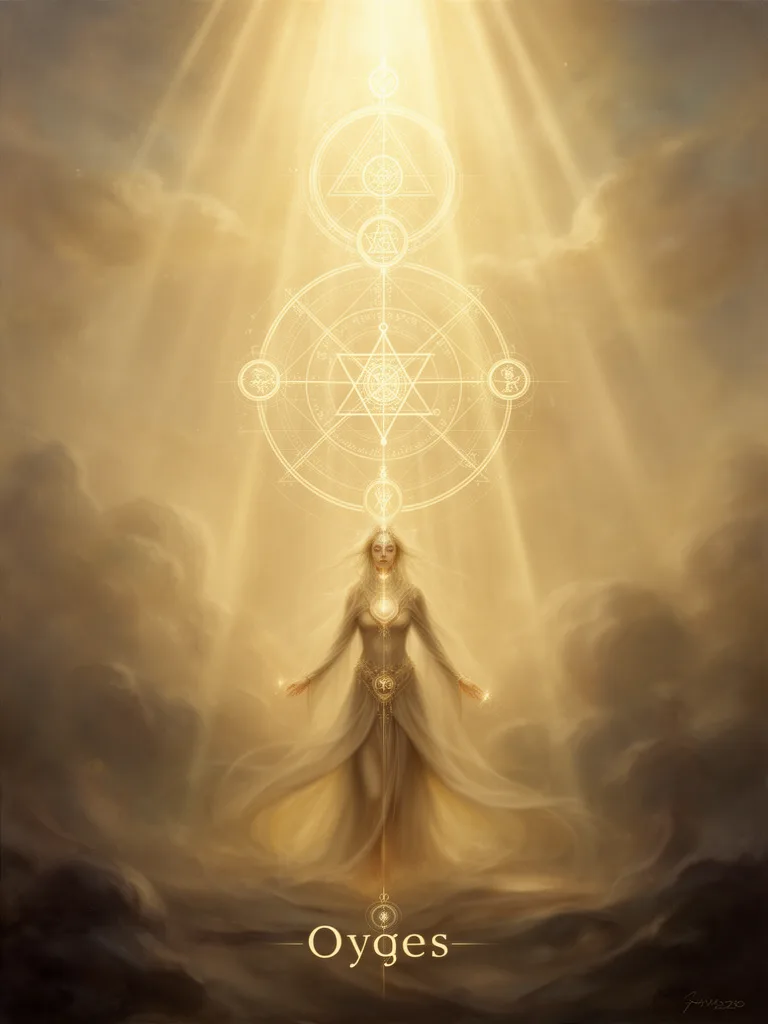
Where the word comes from
The name "Gyges" (Γύγης) is of uncertain Lydian origin. Its appearance in Plato's Republic marks its entry into philosophical discourse. The story itself, though framed by Plato, likely draws upon older mythological motifs of underworld journeys and magical artifacts.
In depth
"Thf rinj: of (lytri-s" has lu'conua familiar mctaj)hor in Kuropcan litcratnn'. (ivjjfs was a Lydian who. after murderinfr the Kinp Candault's, married his widow. I'lato tells us that GyRes ileseended once into a chasm of the earth and di.se(»vered a bra/en horse, within whose op»'n side was the skeleton of a man who had a bra/en rin<j on his tinper. This rinj; when plaeeil on his own finger made him invisible.
How different paths see it
What it means today
The tale of Gyges, as narrated by Plato in the Republic, presents a thought experiment that has resonated through centuries, prompting us to consider the very foundations of justice and morality. The Lydian king, through a curious descent into the earth and the discovery of a ring on a skeletal finger within a bronze horse, acquires the power of invisibility. This artifact, a tangible manifestation of the hidden, allows him to commit deeds without consequence, to act as if the social contract, predicated on mutual observation and accountability, no longer applies.
Mircea Eliade, in his studies of myth and ritual, would likely see this as a potent example of the "hierophany," a manifestation of the sacred or the extraordinary that disrupts the mundane. The chasm, a liminal space, becomes the threshold to a realm where ordinary laws are suspended. The bronze horse, an ancient symbol of power and mobility, guards a secret, a skeletal testament to a previous possessor of this potent magic. The ring itself, a circular symbol often associated with eternity and wholeness, becomes the instrument of transgression.
Carl Jung might interpret the underworld journey and the discovery of the ring as an archetypal descent into the unconscious, a confrontation with the shadow self. The invisibility granted by the ring could symbolize the projection of one's darker impulses onto the world, or the ability to operate from a place of unchecked id, free from the superego's watchful eye. The question Plato poses through Glaucon—would any person, given such power, refrain from injustice?—cuts to the core of human nature, suggesting that our adherence to virtue might be less about inherent goodness and more about the fear of social reprisal.
The modern seeker can find in the Oyges myth a stark reminder that true ethical strength lies not in the absence of external observation, but in the cultivation of an internal moral compass. The ring offers a tempting shortcut, a way to bypass the often arduous process of self-governance. Yet, as the story implicitly warns, true freedom is not achieved through the erasure of one's presence, but through the conscious and responsible engagement with the world, even when one believes oneself to be entirely alone. The power to be unseen is a profound test, revealing that the most significant judgments we face are often our own.
Related esoteric terms
No reflections yet. Be the first.
Share your interpretation, experience, or question.
