Omen
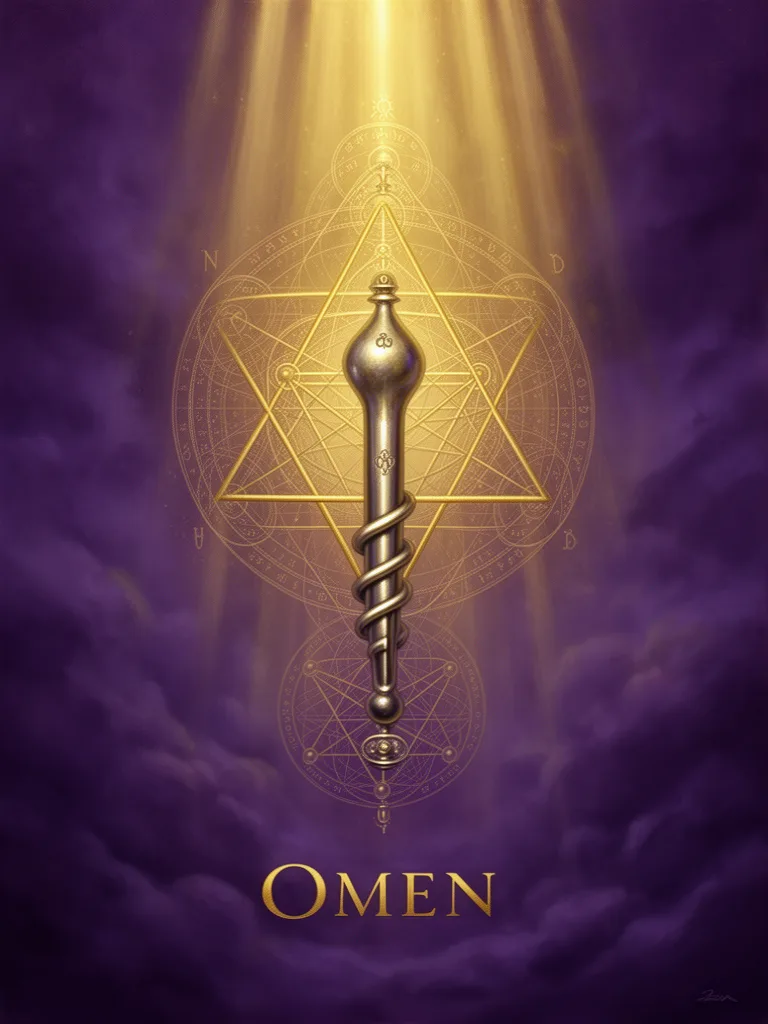
An omen is a perceived sign or event believed to portend future occurrences, often interpreted as a divine message or indicator of impending change. Ancient cultures and some modern traditions view natural phenomena, animal behavior, or symbolic occurrences as omens requiring interpretation by specialists.
Where the word comes from
The word "omen" likely derives from the Latin "omen," meaning "sign" or "foreboding." Its precise origin is debated, but it entered English by the 14th century. The concept of portents and signs, however, is ancient and universal across human cultures, predating the Latin term.
In depth
An omen (also called portent) is a phenomenon that is believed to foretell the future, often signifying the advent of change. It was commonly believed in ancient history, and still believed by some today, that omens bring divine messages from the gods. These omens include natural phenomena, for example an eclipse, abnormal births of animals (especially humans) and behaviour of the sacrificial lamb on its way to the slaughter. Specialists, known as diviners, variously existed to interpret these omens...
How different paths see it
What it means today
The concept of the omen, as Blavatsky notes, is deeply embedded in the human psyche's quest for meaning. It speaks to a time when the veil between the mundane and the sacred, the visible and the invisible, was perceived as far thinner. Mircea Eliade, in his seminal works on shamanism and the sacred, explored how early cultures perceived the world as alive with signs, where natural phenomena were not merely physical events but imbued with symbolic weight and communicative intent. The flight of a bird, the pattern of clouds, the unexpected behavior of an animal—these were not random occurrences but fragments of a cosmic dialogue.
For the Hermeticist, the omen aligns with the axiom "As above, so below," suggesting that events in the material world are reflections or echoes of celestial movements and divine intentions. It is a practice of attunement, a disciplined observation of the world as a text to be read, a method of discerning the subtle currents of fate and free will. This is not passive fatalism but an active engagement with the signs that guide one's path. The diviners of antiquity, like the augurs of Rome or the specialists in ancient India, were not mere fortune-tellers but spiritual technicians, trained to perceive and interpret these celestial whispers.
Carl Jung, in his exploration of synchronicity, touched upon a similar phenomenon—meaningful coincidence—where external events align with internal psychological states. While Jung emphasized the psychological significance rather than divine prophecy, the underlying principle of finding pattern and meaning across disparate occurrences resonates. The omen, in this light, can be seen as an early, pre-scientific attempt to map these synchronicities, to find an external validation for inner intuitions or a premonition of unfolding destiny. It is a testament to our innate desire to feel connected to a larger, purposeful cosmos, a universe that speaks to us, if only we learn to listen. The practice of observing omens, therefore, is less about predicting a fixed future and more about cultivating a heightened awareness of the present moment's potential significance.
Related esoteric terms
Books on this concept





No reflections yet. Be the first.
Share your interpretation, experience, or question.
