Nuns
Nuns, in the context of ancient religious orders, refers to women dedicated to spiritual pursuits, often living in communal settings. This designation signifies a commitment to chastity, asceticism, and service within a religious framework, a role found across various historical cultures.
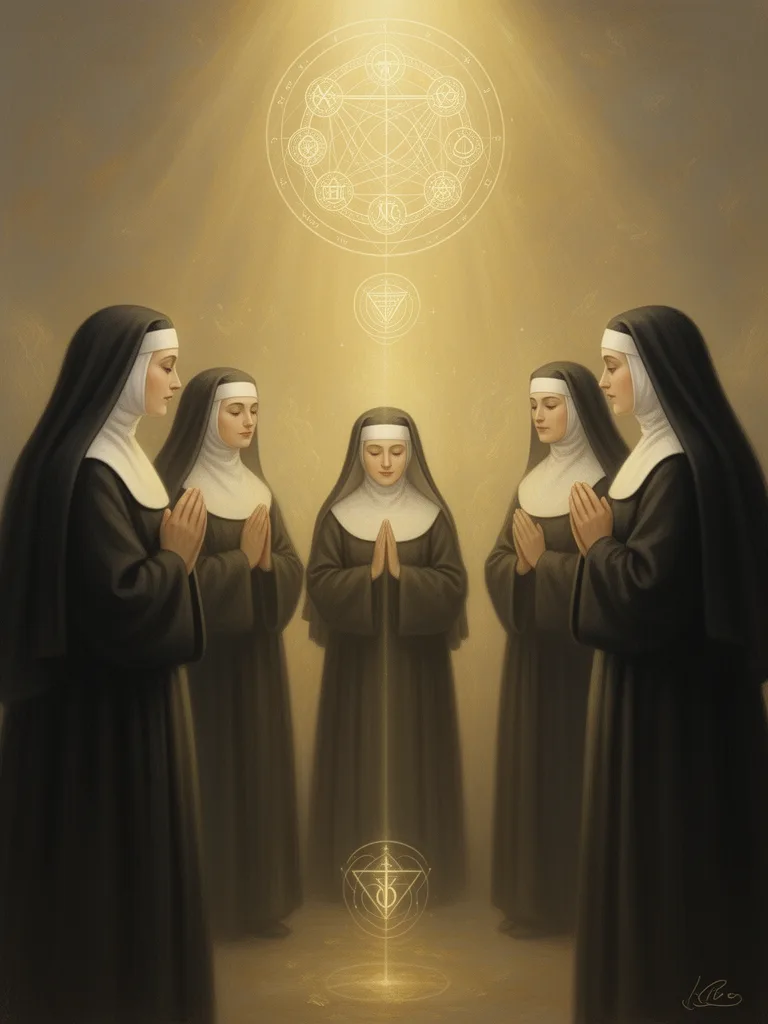
Where the word comes from
The term "nun" derives from the Latin "nonna," meaning "grandmother" or "religious woman." Its usage evolved to denote women in monastic orders, particularly in Christianity. The concept of women devoted to sacred life, however, predates this specific etymological root, appearing in various forms across ancient societies.
In depth
There were nuns in ancient Egypt as well as in Peru and old 218 THBOSOPHKAL
How different paths see it
What it means today
The term "nuns," when considered beyond its specific Western religious context, opens a window onto a profound and persistent human phenomenon: the dedication of women to a life consecrated to the sacred. Blavatsky's brief mention, hinting at their presence in ancient Egypt and Peru, encourages a broader, more inclusive understanding than often afforded by purely Western-centric scholarship. Mircea Eliade, in his explorations of the sacred and profane, illuminates how such renunciatory paths serve as a means of apprehending a reality beyond the everyday, a way to embody the divine in human form. These women, by stepping outside the conventional societal roles, often carved out spaces for intense spiritual cultivation and, in many instances, intellectual and artistic flourishing.
Consider the yoginis of India, or the bhikshunis of Buddhism. Their lives, though framed by distinct cosmologies, share a common thread of intentional detachment from the material world, a deliberate turning inward or upward. This detachment is not an emptiness, but a filling, a space created for the inrush of divine presence or profound insight. For the Christian mystic, the nun's life is a profound act of imitatio Christi, a living out of the Gospel in its most radical form. The vows of poverty, chastity, and obedience are not mere restrictions but tools, sharpened instruments for the soul's ascent. Carl Jung might see in these figures the archetypal embodiment of the Great Mother or the Wise Woman, figures who hold the collective unconscious and offer pathways to individuation through their steadfast devotion.
The existence of these women, often in communal settings like monasteries or convents, highlights the power of shared spiritual endeavor. It is in the echo of communal prayer, the shared discipline, the collective pursuit of wisdom, that individual resolve is strengthened and spiritual breakthroughs are fostered. These are not solitary ascetics in the wilderness, though they share that intensity; they are communities of the devoted, creating sacred enclaves within the secular world. Their renunciations, far from being negations, are affirmative acts, affirmations of a higher reality, a commitment to a life lived in direct communion with the ineffable. Their legacy reminds us that the spiritual quest is not solely a private affair but can be a profoundly communal undertaking, a testament to the enduring human capacity for transcendence.
Related esoteric terms
Books on this concept






![Cruels effets de la vengeance du Cardinal de Richelieu, ou Histoire des diables de Loudun, de la possession des religieuses ursulines, et de la condamnation et du suplice [sic] d'Urbain Grandier, curé de la même ville. 1716: Iss 53](/img/thumb/cruels-effets-de-la-vengeance-du-cardinal-de-richelieu-ou-histoire-des-diables-de-loudun-de-la-possession-des-religieuses-ursulines-et-de-la-condamnation-et-du-suplice-sic-d-urbain-grandier-cur-de-la-.webp)

No reflections yet. Be the first.
Share your interpretation, experience, or question.
