Nogah
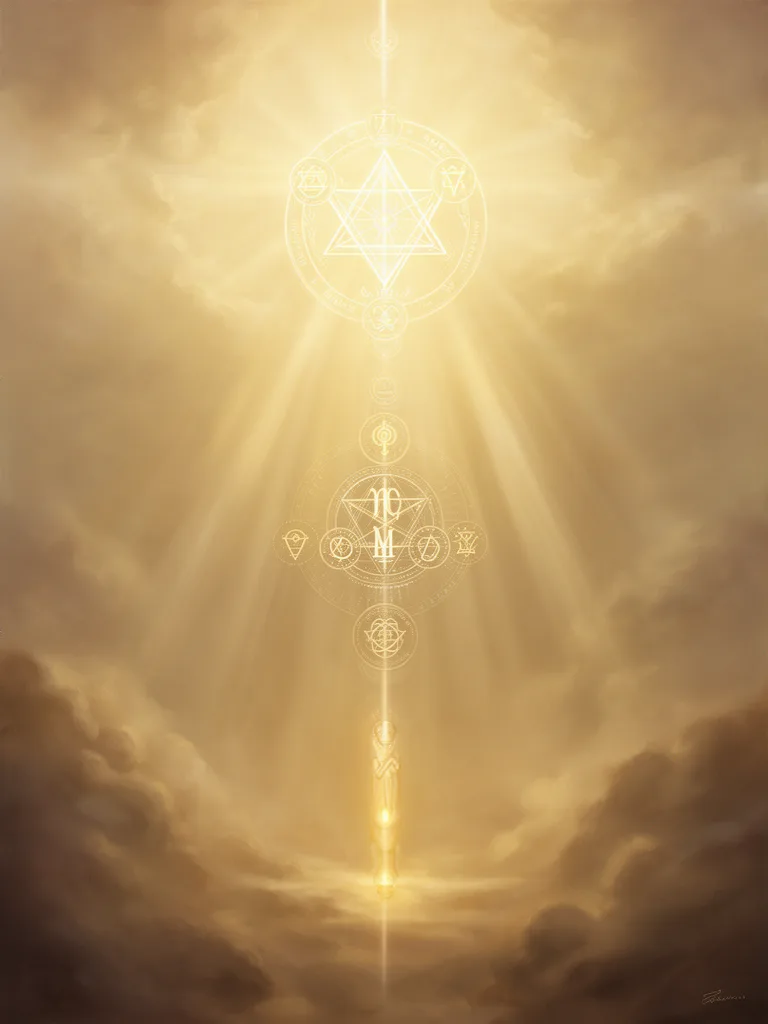
Nogah, meaning "glittering splendor" or "brightness," is an ancient Hebrew term often associated with the planet Venus. It symbolizes divine light, beauty, and the radiant essence of creation, representing a celestial beacon of hope and spiritual illumination.
Where the word comes from
The term "Nogah" (נוֹגָהּ) originates from Hebrew, likely stemming from a root related to brightness or shining. While not a direct translation of "Venus," it became a symbolic appellation for the planet in certain mystical traditions, evoking its visual brilliance in the night sky.
In depth
Venus, the planet; glittering splendour.
How different paths see it
What it means today
The term Nogah, with its evocative resonance of "glittering splendor," invites us to reconsider the celestial bodies not merely as astronomical objects but as carriers of profound symbolic meaning, a practice deeply embedded in the ancient world. Helena Blavatsky's connection to Venus, the planet of love and beauty, is a thread woven through numerous esoteric traditions. In the Hermetic tradition, the planets were seen as emanations of the divine, each possessing a unique energetic signature that influenced the terrestrial realm. Nogah, in this context, would speak to the principle of attraction, harmony, and the aesthetic order that governs the cosmos, a reflection of the divine mind's perfect design.
Within the intricate architecture of Kabbalah, the association of Nogah with Netzach, the Sefirah of victory and eternity, is particularly insightful. Netzach represents the enduring power of divine will, the ceaseless flow of divine energy that overcomes all obstacles. The planet Venus, with its persistent presence and radiant beauty, serves as a fitting emblem for this unyielding spiritual force. For Christian mystics, the planet's luminosity often transformed it into a symbol of the Virgin Mary, the Stella Maris, the star guiding sailors through darkness, a beacon of divine love and intercession. This imagery underscores the universal human yearning for a celestial guide, a luminous presence that offers solace and direction.
In our modern, often desacralized world, the concept of Nogah offers a counterpoint to the pervasive sense of material reductionism. It suggests that beauty, radiance, and a sense of inherent order are not accidental byproducts of cosmic processes but are fundamental qualities of existence. As Mircea Eliade observed, the sky has always been the primary locus of the sacred, and celestial phenomena, like the bright appearance of Venus, served as direct manifestations of the divine. The contemplation of Nogah, therefore, becomes a practice of recognizing the luminous quality of consciousness itself, the inherent brightness that underlies all perceived phenomena, a reminder that the divine is not an external entity but the very fabric of reality, waiting to be perceived in its full splendor. The challenge for the modern seeker is to translate this celestial vision into a terrestrial practice, to find the "glittering splendor" not only in the distant stars but in the immediate experience of being.
Related esoteric terms
No reflections yet. Be the first.
Share your interpretation, experience, or question.
