Lif
Lif and Lifthrasir are the sole survivors of a cataclysm in Norse mythology, destined to repopulate the reborn world. They represent humanity's enduring potential for renewal and innocence after destruction.
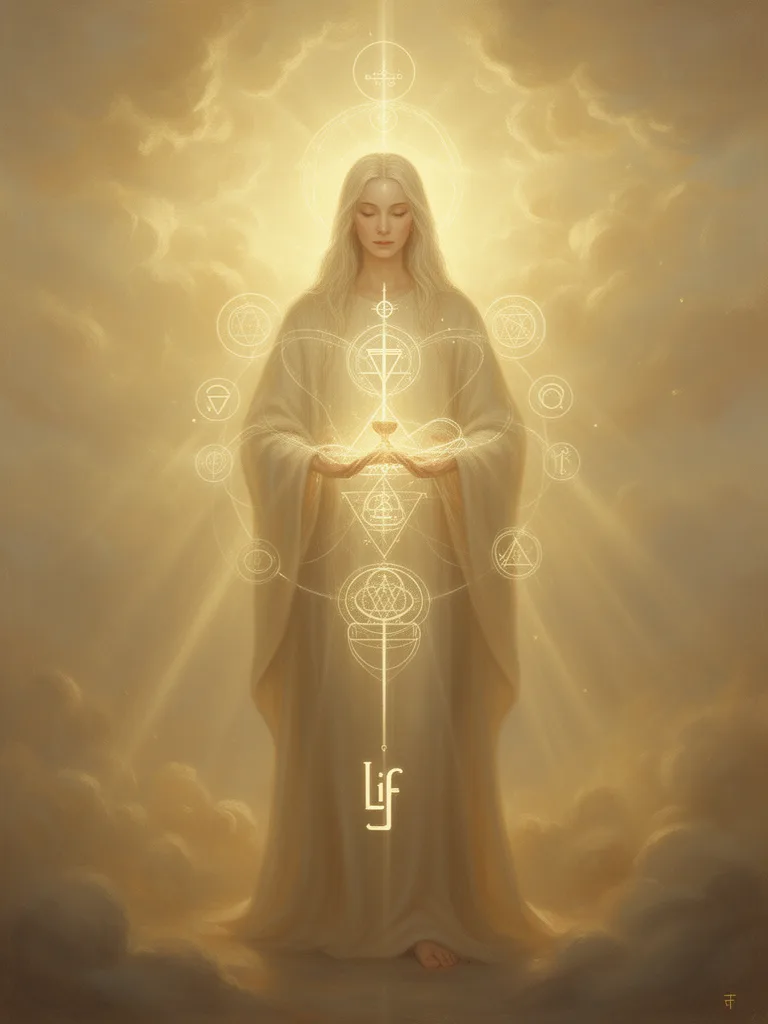
Where the word comes from
The names Lif and Lifthrasir originate from Old Norse. "Lif" means "life," and "Lifthrasir" is often interpreted as "life-yearner" or "one who endures for life." They emerge from the mythological aftermath of Ragnarok, the twilight of the gods.
In depth
Lif and Lifthresir, the only two human beings who were allowed to l)e present at the "Renewal of the World". Being "pure and innocent and free from sinful desires, tliey are permitted to enter the world where peace now reigns". The Edda shows them hidden in Hoddmimir's forest dreaming the dreams of childhood while the last conflict was taking place. These two creatures, and the allegor>in which they take part, are allusions to the few nations of the Fourth Root Race, who, surviving the great submersion of their continent and the majority of their Race, passed into the Fifth and continued their ethnical evolution in our present Human Race. Light, Brothers of. This is what the great authority on secret societies, Brother Kennetli R. H. Mackenzie IX., says of this Brotherhood. "A mystic order, Fratrcs Lucis, established in Florence in 1498. Among the members of this order were Pasqualis, Cagliostro, Swedenborg. St. Martin, Eliphaz Levi, and many other eminent mystics. Its members were very much persecuted by the Inquisition. It is a small but compact body, the members being spread all over the world."
How different paths see it
What it means today
In the stark landscape of Norse eschatology, where the very gods succumb to the cosmic struggle, Lif and Lifthrasir emerge not as heroes wielding weapons, but as primal essences, "pure and innocent and free from sinful desires." They are the quiet promise whispered after the thunderous roar of Ragnarok, the two seeds that survive the inferno. Their refuge in Hoddmimir's forest, a place of primordial concealment, suggests that renewal is not found in grand pronouncements or divine intervention, but in the deep, internal sanctuary of being, where consciousness dreams the dreams of its own potential.
Mircea Eliade, in his studies of myth and ritual, often highlighted the significance of the "eternal return," the cyclical nature of cosmic renewal that underpins many ancient traditions. Lif and Lifthrasir embody this principle, representing the enduring life force that, like a perennial spring, flows even when the surface world is frozen by catastrophe. They are not merely human figures but archetypes of resilience, the embodiment of life's stubborn refusal to be extinguished. Their survival is a testament to the possibility of innocence and purity as the foundation for a new world, a concept that resonates with the alchemical pursuit of the philosopher's stone, a purification and rebirth of matter and spirit.
The idea of a hidden, dreaming consciousness that persists through destruction can also be found in the mystical traditions of Islam, where figures like Ibn Arabi spoke of the "imaginal realm," a space where divine realities are perceived and where the soul can find refuge and renewal. Similarly, in Buddhist thought, the concept of sunyata or emptiness does not imply annihilation but a state of pure potentiality from which all phenomena arise. Lif and Lifthrasir, dreaming in the forest, are akin to this latent potential, the unmanifested possibility of existence awaiting its moment to unfurl. Their story, stripped of its specific Norse trappings, speaks to a universal human hope: that even in the face of ultimate loss, the fundamental essence of life, love, and consciousness can endure and blossom anew. They are the quiet whisper that life, in its most fundamental form, is eternal.
Related esoteric terms
Books on this concept







No reflections yet. Be the first.
Share your interpretation, experience, or question.
