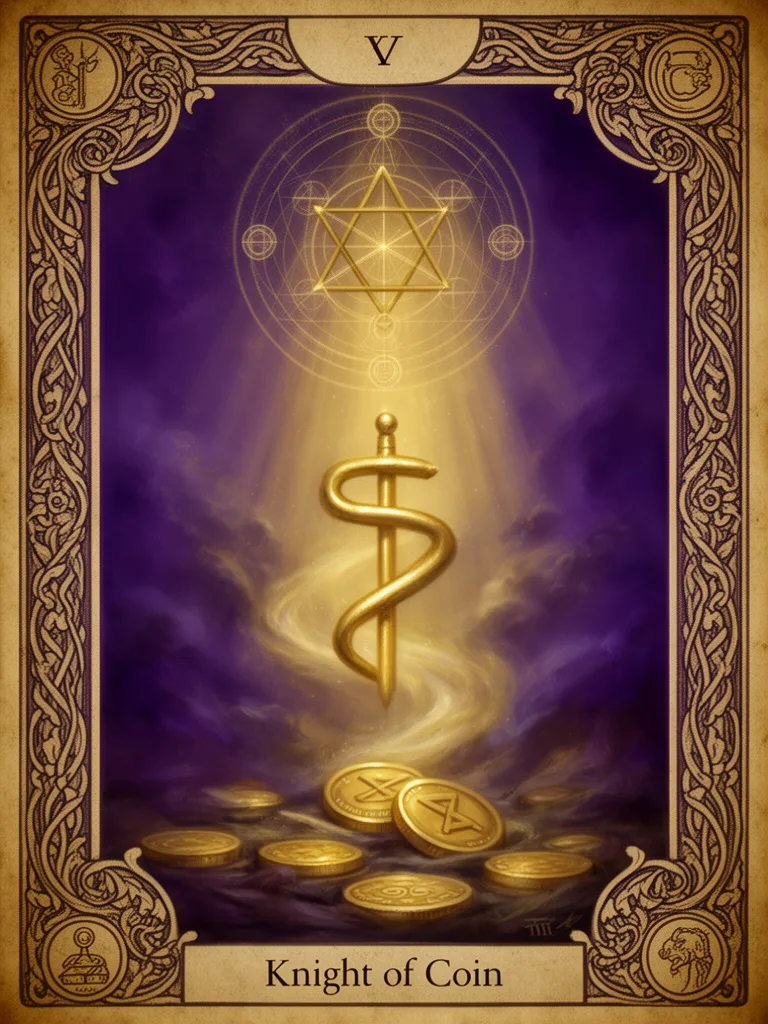
Knight of Coins
The Knight of Coins represents grounded action, patient progress, and the diligent pursuit of material goals. It signifies a steady, practical approach to challenges, often involving methodical work, resourcefulness, and a commitment to seeing projects through to completion. This card embodies reliability and a focus on tangible results.
Where the word comes from
The term "Knight" derives from Old English "cniht," meaning "youth" or "servant," evolving to signify a mounted warrior. "Coins" or "Pentacles" originate from Latin "discus," referring to a flat, circular object, symbolizing material wealth, earthly possessions, and the tangible realm. The combination evokes a figure dedicated to the practical management of resources.
In depth
The Knight of Coins is a card used in Latin-suited playing cards which include tarot decks. It is part of what tarot card readers call the "Minor Arcana". The "coins" suit is sometimes referred to as "pentacles" or "discs" instead. Tarot cards are used throughout much of Europe to play tarot card games. In English-speaking countries, where the games are largely unknown, tarot cards came to be utilized primarily for divinatory purposes.
How different paths see it
What it means today
The Knight of Coins, a figure often overlooked in the dazzling drama of the Tarot's Major Arcana, offers a profound lesson in the virtue of patient, embodied action. He is the quiet engine of the world, the one who understands that the grandest visions are built brick by painstaking brick. In a culture often obsessed with instant gratification and the ephemeral glow of digital ephemera, this card serves as a potent reminder of the enduring power of the tangible.
Mircea Eliade, in his explorations of the sacred and the profane, often highlighted how ancient societies imbued everyday acts with cosmic significance. The Knight of Coins embodies this sensibility, suggesting that the diligent management of one's resources, the methodical execution of a task, and the steadfast commitment to a material goal are not merely mundane chores but acts of creation, mirroring the divine ordering of the cosmos. Carl Jung's concept of individuation, the process of becoming a whole self, often involves integrating the shadow and the anima/animus, but it also necessitates a robust engagement with the material world, a task embodied by this Knight.
Consider the alchemist’s laboratory, a space of meticulous measurement, controlled heat, and patient observation. This is the domain of the Knight of Coins. It is not the fiery spark of eureka, but the steady glow of the furnace, the careful grinding of herbs, the precise pouring of liquids. Similarly, in Sufi traditions, the dervish’s spinning is a form of active meditation, a physical discipline that stills the mind. Idries Shah often spoke of the importance of practical disciplines in spiritual development, emphasizing that wisdom is not solely an intellectual pursuit but a lived experience.
The Knight of Coins invites us to find the sacred in the soil, in the ledger, in the well-crafted object. He asks us to be present in our work, to honor the process, and to trust that consistent effort, like water wearing away stone, will yield enduring results. This is not about avarice or materialism in the negative sense, but about a deep respect for the material world as the canvas upon which spirit expresses itself. He is the embodiment of the truth that the journey, when undertaken with integrity and focus, is as significant as the destination.
RELATED_TERMS: Earth element, Malkuth, groundedness, diligence, material manifestation, practical application, persistence, stewardship
Related esoteric terms
No reflections yet. Be the first.
Share your interpretation, experience, or question.
