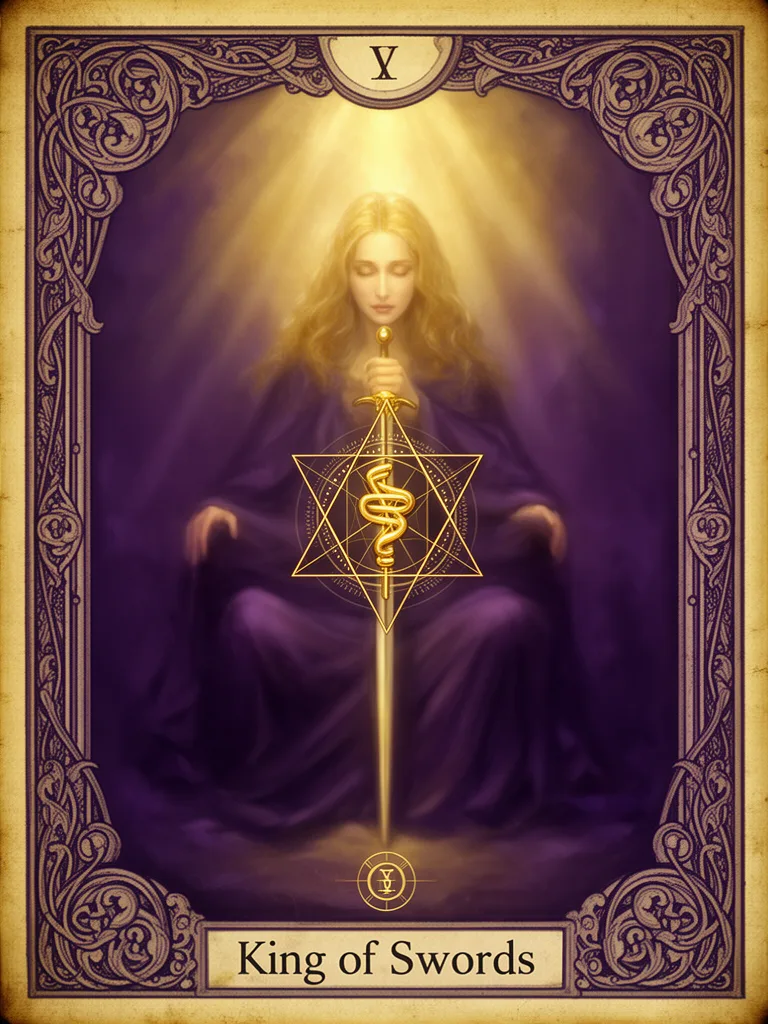
King of Swords
The King of Swords represents intellectual mastery, decisive action, and the authoritative application of reason. It embodies the keen mind that cuts through confusion to achieve clarity and justice, often signifying a leader or advisor who wields truth with precision and courage.
Where the word comes from
The term "King" originates from the Proto-Germanic kuningaz, meaning "royal descendant" or "ruler." "Swords" derive from the Proto-Indo-European root sekʷ-, meaning "to cut." The concept of a King as a supreme authority figure is ancient, while the association with the sword as a symbol of power and justice is prominent in Western heraldry and mythology.
In depth
The King of Swords is a card used in Latin-suited playing cards which include tarot decks. It is part of what tarot card readers call the "Minor Arcana". Tarot cards are used throughout much of Europe to play tarot card games. In English-speaking countries, where the games are largely unknown, tarot cards came to be utilized primarily for divinatory purposes.
How different paths see it
What it means today
The King of Swords, as it appears in the Hermetic tradition of Tarot, is a potent distillation of intellectual sovereignty. It is more than mere cleverness; it is the mind honed to a razor's edge, capable of dissecting complex realities and arriving at unassailable conclusions. Mircea Eliade, in his explorations of shamanism and the sacred, often highlighted the role of the wise elder or the seer whose pronouncements, though sometimes stark, cut through the fog of collective delusion. This King embodies that archetypal figure, one who has mastered the realm of thought and wields it with the authority of a ruler.
Consider the archetype of the judge, not in the punitive sense, but as one who discerns truth. This is the domain of the King of Swords. He is the embodiment of Hermes Trismegistus himself, the thrice-greatest, whose wisdom is both celestial and terrestrial, capable of bridging the gap between the divine and the human through clear articulation and rigorous logic. Carl Jung's concept of the anima and animus, the integration of the masculine principle within the psyche, finds expression here in the mature, authoritative intellect. This is not the impulsive action of a warrior, but the considered, precise strike of a strategist who has foreseen every angle. It is the mind that has learned to discriminate, to cut away the extraneous, and to stand firm in the face of opposition, armed with the clarity of unwavering conviction. The practice associated with this card, in a divinatory context, is often about seeking counsel from such a wise mind, or embodying its qualities oneself when facing difficult decisions. It is the courage to speak truth to power, even when that power resides within one's own internal biases. The King of Swords reminds us that true power lies not in brute force, but in the unassailable strength of reasoned understanding.
RELATED_TERMS: Reason, Discernment, Truth, Authority, Intellect, Logos, Clarity, Judgment
Related esoteric terms
No reflections yet. Be the first.
Share your interpretation, experience, or question.
