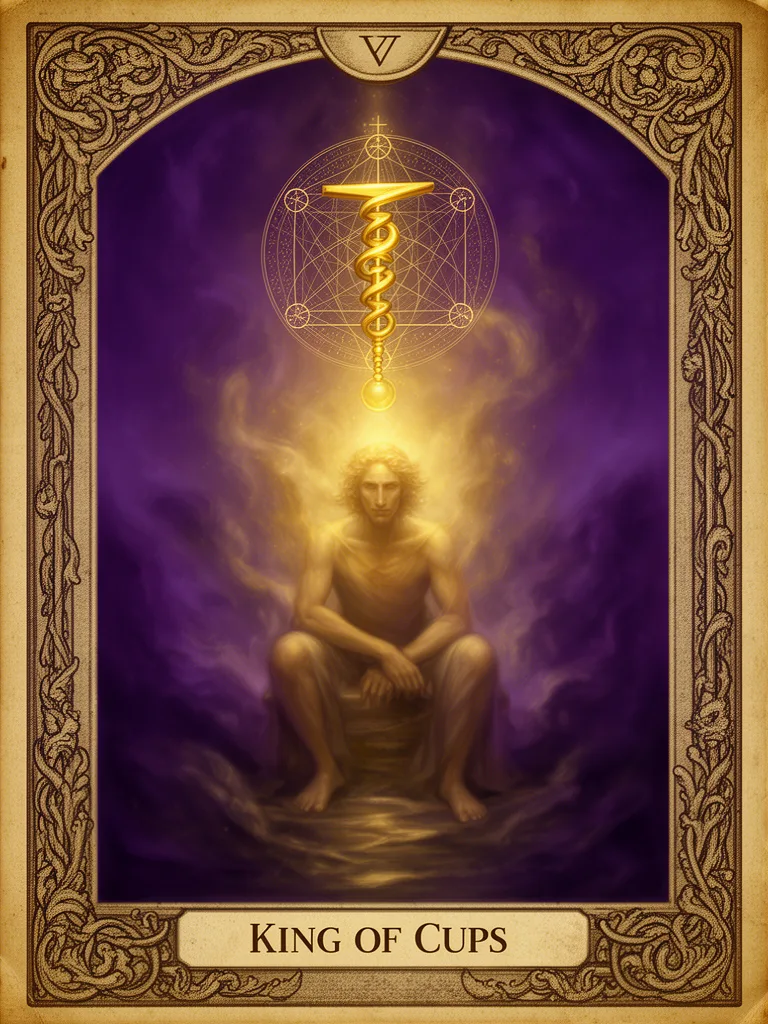
King of Cups
The King of Cups in Tarot symbolizes a mature, emotionally intelligent individual who leads with compassion and wisdom. This figure embodies mastery over feelings, offering diplomatic solutions and nurturing guidance, particularly within the realm of the element Water.
Where the word comes from
The term "King" derives from the Old English "cyning," meaning "royal person." "Cups" refers to the suit in Tarot and playing cards, originating from the Latin "cuppa," a drinking vessel. The King of Cups, as a specific archetype, emerged with the development of Tarot decks in the 15th century, solidifying its symbolic role in esoteric traditions.
In depth
The King of Cups is a card used in suited playing cards, which include tarot decks. It is part of what esotericists call the Minor Arcana. The King of Cups is associated with the element of Water and represents emotional mastery, diplomatic wisdom, and compassionate leadership. Tarot cards are used throughout much of Europe to play tarot card games. In English-speaking countries, where the games are largely unknown, tarot cards came to be utilized primarily for divinatory purposes.
How different paths see it
What it means today
Mircea Eliade, in his seminal work on shamanism, speaks of the initiate's journey through the "cosmic mountain," a metaphor for the ascent of consciousness. The King of Cups, in his quiet dominion, represents a peak in this ascent, a place where the turbulent waters of the psyche have been calmed not by suppression, but by profound understanding and acceptance. He is the embodiment of emotional sovereignty, a state not of being untouched by feeling, but of being its wise steward.
This archetype, as it appears in the Tarot, is a distilled essence of what Carl Jung might call individuation, the process of integrating the conscious and unconscious aspects of the self. The King of Cups has faced the watery depths of his own being, confronting the archetypal feminine, the anima, and has emerged not drowned, but as a master mariner. His rule is not one of force, but of fluid grace, of knowing when to yield and when to gently guide.
The imagery associated with this card—often a king seated by the sea, holding a cup—speaks to a deep communion with the subconscious, the collective unconscious, and the universal flow of life. It suggests a capacity for profound empathy, the ability to feel with and for others, a quality often lacking in more outwardly assertive archetypes. This is the leader who understands that true strength lies in vulnerability, that compassion is not weakness but a potent force for connection and healing.
In the context of esoteric practice, the King of Cups invites introspection. It asks us to examine our own relationship with our emotions. Are we tossed about by them, or do we hold them with a steady hand, like a king holding his scepter? This is not about becoming emotionless, but about achieving a state of inner equanimity, a serene mastery that allows for wise and loving action in the world. It is the realization that the deepest wisdom often arises from the still, quiet waters within.
He is the one who has learned to drink deeply from the well of his own soul and, in doing so, has become a source of nourishment for others. This quiet power, this compassionate authority, is a profound offering to a world often fractured by emotional turmoil and a desperate search for authentic connection.
RELATED_TERMS: Emotional Intelligence, Compassion, Empathy, Inner Peace, Self-Mastery, Archetype, Anima, Intuition
Related esoteric terms
No reflections yet. Be the first.
Share your interpretation, experience, or question.
