Judgement (tarot card)
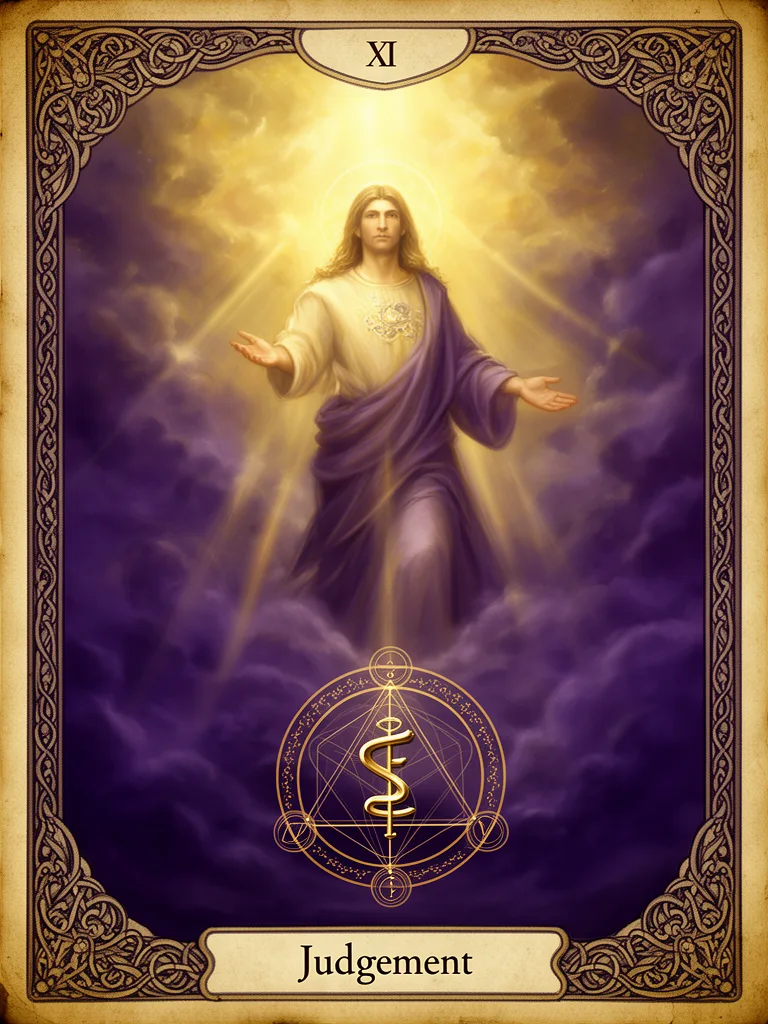
The Tarot card Judgement represents a spiritual awakening and a reckoning with one's past, urging a conscious evaluation of life choices and a call to a higher purpose. It signifies a moment of profound insight, absolution, and the potential for resurrection or transformation.
Where the word comes from
The term "Judgement" originates from the Latin iudicium, meaning "a judging, a decision, a sentence." In the context of the Tarot, it evokes the biblical Last Judgement, a divine assessment of souls. The card's numbering, XX, places it near the end of the Major Arcana, suggesting a culmination.
In depth
Judgement (XX), or in some decks spelled Judgment, is a tarot card, part of the Major Arcana suit usually comprising 22 cards.
How different paths see it
What it means today
The Tarot card Judgement, numbered XX, arrives like a trumpet call at the threshold of the Major Arcana's conclusion. It is a card of profound reckoning, not in the punitive sense of earthly courts, but in the alchemical refinement of the soul. Mircea Eliade, in his exploration of eternal return, might see in Judgement a moment where the cyclical nature of existence is confronted, and a conscious choice is made to break free from the repetitive patterns of the past. The imagery often depicts figures rising from graves, a potent metaphor for awakening from the slumber of unexamined life, a theme echoed in Carl Jung's work on individuation, where confronting the shadow self is essential for wholeness.
This card speaks to the necessity of a spiritual audit, a moment of clarity where one hears the inner call to a higher truth. It is the "Great Awakening" that mystifies mystics across traditions. In Sufism, Idries Shah might point to the concept of "knowledge by presence," where true understanding dawns not through intellectual dissection but through direct, experiential insight, much like the revelation depicted on the card. For the modern seeker, grappling with the cacophony of external demands and internal doubts, Judgement offers a powerful invitation to pause, to listen to the inner oracle, and to understand that the most significant judgment is the one we render upon ourselves, and its ultimate purpose is liberation, not damnation. It is the moment when the scattered fragments of the self are called to assemble, not for judgment, but for integration, a process akin to the Kabbalistic concept of Tikkun Olam, the mending of the world, beginning with the mending of the self.
RELATED_TERMS: Awakening, Revelation, Resurrection, Absolution, Karma, Individuation, Gnosis, Reckoning
Related esoteric terms
No reflections yet. Be the first.
Share your interpretation, experience, or question.
