In
In is the Taoist concept of the female, receptive principle of the universe, often associated with matter and yielding. It represents the passive, yet potent, force that receives and gives form to the active, creative principle, Yin.
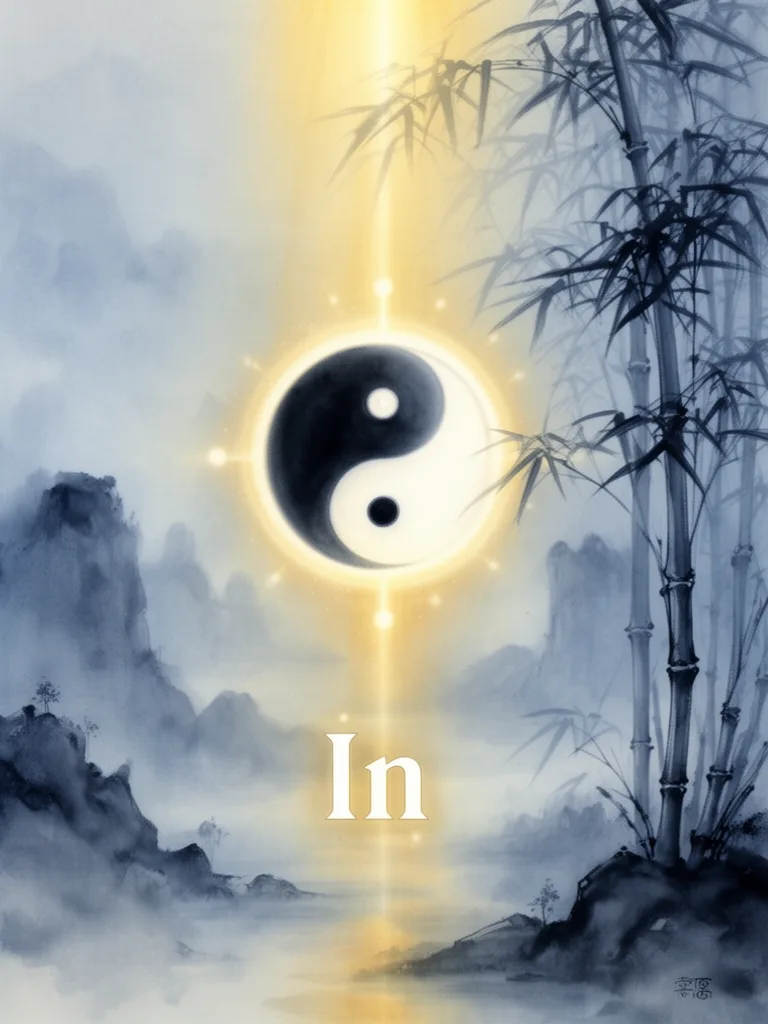
Where the word comes from
The term "In" (陰) originates from ancient Chinese, meaning "shaded," "dark," or "feminine." It is the counterpart to "Yang" (陽), meaning "sunlit," "bright," or "masculine." This duality is fundamental to Taoist cosmology, first systematically explored in texts like the I Ching (Book of Changes).
In depth
The female principle of matter, impregnated by Yo, the male ethereal i»rinci[)le. and precijutated thereafter down into the uni verse. ' Incarnations ( Divim ) or Avatars. The Immaeidate ('onception is as itre-eminently Egyi)tian as it is Indian. As the author of Egi/ptian B<lirf has it: "It is not the vulgar, coar.se and sensual story as in Greek mythology, but refined, moral atid spiritual"; and again the incarnation idea was found revealed on the wall of a Theban temj>le by Samuel Sharpe, who thus analyzes it: "First the god Thoth ... as the messenger of the gods, like the Mercury of the Greeks (or the Gabriel of the first Gospel), tells the mai(h n (pieen Mautmes, that she is to givi' birth to a son, who is to be king Amunotaph III. Secondly, the god Kneph, the Spirit . . . and the goddess Hathor (Nature) . . . both take hold of the queen by the hands and put into her mouth the character for life, « cross, which is to be the life of the coming child ". etc., etc. Truly divine incarnation, or the avatar doctrine, constituted the grandest mystery of every old religious system!
How different paths see it
What it means today
The character "In" (陰) in Taoism, often translated as the feminine, receptive, or dark principle, offers a profound counterpoint to the often overemphasized active, masculine, or bright principle of "Yang" (陽). It is not a void, but a vibrant, generative emptiness, akin to the dark soil that cradles the seed or the deep stillness of a cave that echoes with unseen life. Mircea Eliade, in his studies of comparative religion, noted the universal significance of the feminine principle as a source of life and regeneration, a concept deeply embedded in the "In" of Taoist thought.
This principle is not about subjugation or weakness, but about a different kind of power: the power of yielding, of receptivity, of allowing. It is the moon to the sun's yang, the water that shapes stone through persistent, gentle flow, the quiet breath that sustains the vibrant exhalation. Carl Jung's exploration of the anima, the feminine archetype within the male psyche, echoes this idea of integrating the receptive, intuitive, and feeling aspects of existence, which are often associated with the "In."
For the modern seeker, steeped in a culture that often prizes assertiveness and outward achievement, understanding "In" is an invitation to cultivate inner stillness, to listen to the subtle whispers of intuition, and to recognize the profound creative potential of receptivity. It is about embracing the ebb rather than solely the flow, the shadow rather than only the light, and understanding that true wholeness comes from the harmonious dance of these apparent opposites. As the Tao Te Ching suggests, "The ten thousand things embrace the yin and hold the yang. They are the breath of the uncarved block." It is in this embrace of the receptive, the shaded, that the deepest truths are often found.
Related esoteric terms
No reflections yet. Be the first.
Share your interpretation, experience, or question.
