Ila
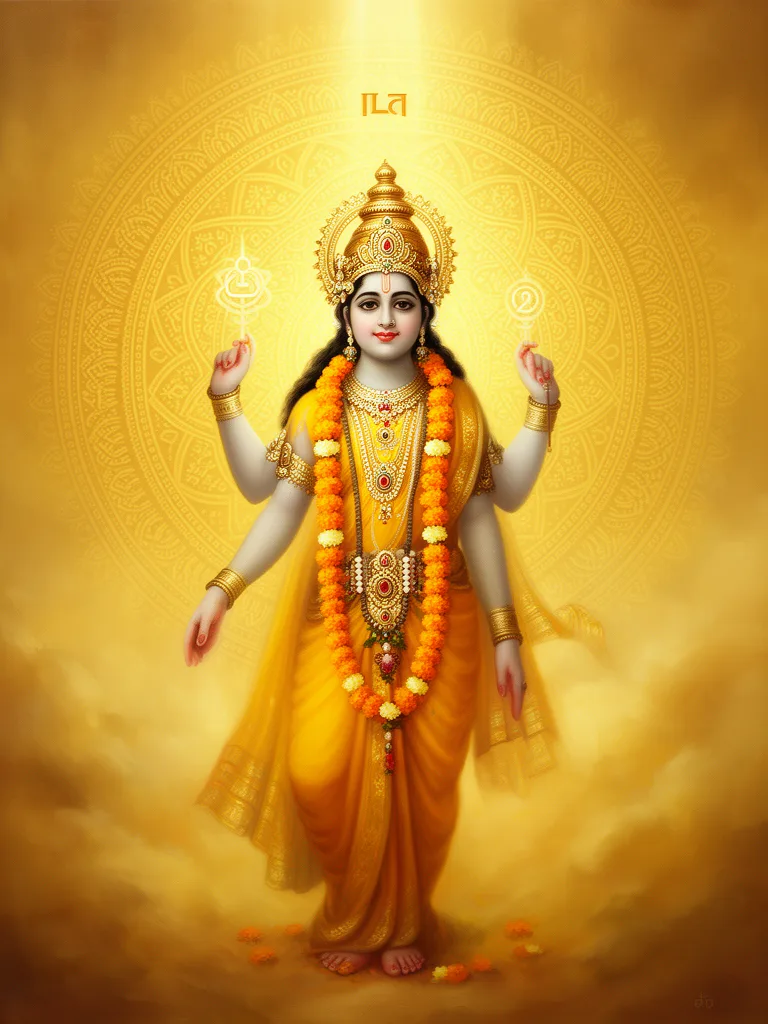
Ila is a complex figure in Hindu cosmology, often depicted as a divine being who embodies both masculine and feminine principles. She represents the cyclical nature of existence, transformation, and the generative power inherent in the universe, bridging divine and earthly realms.
Where the word comes from
The Sanskrit term "Ila" (इला) likely derives from the root "il," meaning "to move" or "to shine." It can also be associated with "earth" or "speech." Its earliest significant appearances are in Vedic literature, signifying a goddess of speech, earth, and sustenance.
In depth
Daughter of Vaivaswata ]\lanu: wife of Buddha, the .son of Soma ; one month a woman and the other a man by the degree of Saraswati ; an illusion to the androgj'nous second race. Tla is also Vaeh in another aspect.
How different paths see it
What it means today
In the vast, intricate cosmogony of Hindu thought, Ila emerges not merely as a mythological character but as a potent symbol of cosmic fluidity and generative power. Blavatsky's annotation points to her androgynous nature, a concept that resonates deeply with philosophical traditions that perceive the ultimate reality as transcending binary distinctions. This duality, the oscillation between masculine and feminine, mirrors the cyclical processes of creation and dissolution that Mircea Eliade described as fundamental to archaic cosmologies. Ila's connection to Saraswati, the goddess of knowledge and speech, further imbues her with the power of manifestation, suggesting that divine utterance and the very fabric of existence are intimately intertwined.
The idea of a being who is "one month a woman and the other a man" speaks to an understanding of time and form not as fixed states but as dynamic processes. This is a profound departure from static conceptions of identity, aligning with the insights of Carl Jung, who explored the anima and animus as archetypal forces within the psyche that mediate between the conscious and unconscious, the individual and the universal. Ila, in this light, becomes a bridge, a conduit through which the undifferentiated divine can manifest in the differentiated world, embodying the inherent capacity for transformation that lies at the heart of all existence. Her presence reminds us that the most profound truths often reside in the liminal spaces, in the embrace of paradox, and in the recognition that the universe itself is a continuous unfolding of potential. The contemplation of such figures invites a re-evaluation of our own perceived limitations, suggesting that within us, too, lies the capacity for profound metamorphosis.
RELATED_TERMS: Brahman, Shakti, Purusha, Prakriti, Ardhanarishvara, Anima, Animus, Androgyny
Related esoteric terms
Books on this concept






No reflections yet. Be the first.
Share your interpretation, experience, or question.
