Ifing
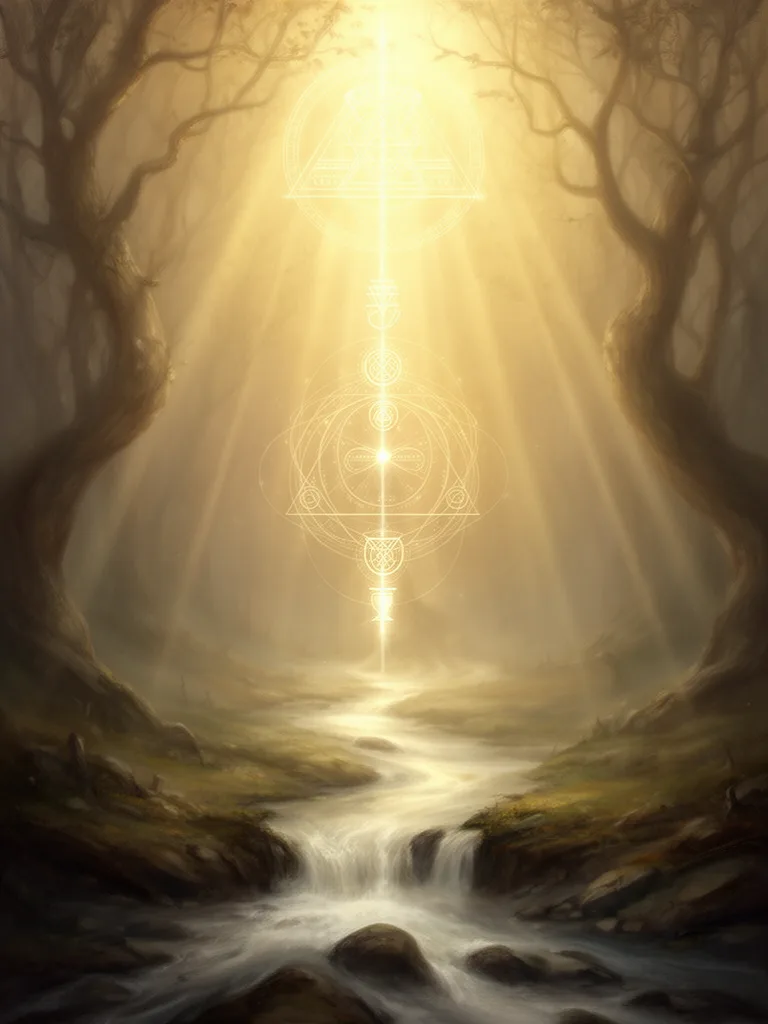
Ifing is a mythical river in Norse cosmology separating the realm of the gods (Asgard) from the land of giants (Jotunheim). It symbolizes a boundary, a liminal space between order and chaos, divine and primordial forces, reflecting universal archetypes of cosmic division.
Where the word comes from
The name "Ifing" (Old Norse: Ifingr) is of uncertain origin. Some scholars suggest a connection to words denoting "river" or "stream," while others propose it relates to the concept of "everlasting" or "unchanging," hinting at its role as a stable, fundamental boundary in the cosmic order.
In depth
The broad river that divides Asgard, the home of the gods, from that of the Jotuns, the great and strong magicians. Below Asgard was Midgard, where in the sunny aether was built the home of the Light Elves. In their disposition and order of locality, all these Homes answer to the Deva and other Lokas of the Hindus, inhabited by the various classes of gods and Asuras.
How different paths see it
What it means today
In the grand, often bewildering, architecture of Norse mythology, the river Ifing emerges not as a mere waterway but as a profound cosmic demarcation. Blavatsky, in her expansive synthesis, places it alongside the Lokas of Hindu cosmology, suggesting a universal principle of layered realities. This is the wisdom of ancient cosmogonies: that the cosmos is not a monolithic entity but a series of interconnected, yet distinct, realms, each with its own inhabitants and governing principles. Ifing, the broad river that separates Asgard, the celestial abode of the Aesir, from Jotunheim, the wild domain of the giants, embodies this fundamental division.
It is the boundary between the cultivated garden and the untamed wilderness, between the divine order and the chaotic primal forces from which that order arose and against which it must perpetually contend. Mircea Eliade, in his exploration of sacred space, would recognize Ifing as a potent axis mundi, a line of separation that simultaneously defines and protects. It is the line drawn in the sand of existence, a necessary barrier that allows for the emergence of form and consciousness, preventing the dissolution of the divine into the formless, the ordered into the chaotic.
The giants, the Jotuns, represent the raw, untamed energies of existence, the primordial powers that predate and threaten the established divine order. Ifing, therefore, is not just a river of water but a river of elemental distinction, a flowing boundary that maintains the integrity of the gods' realm. For the modern seeker, Ifing offers a potent metaphor for the internal divisions we must acknowledge and manage. It speaks to the necessity of establishing boundaries within our own consciousness, separating the cultivated spaces of reason and compassion from the wilder, often disruptive, impulses of the psyche. This is not about suppression but about mindful demarcation, allowing the light of awareness to illuminate and contain the shadows. The river itself, a symbol of flow and constant change, paradoxically serves as a stable, uncrossable barrier, teaching us that even in flux, certain essential divisions are vital for maintaining the integrity of the self.
Related esoteric terms
No reflections yet. Be the first.
Share your interpretation, experience, or question.
