Ganga
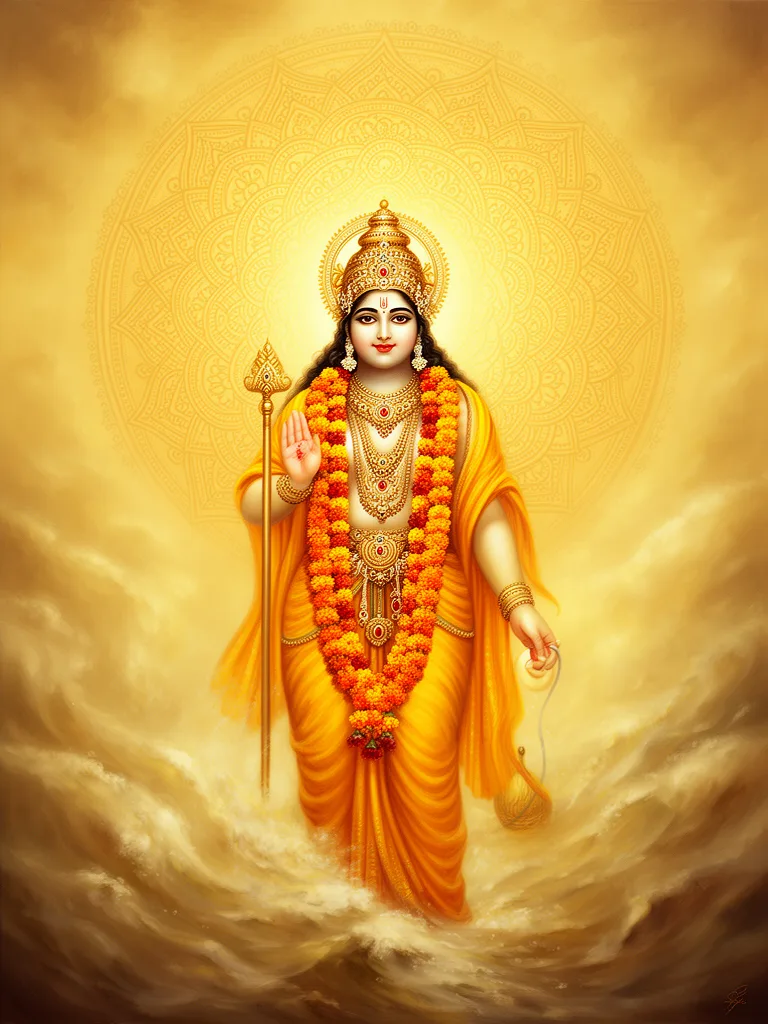
The Ganges River, revered in Hinduism as a divine goddess and a sacred purifier. Its waters are believed to cleanse sins and facilitate spiritual liberation, embodying the flow of cosmic consciousness and the divine presence on Earth.
Where the word comes from
Sanskrit, "Ganga," likely derived from a root meaning "to go" or "to flow." The name refers to the sacred river in India, personified as a goddess. Its mythological origins are deeply embedded in Vedic and Puranic literature, appearing in texts dating back over two millennia.
In depth
The Ganges, the principal sacred river in India. There are two versions of its myth : one relates that Ganga (the goddess) having transformed herself into a river, flows from the big toe of Vishnu ; the other, that the Ganga droi)s from the ear of Siva into the Anavatapta lake, thenee passes out, througli the mouth of the silver eow igoniukhi), crosses all Eastern India and falls into the Southern Ocean. "An 'heretical superstition' ", remarks Mr. Eitel in his Sanskrit, Chinese Dictionary "ascribes to the waters of the Ganges sin-cleansing power". No more a "superstition" one would say, than the belief tliat the waters of Bai)tism and the Jordan have "sin-cleansing i)ower".
How different paths see it
What it means today
The myth of Ganga's descent, whether from Vishnu's toe or Siva's locks, speaks to a profound cosmological understanding. Mircea Eliade, in his exploration of sacred space, would recognize the river as a manifestation of the axis mundi, a cosmic axis connecting the celestial and terrestrial realms. The waters, far from being mere H2O, become imbued with the divine essence, acting as a potent symbol of primal purity. Blavatsky, with her characteristic forthrightness, rightly challenges the "heretical superstition" label, drawing a parallel to Christian sacraments like Baptism. This highlights a universal spiritual impulse: the belief in the transformative power of sacred waters, a theme echoed in countless traditions, from the Jordan River to the ritual ablutions in Islamic practice.
The act of bathing in the Ganga, or scattering ashes into its current, is not a passive superstition but an active engagement with the divine. It is a ritual performance designed to facilitate moksha, the ultimate liberation from the cycle of birth and death. This echoes the alchemical pursuit of purification, transforming the leaden weight of worldly attachments into the golden essence of spiritual freedom. The river's flow, ceaseless and life-giving, becomes a metaphor for the eternal flux of existence and the possibility of transcending it through divine intervention and personal devotion. The Ganga, therefore, is more than a river; it is a sacred geography, a living deity, and a pathway to the divine.
RELATED_TERMS: Moksha, Samsara, Brahman, Atman, Karma, Deva, Puja, Tirtha
Related esoteric terms
Books on this concept








No reflections yet. Be the first.
Share your interpretation, experience, or question.
