Four of Swords
The Four of Swords signifies a period of rest, recovery, and contemplation, often following a period of conflict or intense activity. It suggests a need for strategic withdrawal and mental regrouping before re-engaging with challenges.
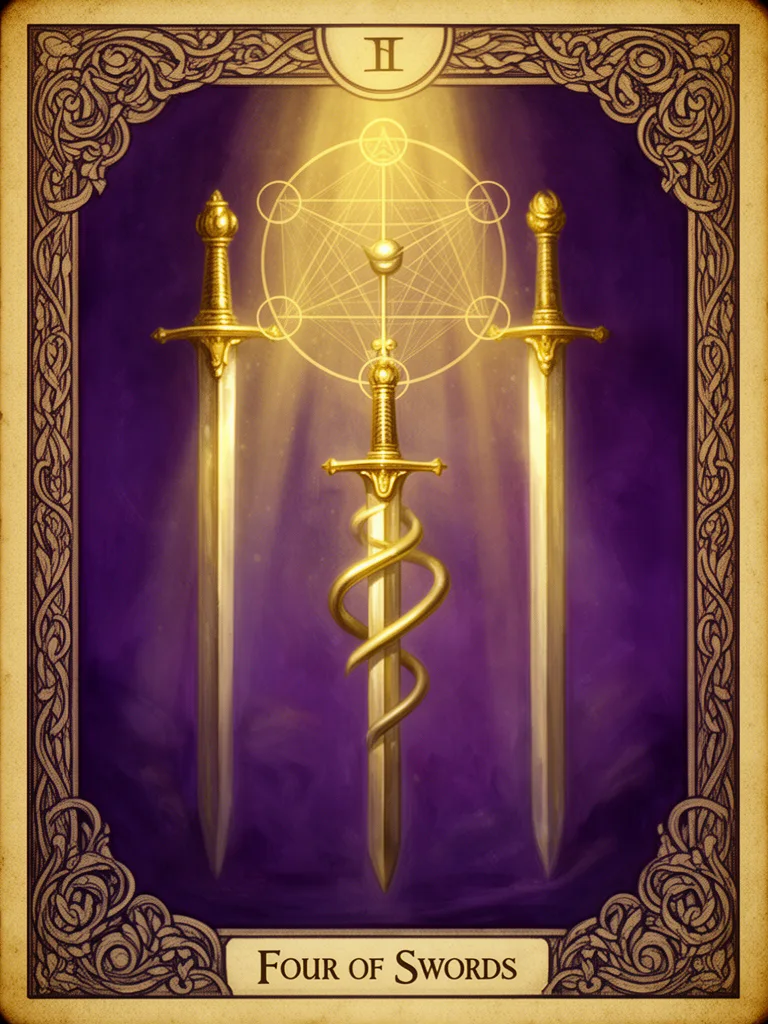
Where the word comes from
The term "Four of Swords" originates from the Tarot, a deck of cards with roots in 15th-century Italy, likely evolving from playing cards. The "Swords" suit generally represents intellect, conflict, and challenges, with "Four" indicating a stable or completed phase within that domain.
In depth
The Four of Swords is a Minor Arcana tarot card. Tarot cards are used throughout much of Europe to play tarot card games. In English-speaking countries, where the games are largely unknown, tarot cards came to be utilized primarily for divinatory purposes.
How different paths see it
What it means today
While Blavatsky's definition points to the card's role in divination and its lesser-known origin in card games, its deeper resonance lies in its archetypal depiction of necessary respite. The image, often showing a figure at rest, sometimes in a tomb-like setting, speaks to the soul's need for sanctuary. This isn't mere idleness; it's a strategic retreat, akin to a warrior nursing wounds or a thinker gathering insights in solitude. Mircea Eliade, in his exploration of sacred time and myth, would recognize this as a liminal space, a period outside the ordinary flow of action, crucial for renewal. Carl Jung might interpret it as an engagement with the anima or animus in a state of repose, allowing for integration and subconscious processing. The swords, symbols of thought and conflict, are laid aside, not discarded, implying a future re-engagement, but one informed by the stillness. This card reminds us that the most profound intellectual breakthroughs and the most effective strategies are often born not in the heat of battle, but in the cool, reflective quietude of a well-earned pause. It is a call to honor the body's and mind's need for recovery, recognizing that true progress is often cyclical, involving periods of intense engagement followed by vital periods of withdrawal and contemplation. It suggests that the deepest wisdom is often found not in the cacophony of the world, but in the silent spaces between the notes.
RELATED_TERMS: Swords, Tarot, Hermeticism, Archetypes, Contemplation, Solitude, Liminality, Inner Peace
Related esoteric terms
No reflections yet. Be the first.
Share your interpretation, experience, or question.
