Four of Coins
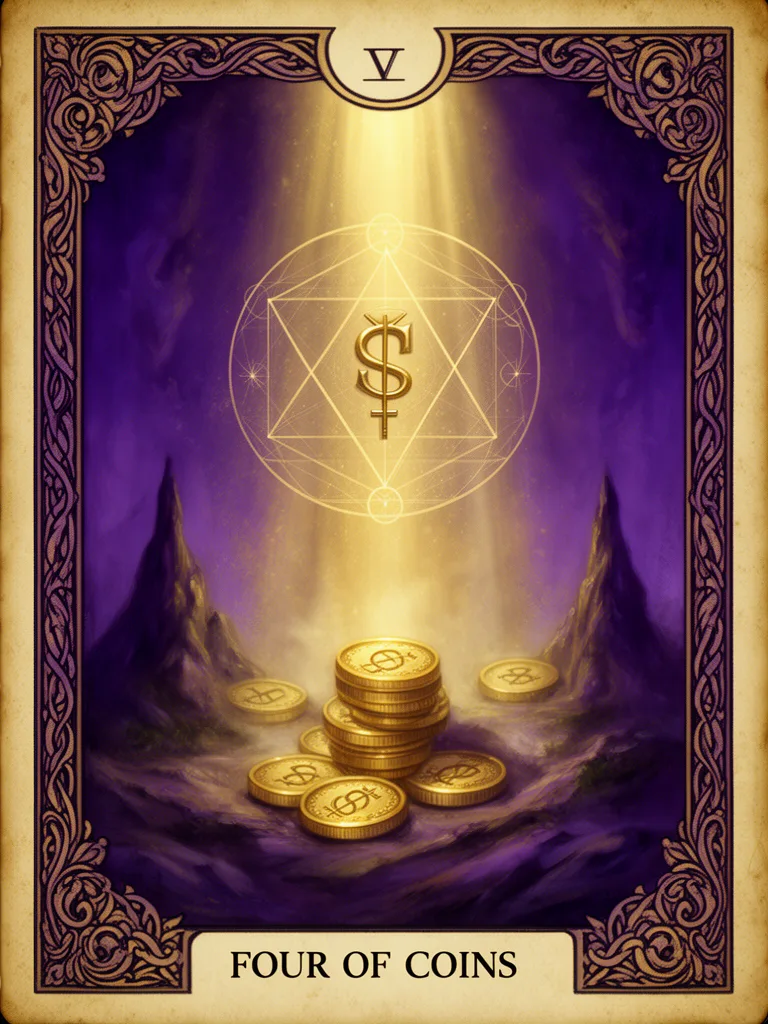
The Four of Coins signifies material security, possessiveness, and the fear of loss. It represents a grounding in the physical world, often to the point of stagnation, where one clings tightly to possessions and stability, resisting change.
Where the word comes from
The term "Coins" or "Pentacles" in Tarot originates from the suit representing the earthly, material realm. While the specific card names evolved, the concept of four as a stable, foundational number is ancient, appearing in philosophical and alchemical systems. The "Coins" suit likely derived from the Italian "Denari" (deniers or coins).
In depth
Four of Coins (also known as the Four of Pentacles) is a card used in Latin-suited playing cards, which include tarot decks. It is part of what tarot card readers call the "Minor Arcana". Tarot cards are used throughout much of Europe to play tarot card games. In English-speaking countries, where the games are largely unknown, tarot cards came to be utilized primarily for divinatory purposes.
How different paths see it
What it means today
The Four of Coins, a card often imbued with the weight of material concerns, offers a potent lens through which to examine our relationship with the tangible world. It speaks to that deep-seated human impulse to secure, to hold, to possess, a drive that, while essential for survival and building civilizations, can, in its extreme, become a gilded cage. Mircea Eliade, in his explorations of sacred time and myth, would likely see in this card the human attempt to anchor oneself in the profane, the everyday, resisting the cyclical dissolution and renewal that characterizes both cosmic and personal transformation.
This card whispers of the fear that underpins our accumulation, the anxiety that if we loosen our grip, all will vanish. It is the echo of the primal need for shelter and sustenance, amplified into a modern obsession with ownership and status. Carl Jung’s concept of the shadow might find resonance here, in the unacknowledged anxieties about lack that drive our acquisitive behaviors. We hoard not just wealth, but security, comfort, and a sense of self defined by what we can claim as ours.
The imagery of the coins held tightly, perhaps even forming a protective circle, suggests a retreat from the world, a self-imposed isolation born of perceived vulnerability. This is the antithesis of the alchemical pursuit, which sought transmutation and integration, not mere preservation. It is also a far cry from the Sufi emphasis on divine generosity and the ephemeral nature of worldly goods, as illuminated by scholars like Annemarie Schimmel, who chronicled the rich traditions of Islamic mysticism. The Four of Coins, in its stark depiction of material attachment, serves as a reminder that true security may lie not in what we grasp, but in what we are willing to release. It is a call to question the foundations of our perceived stability, to ask if our roots are in fertile ground or in shifting sands.
RELATED_TERMS: Attachment, Greed, Security, Stagnation, Materialism, Fear of Loss, Possessiveness, Scarcity Mindset
Related esoteric terms
No reflections yet. Be the first.
Share your interpretation, experience, or question.
