Five of Wands
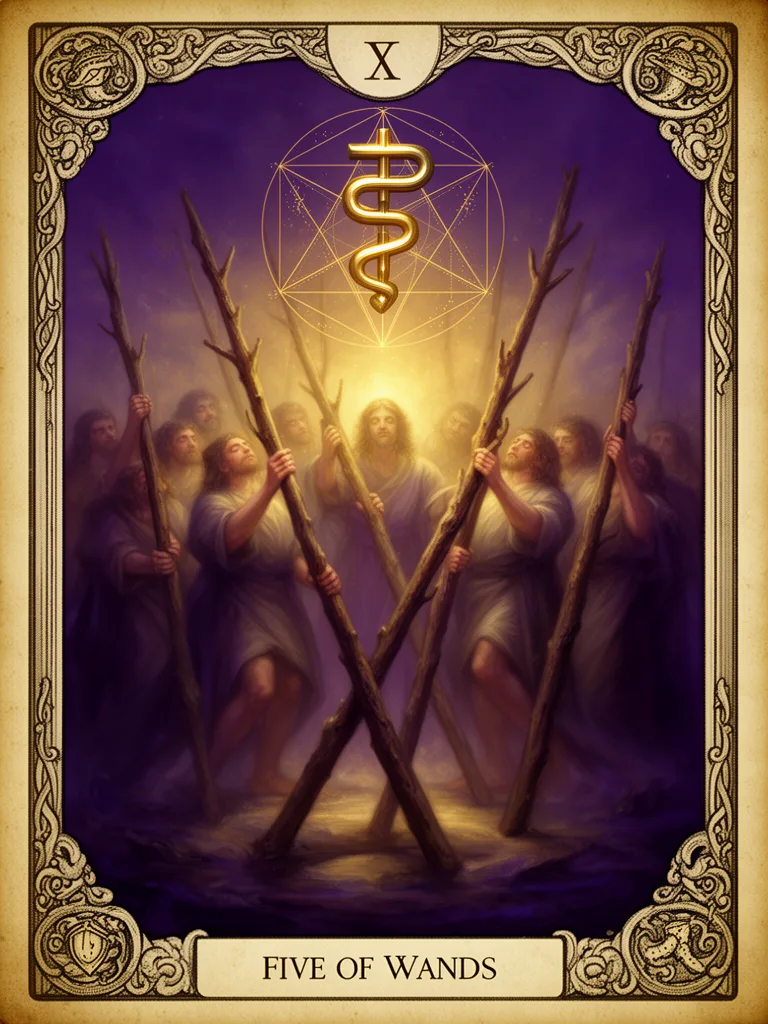
The Five of Wands symbolizes internal conflict and a struggle for dominance, often manifesting as petty squabbles or a clash of wills. It represents a period of disharmony where individual energies vie for supremacy, leading to a chaotic, yet potentially transformative, situation.
Where the word comes from
The term "Wands" in this context derives from the Latin "batonem," meaning staff or club, suggesting a primitive implement of power or contention. The number "Five" universally signifies struggle, change, and the dynamic interplay of forces within a system, as observed in various numerological traditions.
In depth
Five of Wands or Five of Batons is a card used in Latin-suited playing cards which include tarot decks. It is part of what tarot card readers call the "Minor Arcana". Tarot cards are used throughout much of Europe to play tarot card games. In English-speaking countries, where the games are largely unknown, tarot cards came to be utilized primarily for divinatory purposes.
How different paths see it
What it means today
The Five of Wands, though emerging from the relatively mundane context of playing cards, offers a profound lens through which to examine the persistent undercurrent of contention that shapes human experience. Mircea Eliade, in his exploration of the sacred and the profane, would recognize in this card the echo of primal contests, the struggle for territory and dominance that underpins so many myths and rituals. It speaks to the restless energy of the human spirit when it is not yet unified, when the various facets of our personality—ambition, intellect, desire—are not harmoniously aligned but are instead locked in a perpetual, often unconscious, skirmish.
This card reminds us that conflict is not solely an external phenomenon; it is deeply rooted in our internal landscape. The "wands" or staffs, primitive symbols of authority and action, become instruments of discord when wielded without a guiding principle of unity. Carl Jung’s concept of the shadow, the disowned parts of ourselves that can manifest as external projection, finds a fertile ground in the imagery of the Five of Wands. It is the internal battle that often precedes or fuels the external one, a cacophony of competing voices within the psyche.
The challenge presented by this card is not to eliminate conflict entirely, but to understand its nature and to transcend its destructive potential. It calls for a mindful observation of our internal dynamics, recognizing the points of friction and the underlying assumptions that fuel them. Like the Sufi masters who taught the discipline of the self, the Five of Wands invites a period of introspection, a willingness to confront the internal rivalries that prevent us from achieving a state of inner peace and coherent action. It is in understanding this internal struggle that we can begin to transform it, moving from a state of chaotic competition to one of integrated purpose. The potential for growth lies not in winning the battle, but in understanding the battlefield.
Related esoteric terms
No reflections yet. Be the first.
Share your interpretation, experience, or question.
