Five of Cups
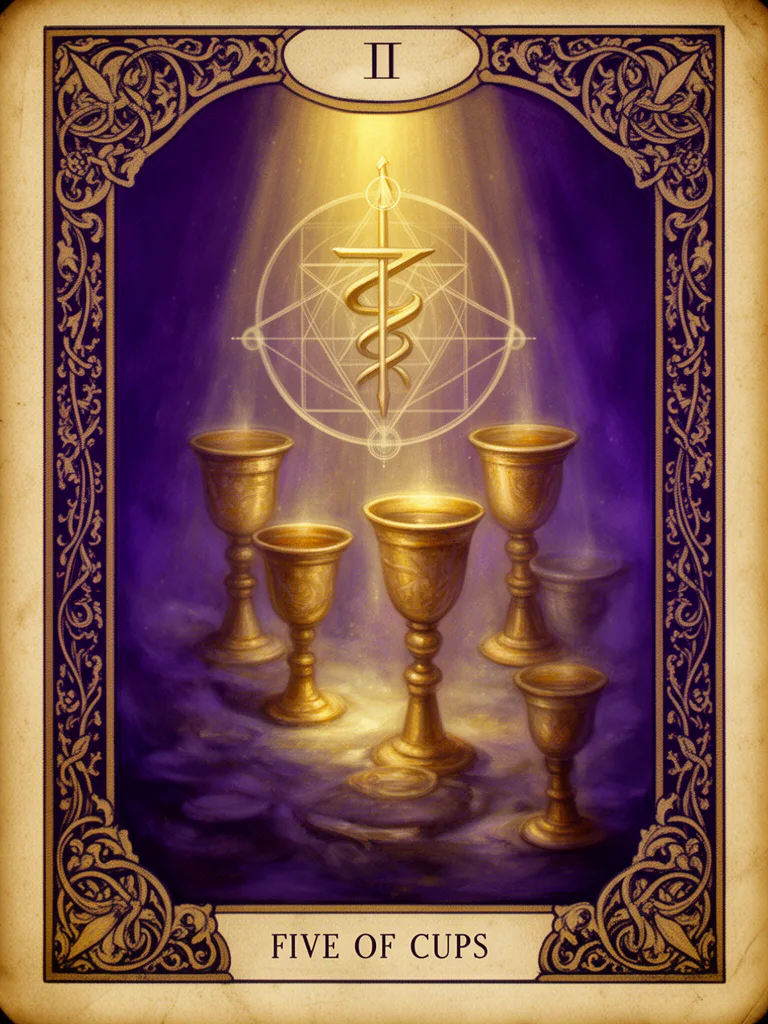
The Five of Cups is a Tarot card representing emotional loss, regret, and disappointment, often stemming from focusing on what has been spilled or lost rather than on what remains. It signifies a period of sorrow or a missed opportunity, urging introspection on the nature of attachment and impermanence.
Where the word comes from
The term "Five of Cups" originates from the Tarot card deck, a system of cards with roots in 15th-century Northern Italy. While the specific imagery of the cups and their spilled contents is a later development, the number five in numerology often signifies change, struggle, and lessons learned, particularly through challenging experiences.
In depth
The Five of Cups is a Minor Arcana tarot card. Tarot cards are used throughout much of Europe to play tarot card games. In English-speaking countries, where the games are largely unknown, tarot cards came to be utilized primarily for divinatory purposes.
How different paths see it
What it means today
The Five of Cups, a card often met with a sigh, invites us into a profound contemplation of loss and its attendant sorrow. It is a visual metaphor for those moments when the precious contents of our lives—be they relationships, ambitions, or cherished beliefs—seem to have been irrevocably spilled, leaving us staring at the empty vessels. This is not a card of utter despair, however, but a threshold. Mircea Eliade, in his work on the sacred and the profane, often spoke of how moments of crisis can become gateways to transformation. The spilled cups, in this light, are not just symbols of what is gone, but catalysts for a deeper understanding of impermanence, a concept central to many spiritual traditions.
Carl Jung might interpret the imagery as a confrontation with the shadow, the parts of ourselves that recoil from pain and cling to what was. The figure in the card, often depicted with their head bowed, is caught in a loop of regret, unable to see the two upright cups behind them, representing the potential for recovery and new beginnings. This visual cue is a powerful reminder that our perception shapes our reality. As Buddhist philosopher D.T. Suzuki elucidated, the nature of suffering is often tied to our attachment to fixed ideas of self and experience. The spilled cups represent the illusion of permanence, and the sorrow arises from the clash between this illusion and the fluid nature of existence.
The Hermetic tradition, with its emphasis on understanding the subtle forces of the universe, would see the Five of Cups as an initiation into the lessons of the lower planes. The spilled wine is not merely a loss, but a necessary shedding of illusions that bind the soul to the material and emotional realms. It is an invitation to transmute the leaden weight of regret into the golden wisdom of acceptance. The challenge presented by this card is to shift our gaze from what has been lost to what remains, and to what can yet be created. It is in this act of reorientation, this turning away from the past's sorrow towards the potential of the future, that the true esoteric lesson of the Five of Cups resides. The insight it offers is that the power to rebuild is not in the spilled liquid, but in the hand that can lift a new cup.
Related esoteric terms
No reflections yet. Be the first.
Share your interpretation, experience, or question.
