Ether
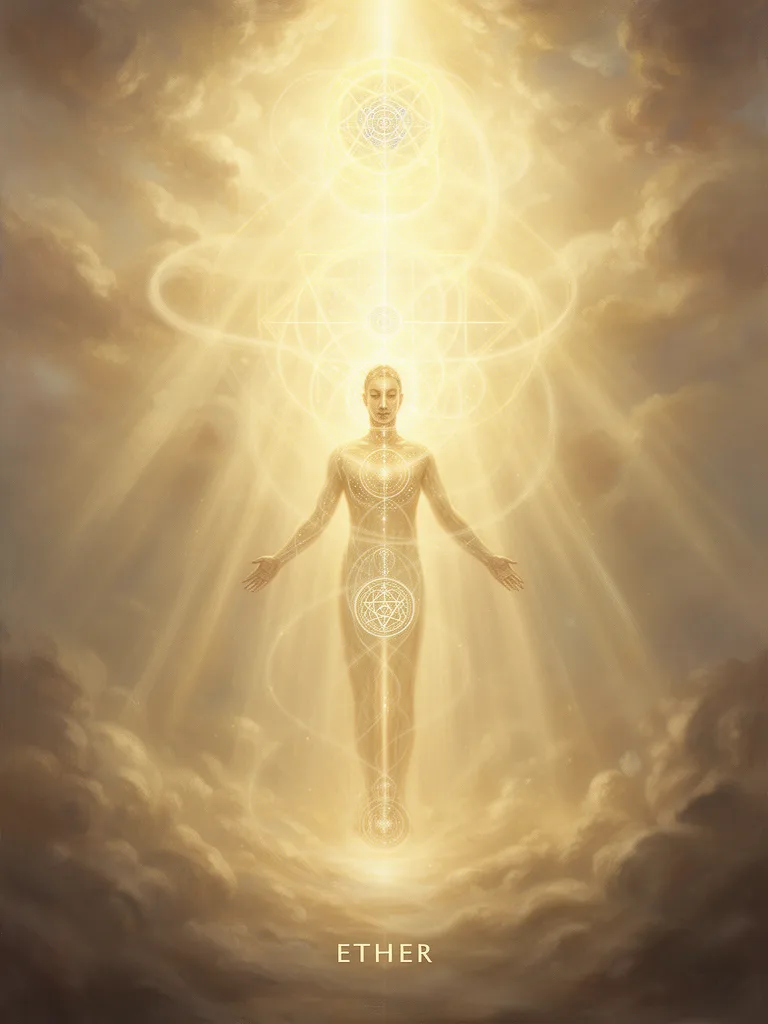
Ether, in esoteric thought, is a subtle, pervasive medium distinct from physical matter, often considered a carrier of consciousness or subtle energies. It bridges the material and spiritual realms, differing from scientific ether or the more spiritual Akasha.
Where the word comes from
The term "ether" derives from the Greek aithēr, meaning "upper air" or "clear sky." It was adopted by ancient philosophers to describe a rarefied substance filling the heavens, distinct from earthly air. Its usage in esoteric contexts predates modern scientific theories of luminiferous ether.
In depth
Students are but too apt to confuse this with Akasa and with Astral Light. It is neither, in the sense in which ether is described by physical Science. Etiier is a material agent, though hitherto undetected by any physical apparatus ; whereas Akasa is a distinctly spiritual agent, identical, in one sense, with the Anima Mundi, while the Astral Light is only the seventh and highest principle of the terrestrial atmosphere, as undctectalile as Akasa and real Ether, because it is something quite on anotlier i)lane. The seventh principle of the earth's atmosphere, as said, the Astral Light, is only the second on the Cosmic scale. The scale of Cosmic Forces, Principles and Planes, of Emanations — on the metaphysical — and Evolutions — on the physical plane — is the Cosmic Serpent biting its own tail, the Serpent reflecting the Higher, and reflected in its turn by the lower Serpent. The Caduceus explains the mystery, and the four-fold Dodecahedron on the model of which the universe is said by Plato to have been built by the manifested Logos — synthesized by the unmanifested First-Born — yields geometrically the key to Cosmogony and its microcosmic reflection — our Earth.
How different paths see it
What it means today
Blavatsky’s distinction between ether, Akasha, and Astral Light is crucial for understanding the nuanced cosmologies of her era, seeking to map the unseen architecture of existence. While modern science has largely abandoned the concept of a physical ether as a medium for light, the esoteric ether persists as a potent metaphor for the pervasive, subtle energies that many traditions believe animate the universe. It is not merely a theoretical construct but often implies a palpable, albeit non-physical, substance that can be perceived or manipulated through focused consciousness.
Think of the ancient Greek notion of aithēr, the pure, bright air that the gods breathed, distinct from the murky air of the mortal world. This celestial breath, this upper stratum of reality, served as a bridge. In esoteric traditions, this bridge is not a passive conduit but an active principle. It is the medium through which consciousness travels, the silent hum beneath the clamor of material existence. Mircea Eliade, in his studies of shamanism and archaic religions, often points to the importance of such subtle realms and their perceived permeability, where the boundaries between worlds are thin.
The Astral Light, as Blavatsky differentiates it, often refers to the dynamic, ever-changing energetic field of the cosmos, a sort of spiritual "weather" that can be influenced by thought and emotion. Akasha, on the other hand, is more akin to the primordial substance, the unmanifest potential from which all things arise. Ether, in this schema, acts as the vibratory substratum that allows these energies and potentials to manifest and interact. It is the silent symphony that underlies all sound, the invisible dance that animates all form.
For the modern seeker, engaging with the concept of esoteric ether invites a radical reorientation. It suggests that our perceived reality, so often understood as solid and independent, is in fact a manifestation within a far vaster, more fluid medium. It encourages practices that cultivate sensitivity to these subtler vibrations, whether through meditation, contemplative prayer, or other forms of inner work. It is an invitation to perceive the world not as a collection of isolated objects, but as a pulsating, interconnected field of consciousness, where the air we breathe is but a grosser manifestation of a cosmic breath. To contemplate ether is to consider the possibility that the universe is not merely made of things, but of relationships, and that these relationships are woven from a substance far more subtle and profound than we typically imagine.
Related esoteric terms
Books on this concept






No reflections yet. Be the first.
Share your interpretation, experience, or question.
