Enochian
Enochian is a constructed language claimed to be divinely received by John Dee and Edward Kelley in the 16th century. It forms the linguistic basis for Enochian magic, a system of ceremonial magic involving communication with angelic beings. The language's structure and vocabulary are unique, intended for ritualistic purposes.
Where the word comes from
The term "Enochian" derives from the biblical figure Enoch, who, according to tradition, "walked with God" and was translated without dying. This association imbues the language with an angelic or heavenly origin. The name first appears in the magical writings of John Dee and Edward Kelley, referencing their belief in an angelic source for the language.
In depth
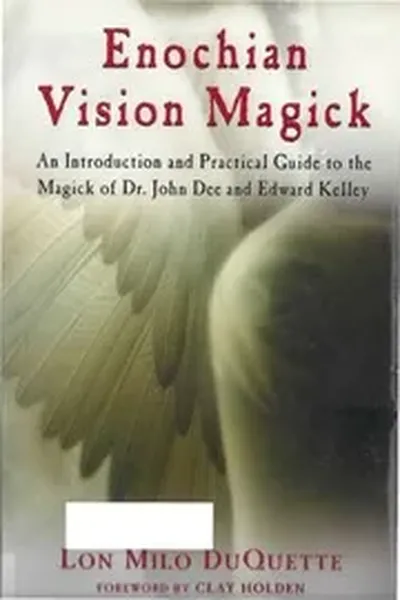
Enochian ( ee-NOK-ee-ən) is an occult constructed language—said by its originators to have been received from angels—recorded in the private journals of John Dee and his colleague Edward Kelley in late 16th-century England. Kelley was a scryer who worked with Dee in his magical investigations. The language is integral to the practice of Enochian magic. The language found in Dee's and Kelley's journals encompasses a limited textual corpus. Linguist Donald Laycock, an Australian Skeptic, studied the...
How different paths see it
What it means today
The appearance of Enochian in the annals of occultism is a curious testament to humanity's persistent yearning for direct communion with the ineffable. John Dee, a mathematician and advisor to Queen Elizabeth I, and his associate Edward Kelley, a scryer, meticulously documented a language they believed was dictated to them by angelic intelligences. This was no mere linguistic curiosity but the very bedrock of a complex system of ceremonial magic, a practice that sought to re-establish a lost connection between the terrestrial and the celestial spheres.
The structure of Enochian, with its unique phonetics and grammar, has been a subject of both fascination and skepticism. Linguists have debated its origins, with some suggesting it was a complex invention, perhaps a form of glossolalia or even a deliberate construction by Dee and Kelley themselves, intended to lend an air of authentic divine revelation to their magical endeavors. However, the sheer detail and internal consistency of the language, as recorded in Dee's diaries, have led others to consider more esoteric explanations. Mircea Eliade, in his exploration of shamanism and archaic techniques of ecstasy, often highlighted the role of sacred languages and cosmographic maps in mediating between worlds, suggesting that such constructs are not simply arbitrary but tap into deeper symbolic matrices of the human psyche.
The practice of Enochian magic, integral to the language, involves invoking angelic beings through specific rituals, often utilizing tables of practice and sigils. This echoes the Hermetic principle of "as above, so below," where the microcosm of human consciousness is seen as a reflection of the macrocosm of the divine order. The Enochian language, in this context, functions as a key, a linguistic cipher capable of unlocking hidden potentials and facilitating interaction with higher planes of existence. It posits that the divine is not silent but speaks in a tongue that, though obscured by the veil of ordinary perception, can be accessed through dedicated spiritual and intellectual discipline. The very act of learning and speaking Enochian becomes a form of spiritual exercise, a way of attuning the practitioner's consciousness to a different order of reality.
Ultimately, Enochian invites us to consider the possibility that language itself is a form of magic, capable of shaping our perception and, perhaps, reality itself. It stands as a reminder that the quest for meaning often leads us to the edges of the known, where the whispers of the unknown can, with sufficient dedication, become intelligible pronouncements.
RELATED_TERMS: Angelic language, Glossolalia, Ceremonial magic, Constructed languages, John Dee, Edward Kelley, Esoteric linguistics, Angelic hierarchy
Related esoteric terms
Books on this concept





No reflections yet. Be the first.
Share your interpretation, experience, or question.
