Eight of Swords
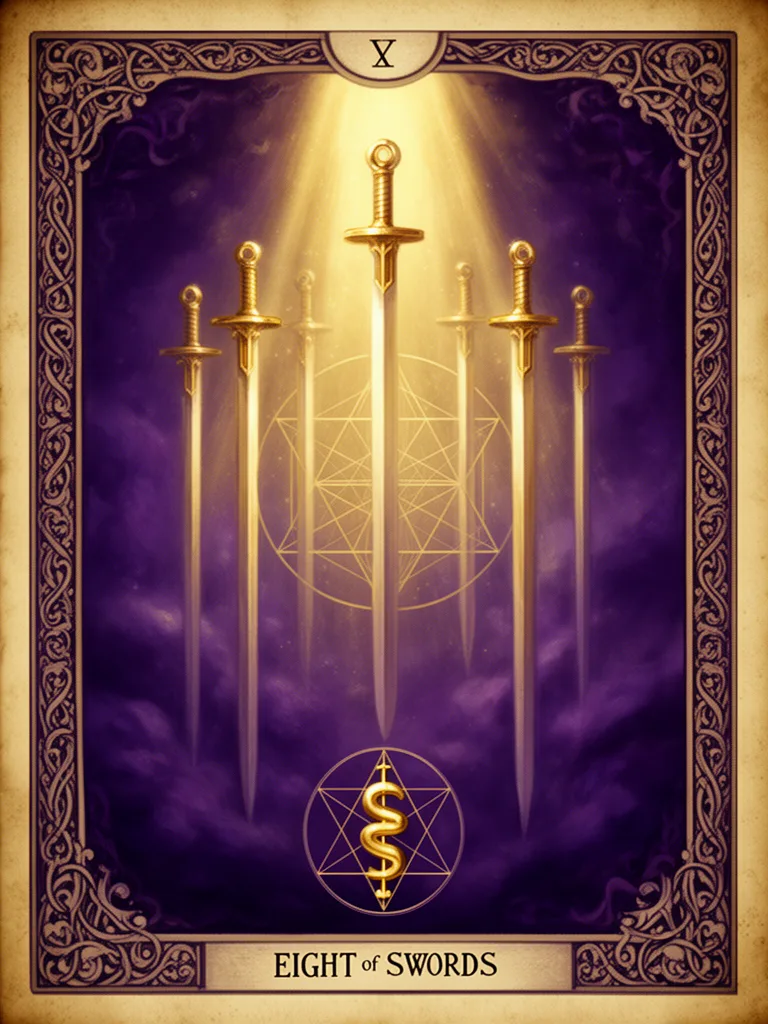
The Eight of Swords represents a state of self-imposed limitation, where perceived obstacles are often mental constructs, trapping an individual in a cycle of inaction and fear. It signifies the moment before liberation, when recognizing one's own agency becomes the key to breaking free.
Where the word comes from
While the "Eight of Swords" is a designation within the Tarot, a system whose origins are debated but often traced to 15th-century Italy, the term itself is a descriptive label rather than a direct etymological root from ancient languages. The number "eight" derives from Proto-Germanic ahtō, and "sword" from Proto-Germanic swurda.
In depth
The Eight of Swords is a Minor Arcana tarot card. Tarot cards are used throughout much of Europe to play tarot card games. In English-speaking countries, where the games are largely unknown, tarot cards came to be utilized primarily for divinatory purposes.
How different paths see it
What it means today
The Eight of Swords, a card from the Minor Arcana, offers a profound, if disquieting, mirror to the modern psyche. It depicts a figure bound and blindfolded, surrounded by swords that appear to threaten, yet are often positioned in a way that suggests they are not actively attacking. Mircea Eliade, in his exploration of the sacred and the profane, might see this as a potent symbol of the individual caught in a profane, mundane reality, unable to perceive the transcendent possibilities because of the very structures of thought and societal conditioning that define their existence.
Carl Jung's concept of the shadow could also be invoked. The swords might represent repressed aspects of the self, judgments and fears that are kept at bay but ultimately confine the conscious personality. The blindfold is crucial; it signifies a refusal or inability to see the truth, a self-imposed blindness that perpetuates the illusion of helplessness. The figure is often standing in water, a symbol of the unconscious, suggesting that the entanglement is deeply rooted in the inner life, a psychic predicament rather than a material one.
The liberation promised by this card, and indeed by many esoteric traditions, is not an external rescue but an internal shift. The figure must choose to remove the blindfold, to acknowledge the swords as extensions of their own mental landscape, and to take the decisive step, however small, out of the perceived predicament. This echoes the insights of thinkers like Idries Shah, who emphasized the importance of recognizing one's own conditioning and the illusory nature of many perceived limitations. The practice here is not one of grand gestures, but of a quiet, internal reorientation, a courageous act of perception. It is the moment the prisoner realizes the bars are merely painted on the wall.
RELATED_TERMS: Illusion, Self-deception, Limitation, Paralysis, Agency, Perception, Inner Freedom, Mental Constructs
Related esoteric terms
No reflections yet. Be the first.
Share your interpretation, experience, or question.
