Eight of Cups
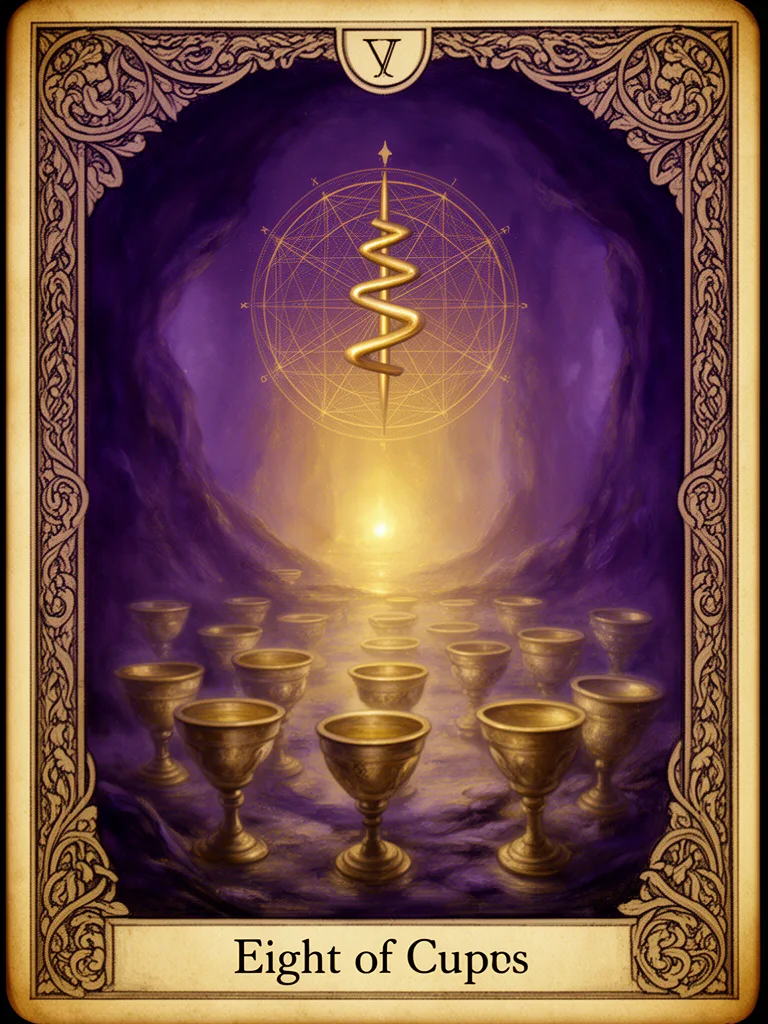
The Eight of Cups signifies a conscious decision to leave behind familiar emotional comforts or established attachments in pursuit of a deeper, perhaps spiritual, fulfillment. It represents a voluntary departure from superficial satisfaction for a more meaningful, albeit uncertain, future.
Where the word comes from
While the "Eight of Cups" itself is a modern designation within the Tarot, the concept it embodies resonates with ancient themes of renunciation and the search for the sacred. The "cups" in Tarot are often linked to the element of Water, representing emotions, intuition, and the subconscious, and the number eight can symbolize completion or a turning point.
In depth
The Eight of Cups is a card used in Latin-suited playing cards, which include tarot decks. It is part of what tarot card readers call the "Minor Arcana". Tarot cards are used throughout much of Europe to play tarot card games. In English-speaking countries, where the games are largely unknown, tarot cards came to be utilized primarily for divinatory purposes. This card indicates changes in emotional attachments, departures, and breaking of links with the past. This card usually carries the meaning...
How different paths see it
What it means today
The Eight of Cups, a potent symbol within the Tarot's Minor Arcana, invites us to consider the nature of fulfillment and the courage required to seek it. It is not a card of passive abandonment, but of active, conscious renunciation. The imagery of the eight cups, often depicted as full and inviting, represents a state of emotional or material satisfaction, a comfortable plateau. Yet, the figure turns away, drawn by an unseen force or an inner knowing, leaving the familiar behind.
This turning away echoes the ancient wisdom traditions that emphasize the necessity of relinquishing worldly attachments for spiritual progress. Mircea Eliade, in his studies of shamanism and archaic religions, often highlighted the theme of the initiate's departure from the ordinary world, a symbolic death and rebirth that prepares them for a higher calling. The Eight of Cups captures this liminal space, the moment of transition where the old self is shed, and the seeker steps into the unknown, guided by an inner compass rather than external validation.
Carl Jung, in his exploration of the collective unconscious, would likely see the Eight of Cups as a manifestation of the individuation process. It represents the courage to confront the shadow, to acknowledge that what once nourished may now hinder growth, and to embark on a journey of self-discovery that requires leaving behind the safety of the known ego. The "cups" can be seen as archetypal representations of emotional dependencies, societal expectations, or even intellectual certainties that must be transcended.
The card's association with the element of Water underscores the intuitive and emotional nature of this departure. It is not a purely rational decision, but one born from a deep inner stirring, a feeling that the current emotional landscape, however pleasant, is no longer conducive to the soul's evolution. This resonates with the Sufi concept of ishq, divine love, which often demands a complete surrender of the self, a leaving behind of all that is not God, in pursuit of ecstatic union. The journey is fraught with uncertainty, yet the promise of a deeper, more authentic connection to the divine, or to one's true nature, propels the seeker forward. It is the moment when the superficial is recognized as insufficient, and the profound, even if daunting, beckons.
RELATED_TERMS: Renunciation, Detachment, Spiritual Quest, Letting Go, Inner Calling, Transition, Transcendence, Individuation
Related esoteric terms
No reflections yet. Be the first.
Share your interpretation, experience, or question.
