Eggs
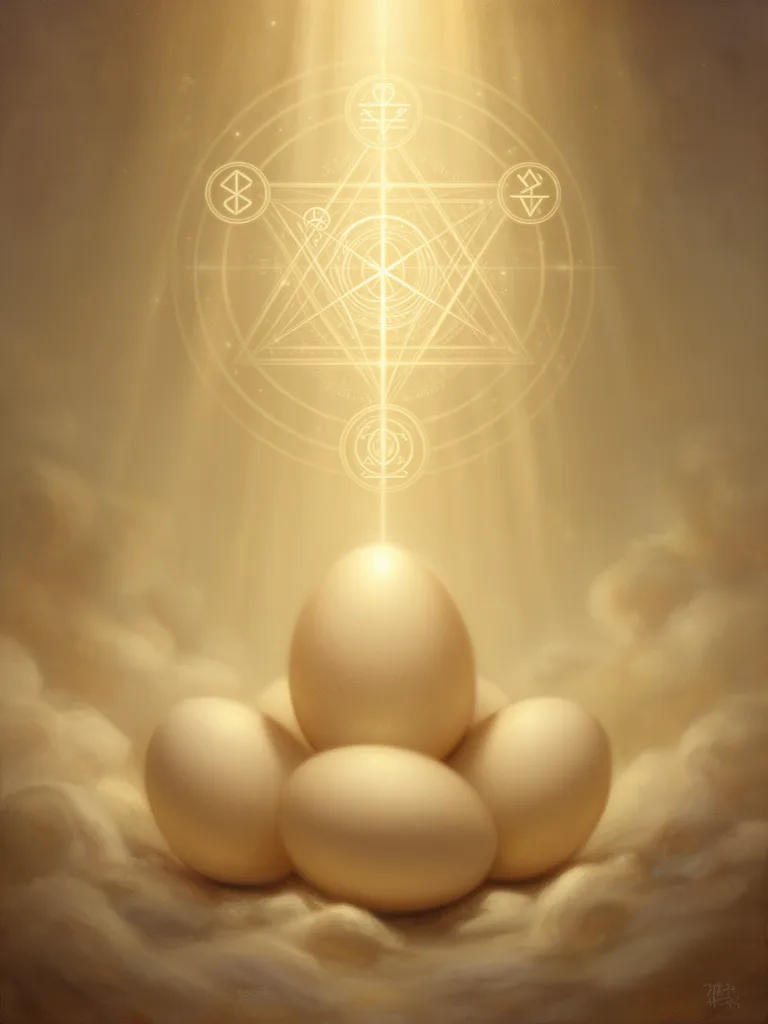
The egg is an ancient, cross-cultural symbol representing cosmic creation, primordial potential, and the cyclical nature of life, death, and rebirth. It signifies the unbroken unity of the universe and the emergence of new existence from a dormant state, often associated with spring festivals and divine generative power.
Where the word comes from
The term "egg" derives from the Proto-Germanic ajja, ultimately tracing back to the Proto-Indo-European root ōwyo-. Its symbolic usage predates recorded linguistic origins, appearing in various cultural mythologies and religious traditions as a universal emblem of genesis and cosmic order.
In depth
Eggs were symbolized from an early time. There was the "Mundane Egg", in which Brahma gestated, with the Hindus the Uiranya-Gharba, and the jMundane Egg of the p]gyptians. which proceeds from the moutii of the "unmade and eternal deity", Kneph, and wiiich is the emblem of generative power. Then the Egg of Babylon, which hatched Ishtar, and was said to have fallen from heaven into the Euphrates. Therefore coloured eggs were used yearly during spring in almost every country, and in Egypt were exchanged as sacred symbols in the spring-time, which was, is, and ever will be, the emblem of birth or rebirth, cosmic and human, celestial and terrestrial. Tiiey were hung up in Egyptian temples and are so suspended to this day in Maliometan mosques.
How different paths see it
What it means today
The humble egg, a recurring motif across human cultures, offers a profound meditation on beginnings. Mircea Eliade, in his seminal work "The Myth of the Eternal Return," meticulously documents the egg's pervasive presence as a symbol of cosmic creation, linking it to the primordial chaos from which order emerges. It is the "Mundane Egg," the "Golden Egg" (Hiranyagarbha) of Hindu cosmology, the sacred ovum from which the Babylonian goddess Ishtar hatches, and the emblem of Kneph in Egyptian mythology.
This potent symbolism speaks to a deep human intuition about the nature of existence: that creation is not a singular event but a continuous cycle of dissolution and renewal. The egg, with its smooth, unbroken shell, contains the potential for all life, a universe held in miniature. Its association with spring festivals worldwide—the exchange of colored eggs, the very emblem of birth or rebirth—underscores this cyclical understanding of cosmic and human existence. It is a reminder that from apparent dormancy, from within a contained unity, the vibrant unfolding of life is perpetually possible. The suspension of eggs in temples and mosques, as noted by Blavatsky, further illustrates its sacred function as a protective and generative symbol, bridging the terrestrial and the celestial. In its simplicity, the egg invites contemplation of the unbroken continuity of being, the ultimate unity underlying all manifest forms.
The egg's archetypal resonance, as Carl Jung might suggest, taps into the collective unconscious, representing the nascent self, the potential for transformation, and the wholeness that precedes differentiation. It is the ultimate symbol of pure potentiality, a silent promise of what is yet to be.
RELATED_TERMS: Cosmos, Genesis, Rebirth, Creation Myth, Archetype, Primordial, Renewal, Unity
Related esoteric terms
Books on this concept








No reflections yet. Be the first.
Share your interpretation, experience, or question.
