Death (tarot card)
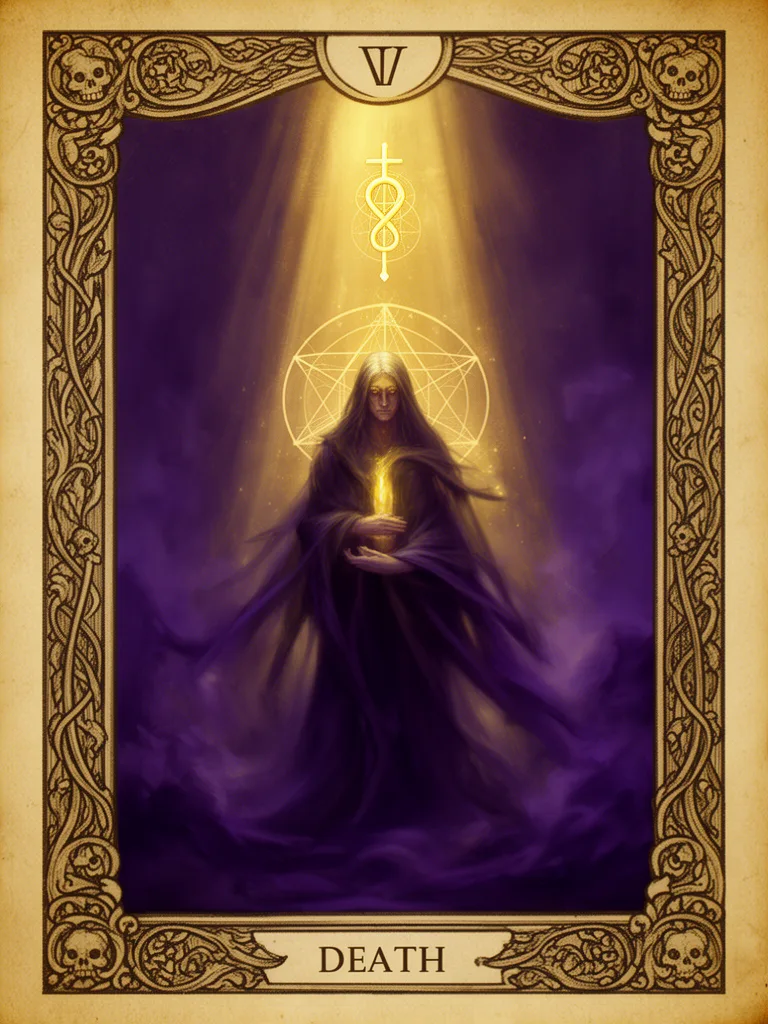
The Death card in tarot signifies profound transformation, the inevitable ending of one phase to make way for another. It represents not literal demise but the necessary shedding of the old, clearing the path for new growth and spiritual evolution.
Where the word comes from
The word "death" derives from the Old English "dēaþ," tracing back to Proto-Germanic roots. In the context of the tarot, the number thirteen, often associated with endings and cycles, amplifies this meaning, moving beyond mere cessation to cyclical renewal.
In depth
Death (XIII) is the 13th trump or Major Arcana card in most traditional tarot decks. It is used in tarot card games as well as in divination. The card typically depicts the Grim Reaper, and when used for divination is often interpreted as signifying major changes in a person's life.
How different paths see it
What it means today
The stark imagery of the Death card, often depicting a skeletal figure astride a pale horse, can be initially unsettling, a visceral confrontation with our deepest anxieties about cessation. Yet, as Mircea Eliade illuminated in his studies of shamanism and archaic religions, death in these contexts is rarely a terminal event; it is a passage, a rite of transformation. The alchemists, those Hermetic precursors to modern psychology, understood this intimately. Their work was a literal and symbolic process of solve et coagula—dissolve and coagulate. The dissolution was the death of the base material, its form broken down, making it amenable to reformation into something more refined, more golden.
This is the essence of the Death card's message for the modern seeker adrift in a culture that often valorizes perpetual youth and stasis. It speaks to the necessity of letting go, not just of material possessions or relationships that no longer serve, but of ingrained patterns of thought, limiting beliefs, and the very identity we have constructed around these impermanent structures. Carl Jung, in his exploration of the collective unconscious, recognized these archetypal images as potent symbols of psychological metamorphosis. The Grim Reaper is not an enemy but an agent of cosmic order, a force that clears the ground so that new life may sprout.
The card urges us to embrace the inevitable cycles of life, much like the Hindu concept of Pralaya, the cosmic night of dissolution that precedes a new creation. It is a call to surrender the illusion of control, to accept that endings are not failures but fertile voids from which new beginnings invariably arise. As Alan Watts so eloquently articulated the spirit of Eastern philosophies, the universe is not a thing that happens, but a process of becoming. The Death card is a powerful reminder that to truly become, we must first unbecome.
It asks us to consider what parts of ourselves have calcified, what attachments bind us to a past that no longer nourishes our spirit. The transformation it signifies is not always dramatic or catastrophic; it can be a quiet, internal shedding, a gradual release that allows for a more authentic and expansive way of being to emerge. This is the true alchemy of existence.
RELATED_TERMS: Transformation, Endings, Cycles, Letting Go, Renewal, Impermanence, Dissolution, Rebirth
Related esoteric terms
No reflections yet. Be the first.
Share your interpretation, experience, or question.
