Cross
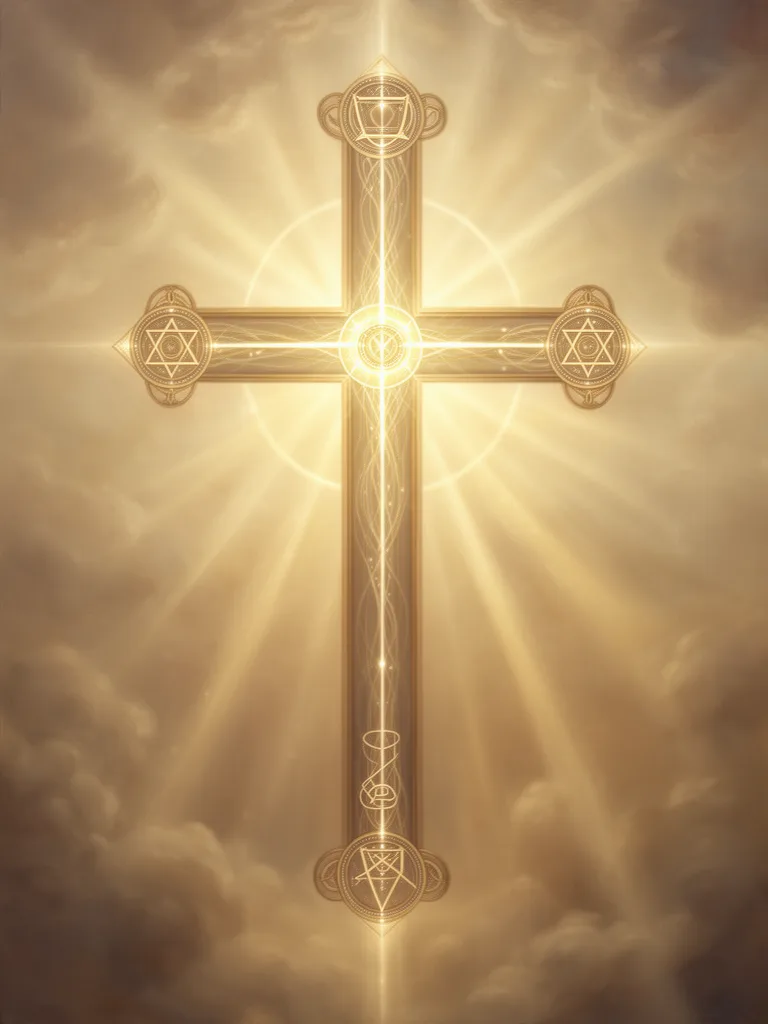
The cross is a geometric symbol representing the intersection of two perpendicular lines, historically signifying cosmic order, spiritual union, and life itself across diverse ancient cultures before its adoption by Christianity.
Where the word comes from
The English word "cross" derives from the Old English "cros," likely of Celtic origin. Its symbolic usage predates Christianity by millennia, appearing in various forms like the Egyptian ankh (crux ansata) and the Pythagorean tau.
In depth
Maiiette liey has shown its antiquity in Kjrypt hy jirovinjr tliat in all the primitive sepulchres "the plan of the chamber has the form of n cross". It is the symbol of the Hrotherhood of races and men; Hud was laid on the breast of the corpses in Kprypt. as it is now placed on the corpses of deceased Christians, and, in its Sicastica form {croix crampoiuia ), on the hearts of tlie Buddhist adepts and Buddlias. (See "Calvary Cross".) Crux Ansata (Lnl.i. Tlie handled erosN. -f- ; whereas the iau is T. in this form, and the oldest Egyptian cro.ss or the tat is tlius +. The cruj atisafa was the symbol of immortality, but the tat-cross was that of spirit-matter and had the significauce of a sexual emblem. The crux (i)isat(i was the foremost symbol in the Egj-ptian I^Iasonry instituted by Count Caglio.stro: and IMasons must have indeed forgotten the primitive signiticauce of their highest symbols, if some of their autliorities still insist that the crux ansata is only a comlTination of the cteis (or yoni) and phallus (or lingham). Far from tiiis. The handle or ansa had a double significance, but never a phallic one; as an attribute of Isis it was the mundane circle; as a symbol of law on the breast of a mummy it was that of immortality, of an endless and beginningless eternity, that which descends upon and grows out of the i)lane of material nature, the horizontal feminine line, surmounting the vertical male line — the fructifying male principle in nature or spirit. Without the handle the crux ansata became the tan T, which, left by itself, is an androgyne symbol, and becomes purely i)iiallic or sexual only when it takes the shape +•
How different paths see it
What it means today
The cross, as Madame Blavatsky notes, is a symbol of profound antiquity, its form appearing in the most ancient sepulchers, suggesting its role as a fundamental marker of human consciousness and cosmic understanding. Mircea Eliade, in his seminal work "The Myth of the Eternal Return," highlights how ancient peoples perceived sacred places as cosmic centers, points where the vertical axis of the world intersects with the horizontal, a concept visually echoed in the cross. It is the geometry of convergence, the meeting of spirit and matter, the divine and the human.
Long before it became the central icon of Christianity, the cross, in its various guises like the Egyptian ankh or the tau, was a potent emblem of life, immortality, and the union of opposing forces. It speaks to a universal human impulse to find order in chaos, to map the invisible realms onto the visible. Carl Jung would recognize this as an archetypal image, a manifestation of the collective unconscious, resonating with humanity across cultures and epochs. The "crux ansata," the handled cross, Blavatsky reminds us, was specifically a symbol of immortality, a promise held out by the divine.
The significance of the cross extends beyond mere geometric representation. It is an invitation to perceive the interconnectedness of all things. In Sufism, the concept of fana, annihilation of the self in the divine, and baqa, subsistence in God, can be seen as a spiritual crossing of the planes of existence. Similarly, in Taoism, the interplay of Yin and Yang, the feminine and masculine, the passive and active, finds a geometric echo in the intersecting lines of the cross, representing the dynamic balance that underlies all creation. For the modern seeker, the cross, stripped of its purely religious dogma, offers a potent reminder of the inherent unity that underlies apparent dualities, a geometric key to unlocking a deeper perception of reality. It is a symbol that, when understood in its broadest context, points not to division, but to the ultimate reconciliation of all things.
Related esoteric terms
Books on this concept





No reflections yet. Be the first.
Share your interpretation, experience, or question.
