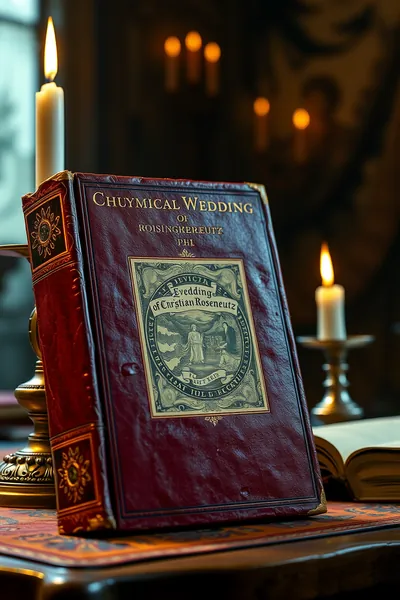
Chymical Wedding of Christian Rosenkreutz
A symbolic allegorical narrative, the "Chymical Wedding" describes an alchemical and spiritual transformation, often interpreted as a mystical marriage between the soul and the divine, or the union of opposites within the individual. It represents a profound inner purification and illumination.
Where the word comes from
The title "Chymical Wedding" is a direct translation from the German "Chymische Hochzeit." The term "chymical" is an archaic spelling of "chemical," reflecting the alchemical context where the process was understood as a transformation of matter and spirit. The "wedding" signifies union, a central metaphor in alchemical symbolism.
In depth
The Chymical Wedding of Christian Rosenkreutz (German: Chymische Hochzeit Christiani Rosencreutz anno 1459) is a German book edited in 1616 in Strasbourg. Its anonymous authorship is attributed to Johann Valentin Andreae. The Chymical Wedding is often described as the third of the original manifestos of the mysterious "Fraternity of the Rose Cross" (Rosicrucians), although it is markedly different from the Fama Fraternitatis and Confessio Fraternitatis in style and in subject matter. As one of the...
How different paths see it
What it means today
The "Chymical Wedding of Christian Rosenkreutz," appearing in the early 17th century, is less a historical account and more a potent alchemical allegory, a spiritual roadmap disguised as a fantastical journey. Its anonymous author, often linked to Johann Valentin Andreae, presented a narrative that was both profoundly esoteric and startlingly modern in its psychological resonance. Mircea Eliade, in his seminal works on alchemy, recognized such texts not merely as proto-scientific endeavors but as profound expressions of the human quest for transformation, a desire to overcome the limitations of ordinary existence and achieve a state of spiritual perfection.
The "wedding" itself is not a corporeal union but a symbolic one, a metaphor for the integration of opposites. In alchemical terms, this often refers to the marriage of the Sun and Moon, the masculine and feminine principles, or the volatile and fixed elements, all culminating in the creation of the Philosopher's Stone. For the individual seeker, as Carl Jung posited in his explorations of alchemy, this represents the integration of the conscious and unconscious, the anima and animus, leading to psychic wholeness. The elaborate rituals, the castles, the kings and queens, all serve as archetypal imagery, speaking to the deep structures of the psyche that transcend cultural and temporal boundaries.
This text invites the reader to participate in a process, not merely to observe it. It is an active engagement with symbolism, a journey of inner discovery that mirrors the alchemist's meticulous work in the laboratory. The purification rites, the trials, and the eventual union speak to the arduous but ultimately rewarding path of spiritual development, a path that requires both rigorous discipline and an openness to the divine. It reminds us that the greatest transformations often occur not in grand external events, but in the quiet, alchemical chambers of the soul. The "Chymical Wedding" thus remains a compelling testament to the enduring human aspiration for unity and transcendence.
Related esoteric terms
Books on this concept


No reflections yet. Be the first.
Share your interpretation, experience, or question.
