Bune
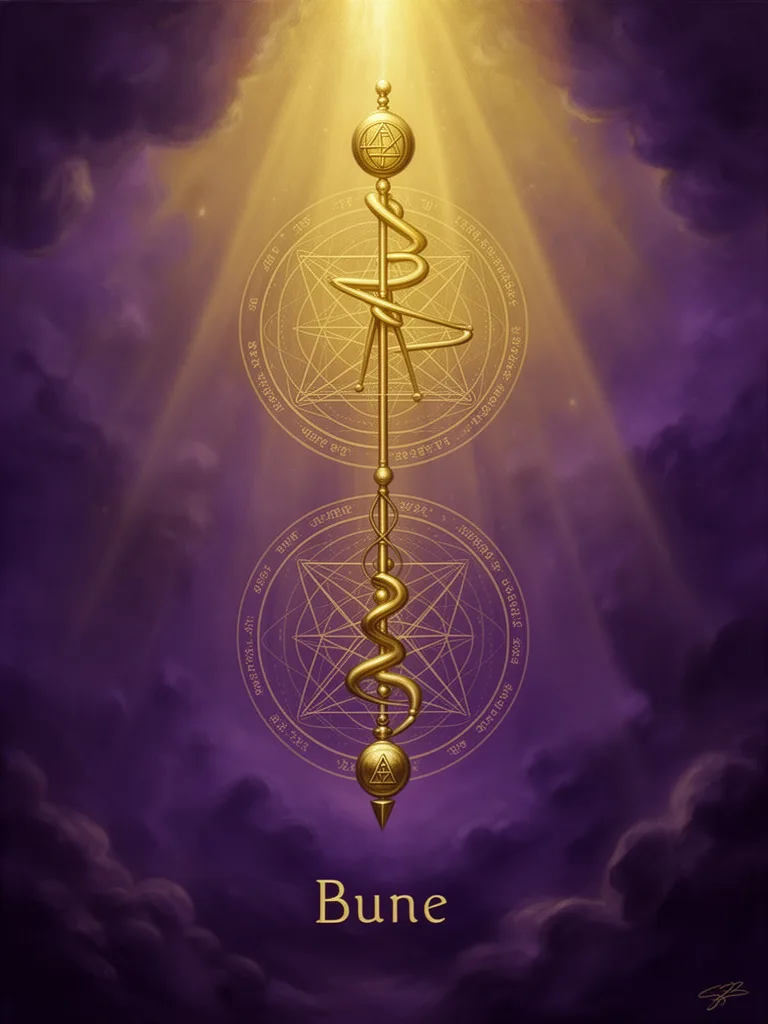
Bune is a spirit described in Western grimoires as a Duke of Hell. It is said to possess the power to bestow riches, grant knowledge of past and future events, and cause the dead to rise and assemble.
Where the word comes from
The precise etymology of "Bune" is obscure, with no clear linguistic roots identified in classical languages. It first appears in demonological texts of the late medieval and early modern periods, notably in Johann Weyer's Pseudomonarchia Daemonum (1577) and later in the Lesser Key of Solomon. The name may be a corruption or invention specific to these magical traditions.
In depth
Bune is a demon listed in demonological grimoires such the Lesser Key of Solomon (including Thomas Rudd's version, as Bime) Johann Weyer's Pseudomonarchia Daemonum, Jacques Collin de Plancy's Dictionnaire Infernal, and the Livre des Esperitz. All of these texts describe Bune as a duke who is able to move the dead, make one rich, and answer a variety of questions. The Livre des Esperitz claims that Bune rules 35 legions of spirits, while the other texts only give him 30 legions to command. The other...
How different paths see it
What it means today
The figure of Bune, as cataloged in the dusty pages of grimoires like the Lesser Key of Solomon, presents a fascinating, albeit grim, facet of Western esoteric thought. Here we find a spirit, a Duke of Hell, endowed with powers that speak directly to the anxieties and aspirations of a pre-modern world: the desire for wealth, the yearning for forbidden knowledge, and a morbid curiosity about the afterlife. This is not the serene contemplation of the divine found in Eastern mysticism, nor the philosophical ascent of Neoplatonism. Instead, it is a more visceral, transactional engagement with the unseen, a pact made with entities believed to inhabit the shadowy margins of existence.
The description of Bune's ability to "move the dead" and cause them to "assemble" taps into a deep-seated human fascination with mortality and the boundary between life and death. It echoes ancient necromantic practices and the persistent belief in the possibility of communicating with those who have passed beyond the veil. Mircea Eliade, in his studies of shamanism and archaic religions, often highlighted the role of the shaman as a mediator between worlds, capable of traversing the cosmic realms and interacting with spirits, both benevolent and malevolent. While Bune is explicitly demonic, the underlying impulse to seek aid or knowledge from non-human intelligences is a common thread.
Furthermore, the promise of riches, a power attributed to Bune, speaks to the material concerns that have always shaped human endeavor. In a world often marked by scarcity and uncertainty, the allure of sudden wealth, even if obtained through infernal means, would have been potent. This aspect of Bune’s purported abilities can be seen as a dark reflection of the alchemical quest for the philosopher's stone, a desire to transform the base into the precious, though in the grimoire tradition, the transaction is with infernal powers rather than cosmic principles.
The very act of cataloging and defining such entities, as seen in the works of Weyer and later compilers, reflects a desire to impose order on the chaotic realm of the supernatural. It is an attempt to understand, categorize, and perhaps even control the forces that lie beyond ordinary human comprehension. These grimoires, while often condemned by religious authorities, represent a persistent current within Western esotericism, a testament to the enduring human impulse to seek power and knowledge in unconventional places.
What Bune’s spectral presence ultimately offers is not a path to enlightenment, but a stark reminder of the shadow side of human desire, a potent symbol of the Faustian bargain that has captivated the Western imagination for centuries.
Related esoteric terms
Books on this concept


No reflections yet. Be the first.
Share your interpretation, experience, or question.
