Anatu
Anatu is the feminine, earth-bound aspect of the Mesopotamian deity Anu, representing the depths and the generative power of the earth. She is associated with fertility and the creation of both heaven and earth, often identified with celestial bodies like Venus.
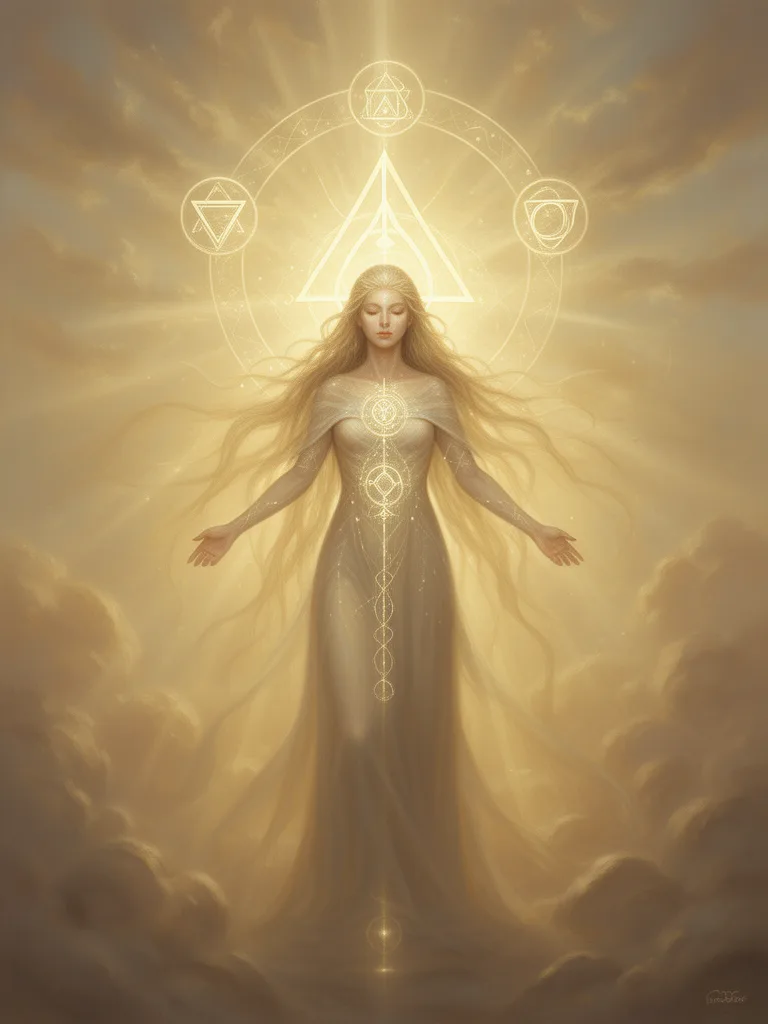
Where the word comes from
The name "Anatu" is the feminine form derived from the Sumerian and Akkadian deity Anu, meaning "sky" or "heaven." While Anu represents the celestial father, Anatu embodies the terrestrial mother, a common dualistic representation in ancient cosmologies.
In depth
The fenude aspect of Anu (q.v.) She represents the Earth and Depth, while her consort represents the Heaven and Height. She is the mother of the god Hea, and produces heaven and earth. Astronomically she is Ishtar, Venus, the Ashtoreth of the Jews.
How different paths see it
What it means today
Anatu, as presented, offers a potent reminder of the sacredness of the terrestrial realm, a counterpoint to the often-prioritized celestial or transcendent. In Mesopotamian thought, she is not merely a passive recipient of Anu's heavenly influence but an active generative force, the very matrix from which existence springs. This echoes Mircea Eliade's observations on the sacredness of earthly realities in archaic societies, where the ground beneath one's feet was imbued with divine power and cosmic significance.
Her identification with Ishtar, the planet Venus, further entwines the chthonic with the celestial. Venus, visible in both dawn and dusk skies, bridges the terrestrial and the cosmic, a celestial messenger that also governs earthly matters of love and war. This duality suggests that the material world, far from being a lesser creation, is a direct manifestation of divine will, a fertile ground for divine activity. For the modern seeker, Anatu’s archetype invites a re-evaluation of our relationship with the earth, not as a resource to be exploited, but as a primal source of being, a divine mother deserving of reverence. Her mythos encourages an integration of the immanent and the transcendent, recognizing the sacred potential within the very soil we walk upon.
The earth, in this context, is not a fallen state but a fundamental aspect of reality, a womb of creation. This perspective challenges purely spiritualistic or escapist tendencies, grounding esoteric inquiry in the palpable realities of existence. Anatu’s story reminds us that the mysteries are not solely in the heavens, but also in the deep, fertile darkness of the earth.
RELATED_TERMS: Prithvi, Gaia, Mother Goddess, Inanna, Ishtar, Earth Mother, Primordial Mother, Demeter
Related esoteric terms
No reflections yet. Be the first.
Share your interpretation, experience, or question.
