Amba
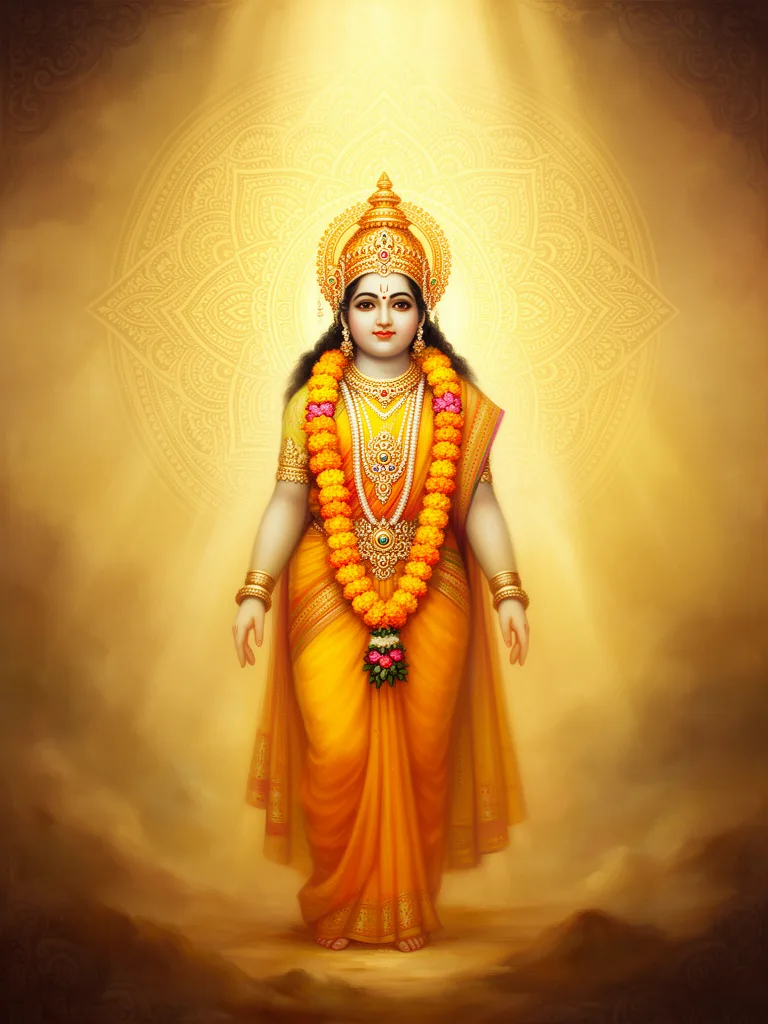
Amba is a Sanskrit name meaning "mother" or "grandmother," often associated with the divine feminine in Hinduism. She is recognized as the mother of the divine trinity (Brahma, Vishnu, Shiva) and a principal deity in Tantric traditions, embodying cosmic creation and nurturing power.
Where the word comes from
The Sanskrit word "Amba" (अम्बा) translates to "mother" or "maternal aunt." Its Proto-Indo-European root is *anana, meaning "mother," a cognate found in many Indo-European languages. In Vedic Sanskrit, it appears as a term of respect and affection for a maternal figure, later evolving into a divine epithet.
In depth
Tlu* name of tlw eldest of the seven Ph uid4 s, tlie litavtiily sisters married each to a Rishi l)el()n<rinfr to the Saptarikslui or tlie scvtii Kishis of tlie constellation known as the Great Bear.
How different paths see it
What it means today
The term "Amba," with its resonant simplicity, echoes through the vast spiritual landscape of India, carrying the weight of primal affection and cosmic origination. It is more than a name; it is an invocation of the foundational feminine principle, the source from which all existence flows. In Hindu thought, Amba is often identified with Devi, the Great Goddess, whose manifold forms—from the gentle Parvati to the formidable Durga—all stem from this singular, nurturing essence. Mircea Eliade, in his studies of comparative religion, often highlighted the significance of the Great Mother archetype as a universal symbol of fertility, life, and the cyclical nature of the cosmos. This concept is not confined to abstract theology; it is woven into the fabric of ritual and devotion, where the devotee seeks the embrace of the divine mother for protection, sustenance, and liberation.
The connection to the seven Rishis and the Saptarishi constellation, as noted in Blavatsky's definition, links Amba to the celestial order, suggesting her role in the cosmic architecture. This celestial lineage imbues her with a sense of ancient authority, a matriarch presiding over the very structure of the universe. In Tantric traditions, the worship of Amba, particularly as the Shaktis or divine energies, becomes a path to realizing the immanent divine within oneself, a journey of awakening the creative and transformative power that resides at the core of being. The emphasis is on recognizing the divine feminine not as a distant deity, but as the very lifeblood of creation, a force that is both immanent and transcendent, accessible through devotion and inner contemplation. To invoke Amba is to call upon the ultimate source of life, the primal womb from which all things emerge and to which they ultimately return.
RELATED_TERMS: Devi, Shakti, Durga, Parvati, Brahman, Prakriti, Kundalini, Mahadevi
Related esoteric terms
Books on this concept








No reflections yet. Be the first.
Share your interpretation, experience, or question.
