Ahti
Ahti is the Scandinavian mythological figure often equated with the "Dragon" in ancient Norse texts. Representing primal unity and the primordial "One," Ahti embodies the foundational, singular essence from which existence emerges, echoing concepts of cosmic origin found in various world mythologies.
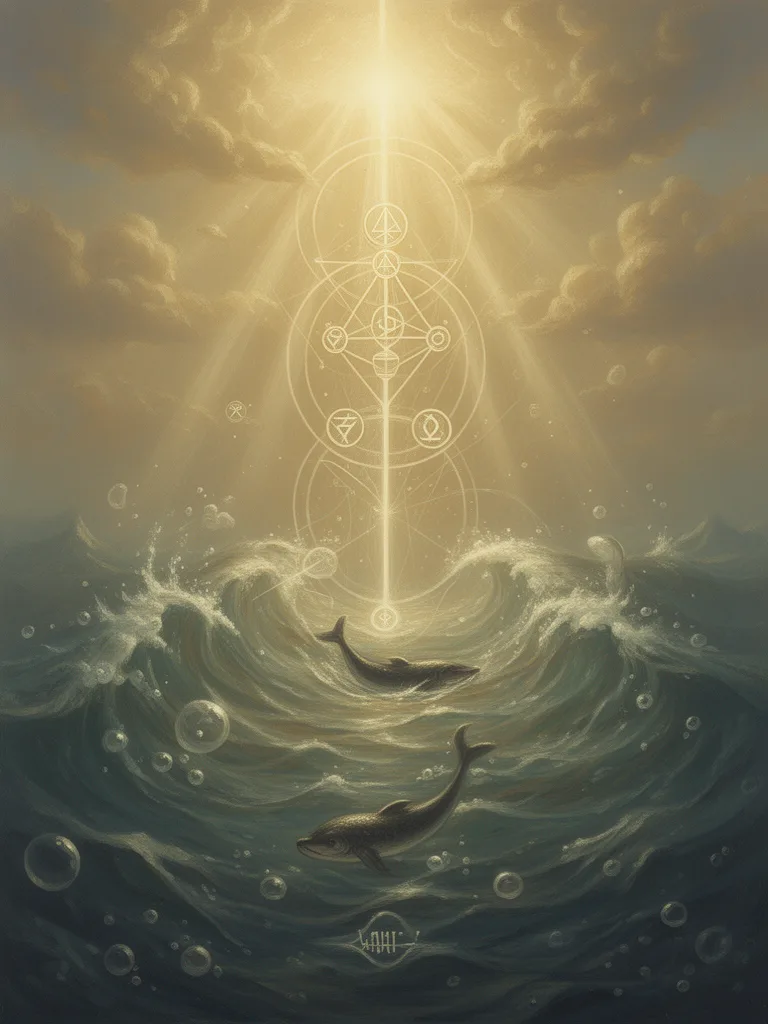
Where the word comes from
The term "Ahti" is of Scandinavian origin, appearing in Old Norse literature. It is linked to the Proto-Germanic root *ahta-, meaning "eight," though Blavatsky's definition associates it with "One" and "first." This linguistic ambiguity invites deeper consideration of its symbolic rather than literal numerical meaning in its Eddic context.
In depth
The "Dragon" in the Eddaa. Ahu (Scand.). "One" and the first.
How different paths see it
What it means today
Blavatsky's brief gloss on "Ahti" as the "Dragon" in the Edda, linked to "One" and the "first," opens a fascinating portal into the Scandinavian imagination's encounter with the primordial. The dragon, a ubiquitous archetype across cultures, often embodies chaos and destruction, but in its more ancient, esoteric interpretations, it signifies the unformed, undifferentiated potential of existence itself. Mircea Eliade, in his seminal work on myth and reality, frequently explored how cosmic dragons represent the pre-cosmic state, the watery abyss or primal chaos that precedes order and form. Ahti, in this light, is not a mere beast to be slain but the very source of being, the singular point from which the multiplicity of the cosmos unfurls.
This resonates deeply with the modern seeker's quest for understanding unity. While Western traditions have often emphasized a dualistic creator God, many Eastern philosophies and indigenous cosmologies embrace a singular, often androgynous or formless, origin. The Hindu concept of Brahman, the impersonal Absolute, or the Buddhist notion of Shunyata, emptiness as the ground of all phenomena, offer conceptual parallels. The dragon, with its serpentine coils, can be seen as a symbol of cyclical time and the continuous unfolding and re-absorption of the universe, a concept explored by scholars like Ananda Coomaraswamy who saw in such imagery the cosmic dance of Shiva.
The "One" and "first" attributed to Ahti by Blavatsky suggest a return to the unmanifest, a state prior to the differentiation of subject and object, self and other. This is the realm of pure potentiality, a concept that Carl Jung would recognize in the archetypal imagery of the Self, the totality of the psyche that encompasses both conscious and unconscious elements. The dragon, often depicted as guarding treasures, can also symbolize the hidden wisdom or the profound, often frightening, truth of our own interconnectedness. To confront Ahti is not to defeat an external foe but to recognize the primordial unity within and without, a realization that can be as terrifying as it is liberating. The challenge for the modern mind is to move beyond the simplistic narrative of good versus evil and to embrace the complex, often paradoxical, nature of the source from which all arises.
RELATED_TERMS: Brahman, Shunyata, Chaos, Archetype, Primordial, Cosmic Serpent, Unity, The Absolute
Related esoteric terms
No reflections yet. Be the first.
Share your interpretation, experience, or question.
