Ace of Cups
The Ace of Cups symbolizes the potent beginning of emotional and spiritual fulfillment, representing a divine offering or a new wellspring of love, intuition, and creative potential. It signifies the opening of the heart to profound experiences and the emergence of inner wisdom.
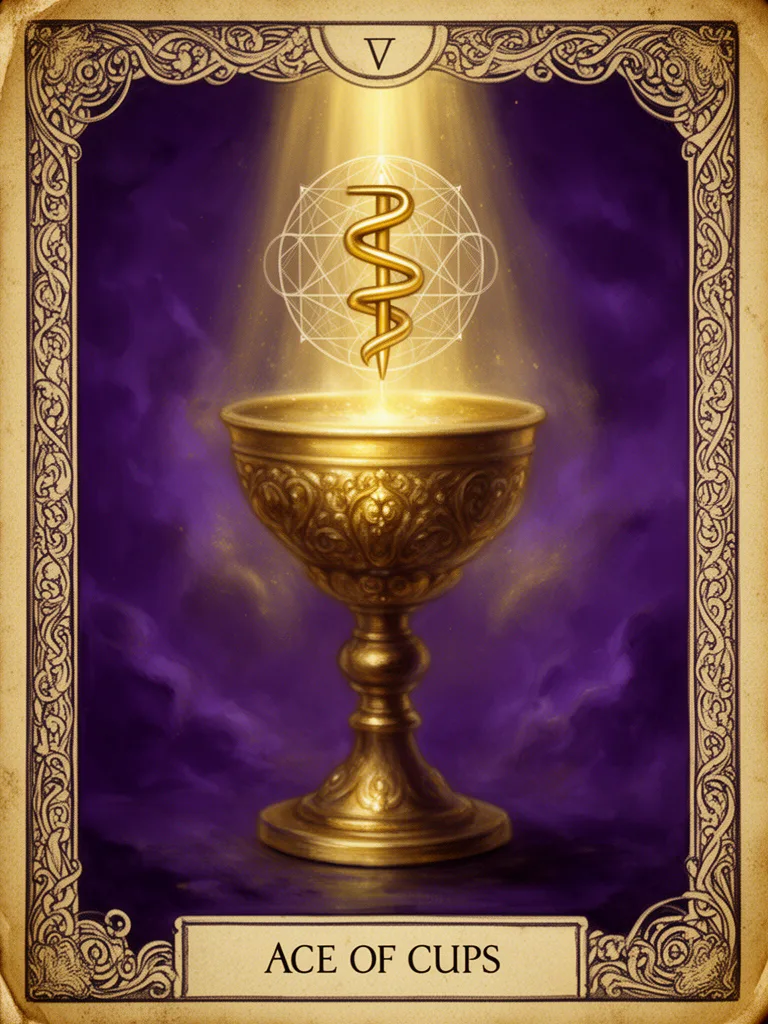
Where the word comes from
While the term "Ace of Cups" originates from modern Tarot, the concept of a primordial, generative cup or chalice is ancient. The Latin "calix" and Greek "kylix" refer to drinking vessels, often imbued with symbolic meaning in rituals. The "ace," from Latin "as," originally meant a unit or a single coin, evolving to signify the highest or first card.
In depth
The Ace of Cups is a card used in Latin-suited playing cards (Italian, Spanish and tarot decks). It is the ace from the suit of cups. In Tarot, it is part of what card readers call the "Minor Arcana", and as the first in the suit of cups, signifies beginnings in the area of the social and emotional in life. Tarot cards are used throughout much of Europe to play tarot card games. In English-speaking countries, where the games are largely unknown, tarot cards came to be utilized primarily for divinatory...
How different paths see it
What it means today
The Ace of Cups, a seemingly simple card in the modern divination system of Tarot, carries echoes of profound archetypes that have resonated across cultures and epochs. It speaks to the universal human yearning for connection, for love, and for a deeper spiritual wellspring. In the context of Hermeticism, it aligns with the concept of divine outpouring, the generative force that animates existence. Mircea Eliade, in his studies of myth and ritual, often highlighted the significance of sacred vessels and primordial waters as symbols of creation and renewal. The cup, in this light, is not just a container but a conduit, a point of intersection between the material and the divine.
This symbol’s resonance can be felt in the Sufi tradition, where the divine love is often described as an intoxicating wine poured from an eternal cup, leading the seeker towards ecstatic union. Annemarie Schimmel, a preeminent scholar of Sufism, frequently explored the rich symbolism of intoxication and divine love. Similarly, in Hinduism, the heart chakra, Anahata, is the seat of unconditional love and compassion, a spiritual center that, when awakened, overflows with divine energy, much like the Ace of Cups. The concept of "kripa," divine grace, can be seen as the essence of this overflowing cup.
For the Christian mystic, the Ace of Cups finds its most potent expression in the Holy Grail, a symbol of Christ's sacrifice and the promise of spiritual sustenance. It represents the divine presence made manifest, a source of healing and eternal life. Carl Jung, in his exploration of archetypes, would likely see the Ace of Cups as a manifestation of the anima, the feminine principle within the psyche, representing intuition, emotion, and the capacity for deep connection. Its appearance signals an opening, a fertile ground for emotional and spiritual growth, a reminder that the deepest wells of fulfillment lie not in acquisition, but in receptivity and the courage to open one's heart. It is a call to recognize the sacredness of our own emotional and intuitive capacities, to drink deeply from the wellspring of our inner life.
Related esoteric terms
No reflections yet. Be the first.
Share your interpretation, experience, or question.
