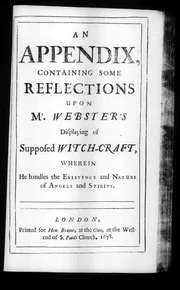
The sign of the witch

 77
77

The sign of the witch
David Waldron's "The Sign of the Witch" presents a detailed and often dense exploration of how witchcraft has been conceptualized and contested. The book excels in dissecting the scholarly debates that emerged in the late 20th century, particularly concerning the historical reality of witch-cults. Waldron meticulously traces the intellectual lineage of these ideas, demonstrating a strong command of his source material. However, the narrative can sometimes become overly academic, potentially alienating readers seeking a more accessible overview. A particular strength lies in its examination of the reception and critique of figures like Margaret Murray. Despite its academic rigor, the work offers a valuable perspective on the historiography of witchcraft studies. "The Sign of the Witch" is a solid, if sometimes dry, contribution to understanding how witchcraft narratives have been constructed and deconstructed.
📝 Description
77
David Waldron's 2008 book, "The Sign of the Witch," examines historical witchcraft beliefs.
Published in 2008, David Waldron's "The Sign of the Witch" provides a scholarly look at how beliefs about witchcraft developed over time. The book moves past sensational stories to consider the intellectual and social forces that shaped views of witchcraft in various historical periods. Waldron's study is for those who seriously study esotericism, history, and religion. It focuses on the ideas behind magical beliefs and how the concept of the "witch" was formed historically. It does not focus on practical magic or spellbooks.
The author places his research within the late 20th and early 21st centuries, a time when academics showed renewed interest in occultism and less common spiritual paths. The work responds to earlier academic studies that presented more romanticized versions of witchcraft and the occult. Waldron critically examines ideas like the "witch-cult hypothesis," writings on demonology, and the shift from everyday folk magic to the idea of witchcraft as diabolical. He looks at how these notions spread and influenced public opinion and legal actions.
This book fits within the academic study of Western esotericism, particularly concerning the history of magical beliefs and their societal impact. It engages with scholarly discussions that emerged from critiques of earlier, often romanticized, interpretations of occult phenomena. Waldron's work contributes to understanding how concepts of witchcraft, from folk practices to demonological constructs, were shaped by intellectual currents and social anxieties throughout history. It is a study of the historical discourse surrounding witchcraft, rather than a guide to contemporary practice.
💡 Why Read This Book?
• Gain a nuanced understanding of the "witch-cult hypothesis" and its scholarly refutation, moving beyond simplistic portrayals of historical witchcraft. • Explore the intellectual history of demonology and the evolution of beliefs surrounding magical practices, as detailed through specific 16th-century texts. • Appreciate the academic discourse surrounding witchcraft, particularly the critical engagement with early 20th-century scholarship by figures like Margaret Murray.
⭐ Reader Reviews
Honest opinions from readers who have explored this book.
❓ Frequently Asked Questions
When was David Waldron's "The Sign of the Witch" first published?
The book "The Sign of the Witch" by David Waldron was first published in 2008, marking a significant contribution to the scholarly discussion on witchcraft beliefs in that period.
What is the "witch-cult hypothesis" discussed in the book?
The "witch-cult hypothesis," explored in "The Sign of the Witch," posits that European witchcraft trials were actually persecutions of an ancient pagan religion that survived underground. The book examines its origins and critiques.
Does "The Sign of the Witch" offer practical witchcraft advice?
No, "The Sign of the Witch" is a historical and academic work. It focuses on the study of beliefs about witchcraft, not on providing instructions for contemporary magical practice.
Which historical figures or concepts are central to the book's argument?
Central to the book are discussions around Margaret Murray's theories on the witch-cult, the historical development of demonology, and the academic reception of these ideas throughout the 20th century.
Is the book suitable for beginners in occult studies?
While informative, "The Sign of the Witch" is written for a more academic audience. Beginners might find its scholarly tone and deep dive into historiography challenging without prior context.
What academic field does "The Sign of the Witch" primarily engage with?
The book primarily engages with the academic fields of religious studies, history, and the sociology of belief, specifically focusing on the historiography of witchcraft.
🔮 Key Themes & Symbolism
Historiography of Witchcraft Beliefs
The work meticulously traces the scholarly evolution of understanding witchcraft, particularly focusing on the late 20th-century academic debates. It examines how figures like Margaret Murray influenced perceptions and how subsequent scholarship critically engaged with and often refuted her "witch-cult hypothesis." This theme highlights the academic process of re-evaluating historical narratives and the construction of knowledge surrounding occult phenomena.
The "Witch-Cult Hypothesis" Critiqued
A central focus is the deconstruction of the idea that European witchcraft trials were primarily persecutions of an ancient, surviving pagan religion. Waldron analyzes the origins of this hypothesis, its proponents, and the academic counter-arguments that emerged, underscoring the distinction between historical evidence and speculative theory in occult studies.
Demonology and Societal Fear
The book explores the historical development of demonological texts and the societal anxieties that fueled beliefs in malevolent magic. It examines how these concepts were articulated in scholarly and religious works, contributing to the persecution of individuals accused of witchcraft, and how these narratives shifted over time.
Intellectual Currents in Esotericism
Waldron situates the study of witchcraft within broader intellectual trends, particularly those influencing esoteric thought in the 20th century. The work demonstrates how academic disciplines intersect with and challenge popular or fringe interpretations of occult history, offering a grounded perspective.
💬 Memorable Quotes
Direct passages from the work, attributed to the author.
“The witch-cult hypothesis was a significant, though ultimately flawed, attempt to reimagine the historical basis of witchcraft allegations.”
— This highlights the book's critical stance on certain historical theories, acknowledging their impact while emphasizing the need for rigorous academic scrutiny and evidence-based analysis.
“Demonological treatises served not only as theological arguments but also as influential blueprints for identifying and prosecuting supposed witches.”
— This interpretation emphasizes the practical, legal, and social consequences of theological and scholarly writings on witchcraft, illustrating their direct impact on historical events and individuals.
“Academic reception of Murray's work demonstrates the dynamic nature of historical interpretation.”
— This points to the book's focus on the scholarly conversation surrounding witchcraft, showing how ideas are debated, accepted, or rejected within academic circles over time.
“The transition from folk magic to diabolical witchcraft signifies a major shift in cultural and religious perception.”
— This captures the essence of how beliefs about magic evolved, moving from potentially accepted folk practices to feared, religiously condemned devil-worship, a key theme in the book's historical analysis.
“Distinguishing between historical fact and later romanticized or speculative constructions of witchcraft is paramount.”
— This underscores the book's core methodological approach: a commitment to scholarly rigor and a careful separation of documented history from imaginative interpretations of the past.
🌙 Esoteric Significance
Tradition
While not strictly an esoteric text, "The Sign of the Witch" engages with the historical underpinnings of Western esoteric traditions that often incorporate or interpret witchcraft lore. It operates within the lineage of critical historical analysis that seeks to demythologize occult phenomena, providing a scholarly counterpoint to more devotional or practical approaches to witchcraft that might draw from Neopaganism or other modern magical systems.
Symbolism
The book analyzes symbols not in a practical, ritualistic sense, but as signifiers within historical belief systems. For instance, the "sign of the witch" itself, as a concept, functions as a historical marker of perceived transgression and societal fear. The imagery associated with demonology, such as pacts with the devil or sabbatic rituals, are examined as cultural constructs that reveal anxieties about heresy and the supernatural.
Modern Relevance
Contemporary scholars of Western esotericism and religious history frequently cite Waldron's work for its critical engagement with the historiography of witchcraft. Thinkers interested in the sociology of belief, the construction of religious identities, and the academic study of magic can draw upon its rigorous analysis to understand how historical narratives about witchcraft have been formed and debated, influencing modern perceptions.
👥 Who Should Read This Book
• Academic researchers in religious studies and history seeking a critical overview of witchcraft historiography. • Students of Western esotericism interested in the historical context and scholarly debate surrounding witchcraft beliefs, moving beyond popular folklore. • Readers of comparative religion who wish to understand the evolution of demonological concepts and their societal impact in pre-modern Europe.
📜 Historical Context
Published in 2008, "The Sign of the Witch" emerged during a period of intense academic scrutiny of witchcraft studies. The late 20th century saw scholars critically re-examining earlier theories, most notably Margaret Murray's influential "witch-cult hypothesis" from her 1921 work, *The Witch-Cult in Western Europe*. Waldron engages directly with this historiographical shift, situating his work within a broader academic discourse that questioned the empirical basis of the witch-cult idea. Key contemporaries in this field included scholars like Jeffrey Burton Russell and Norman Cohn, whose works also grappled with the nature of diabolism and witchcraft beliefs. This era was characterized by a move away from romanticized interpretations towards rigorous analysis of legal records and theological texts, often within the framework of religious studies and social history.
📔 Journal Prompts
The scholarly critique of Margaret Murray's "witch-cult hypothesis" and its implications for historical interpretation.
Reflecting on the function of demonological treatises as both theological arguments and practical guides for persecution.
Consider the shift from folk magic to the concept of diabolical witchcraft and what this transition signifies.
Analyze how academic reception shapes our understanding of historical occult beliefs.
The "sign of the witch" as a historical construct versus a lived reality.
🗂️ Glossary
Witch-cult Hypothesis
A theory, notably proposed by Margaret Murray, suggesting that historical witchcraft persecutions were directed against an ancient, underground pagan religion that had survived into the early modern period.
Demonology
The study of demons or beliefs about demons. In historical context, it refers to theological and scholarly works that defined demonic beings, their nature, and their influence on human affairs, often linking them to witchcraft.
Diabolical Witchcraft
A form of witchcraft characterized by explicit pacts with the Devil and adherence to Satanic rites, as distinct from earlier notions of folk magic or maleficium (harmful magic).
Historiography
The study of the writing of history. In this context, it refers to the analysis of how historians have written about witchcraft over time and how their interpretations have evolved.
Maleficium
Latin for 'harmful deed' or 'mischief.' In historical witchcraft accusations, it referred to magic used with the intent to cause harm, such as illness, crop failure, or death, often without necessarily implying a pact with the Devil.
Sabbat
In the context of demonology and witchcraft accusations, the Sabbat was described as a nocturnal assembly of witches, allegedly presided over by the Devil, involving revelry and dark rituals.
Theological
Relating to the nature of God and religious belief. The book examines theological arguments used to define and condemn witchcraft.
🔮 Readers Also Liked
Browse all →





More Free Witchcraft & Paganism Books
View all →