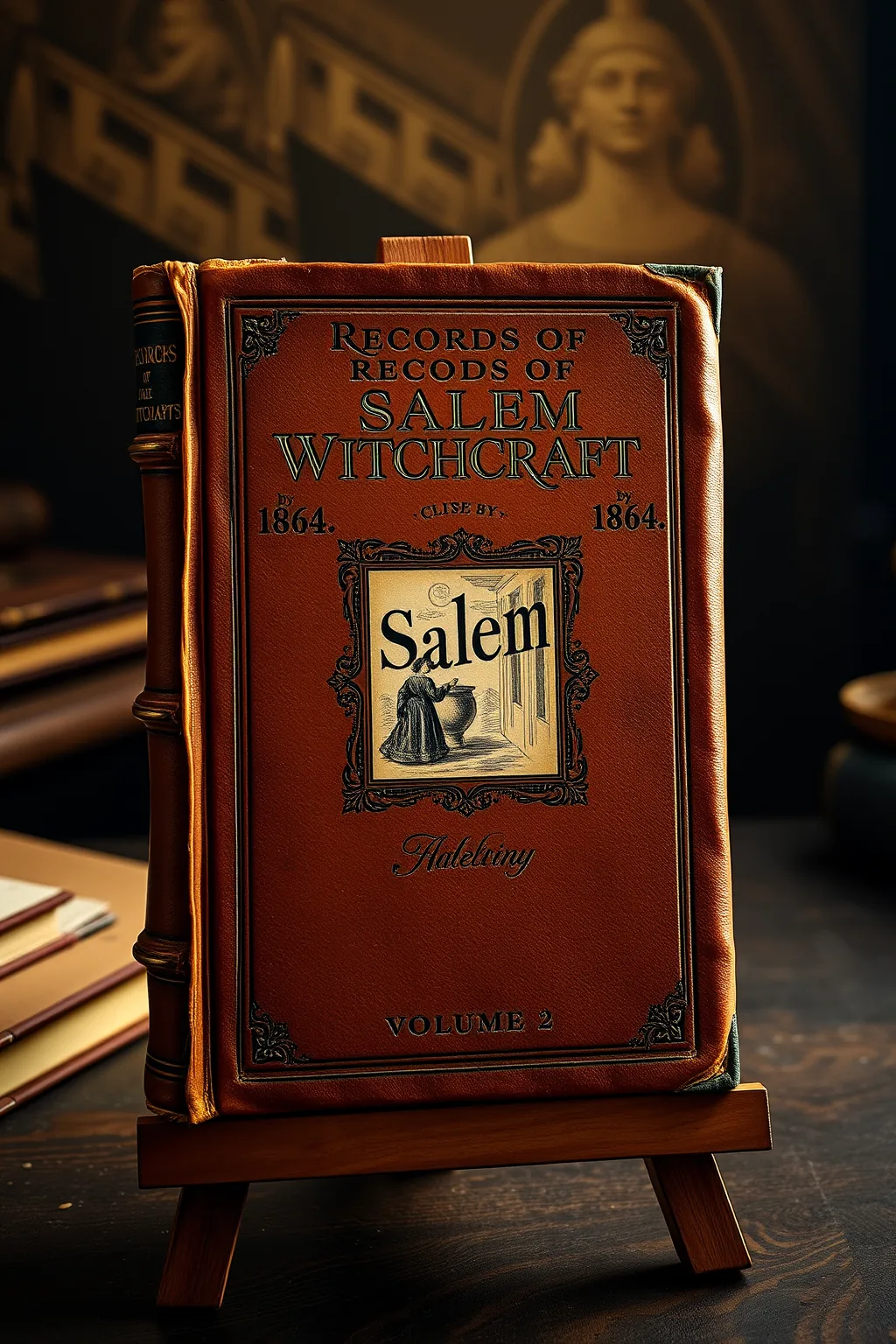
Records of Salem Witchcraft Copied from the Original Documents. 1864: Vol 2
 74
74

Records of Salem Witchcraft Copied from the Original Documents. 1864: Vol 2


Celeste Moreau (Divination & Symbolism Reviewer) — This seminal work, Volume 2 of the 1864 'Records of Salem Witchcraft,' is an indispensable resource for serious students of esotericism and historical occultism. The direct transcription from original documents provides an unparalleled authenticity, revealing the raw anxieties and proto-magical thinking prevalent during the Salem period. It offers profound insights into the communal consciousness and the manipulation of fear as a tool of control, echoing across centuries. For practitioners and scholars alike, these records are a potent lens through which to examine the historical evolution of witchcraft beliefs and the enduring power of shadow narratives. A truly essential piece for any occult library.
📝 Description
74
Volume 2 of 'Records of Salem Witchcraft' was published in 1864, presenting transcribed documents from the 1692 trials.
This 1864 compilation presents transcribed primary source documents related to the Salem witchcraft trials of 1692. It moves beyond the sensational aspects of the legal proceedings to reveal the underlying beliefs and practices prevalent in colonial Massachusetts. Readers will find details on folk magic, communal anxieties, and the spiritual world as understood by the people of that era. The text allows for a close examination of how accusations of witchcraft were formulated and sustained within a specific religious and social context.
These records are valuable for understanding the historical roots of certain esoteric traditions and the persistent human interest in the supernatural. They offer direct access to the language and mindset of a community confronting what it perceived as malevolent forces. The volume serves as a historical artifact, illuminating the complex relationships between religious doctrine, social control, and the fear of the unknown that characterized the period.
This volume contributes to understanding the historical context for Western esoteric traditions, particularly those that emerged from or reacted against Puritanism. The documented beliefs and practices, while framed within a historical legal context, touch upon concepts of unseen forces, spiritual influence, and ritualistic actions. It provides a window into the folk beliefs and anxieties that sometimes form the raw material for later magical and occult interpretations, illustrating how everyday fears and superstitions could be codified and perceived as evidence of supernatural malevolence.
💡 Why Read This Book?
Uncover the unfiltered historical narrative of the Salem Witch Trials, directly from original documents. This volume offers a rare window into the societal fears, religious fervor, and nascent occult beliefs of colonial America. Ideal for scholars, history buffs, and practitioners seeking to understand the roots of Western witchcraft traditions and the psychological underpinnings of persecution. Explore primary source material that illuminates the complex interplay of belief, power, and fear.
⭐ Reader Reviews
Honest opinions from readers who have explored this book.
❓ Frequently Asked Questions
What period does Volume 2 of the Salem Witchcraft Records cover?
Volume 2, like its predecessor, focuses on the primary documentation from the Salem Witch Trials, predominantly the latter stages of the accusations and examinations that took place in 1692 and early 1693, offering crucial insights into the unfolding crisis.
Are these verbatim transcriptions of the original documents?
Yes, this volume is a direct copy of the original documents, ensuring an authentic and unadulterated representation of the testimonies, accusations, and legal proceedings of the era.
Who compiled or published the original 1864 edition?
The original 1864 compilation was undertaken by a group of historians and antiquarians aiming to preserve these critical primary sources, though specific individual compilers are not always prominently credited in this edition.
What is the historical significance of these records?
These records are paramount in understanding the socio-religious climate of colonial Massachusetts, the dynamics of mass hysteria, and the historical trajectory of witchcraft accusations in Western culture, providing invaluable data for historians and occultists.
Is Volume 2 a continuation or a separate collection from Volume 1?
Volume 2 is a direct continuation and essential complement to Volume 1, expanding upon the documented evidence and testimonies, providing a more comprehensive picture of the events and the individuals involved.
🔮 Key Themes & Symbolism
The Anatomy of Fear and Accusation
This volume dissects the insidious tendrils of fear that gripped colonial Salem, revealing how societal anxieties, religious dogma, and personal vendettas converged to create a climate ripe for accusation. It explores the psychological mechanisms behind mass hysteria and the subtle, yet potent, ways accusations could be weaponized. For the esoteric student, it highlights the power of collective consciousness and the dark arts of manipulation that can manifest within a community, offering lessons in spiritual defense and critical discernment.
Folk Magic and Early American Spirituality
Beyond the legal proceedings, these records offer glimpses into the vernacular beliefs and practices that permeated daily life. While often framed as 'witchcraft,' many of these 'crimes' point to the survival of older, nature-based spiritualities and folk remedies. This volume serves as a proof of the enduring human impulse to connect with unseen forces and the ways in which such practices were demonized by dominant religious structures. It invites contemplation on the syncretism of beliefs and the resilience of indigenous and European folk traditions.
The Power of Testimony and Narrative
The core of these records lies in the collected testimonies, confessions, and depositions. This theme explores the construction of narrative in the face of extreme pressure and the lasting impact of spoken and written word. For those interested in ritual and spellcraft, it underscores the power inherent in declaration and the shaping of reality through language. The varied accounts reveal not only what happened but how it was perceived and subsequently recorded, offering a complex set of human experience and the manipulation of truth.
💬 Memorable Quotes
Direct passages from the work, attributed to the author.
“"The Devil doth appear in the shape of a black man."”
— This chilling phrase captures the visual and symbolic manifestations attributed to malevolent forces, reflecting deep-seated fears of the unknown and the embodiment of darkness.
“"She confessed to signing the Devil's book."”
— An important point in many confessions, symbolizing a perceived pact or allegiance with infernal powers, marking a dramatic narrative arc of perceived spiritual transgression.
“"A spectral sight did torment me."”
— Highlights the belief in spectral evidence, where spirits and apparitions were accepted as tangible proof, revealing the blurred lines between psychological experience and perceived supernatural reality.
“"The afflicted cried out that they were pinched."”
— Illustrates the physical manifestations of the 'affliction,' often interpreted as the direct result of a witch's invisible assault, fueling the cycle of accusations and fear.
“"The magistrate asked if she knew the cause of her troubles."”
— This question reveals the judicial approach of seeking a culprit, often pre-supposing supernatural influence and guiding testimonies towards predetermined outcomes.
🌙 Esoteric Significance
Tradition
These records are foundational to understanding the historical manifestation of Western esotericism, particularly its darker aspects and folk traditions. They provide primary source material for the study of demonology, spectral evidence, and the societal beliefs that underpinned early American occultism. The Salem narrative is a case study in the manipulation of spiritual beliefs for social and political control, offering profound lessons for contemporary practitioners of magic and those studying the history of consciousness.
Symbolism
The symbolism within these records is potent and multi-layered. The 'black man' represents the archetypal shadow and demonic adversary. Accusations of 'pinching' and 'tormenting' symbolize the unseen attacks and energetic manipulation attributed to malicious forces. The 'Devil's book' signifies a pact, a renunciation of divine connection, and the perceived surrender of will. The 'spectral evidence' itself embodies the belief in a parallel spiritual realm directly influencing the material world, a concept central to many esoteric traditions.
Modern Relevance
The Salem records remain remarkably relevant, offering insights into the enduring power of fear, prejudice, and scapegoating. They serve as a stark reminder of how easily societal anxieties can be channeled into persecution, a phenomenon still observable today. For esoteric practitioners, these documents illuminate the historical roots of witchcraft accusations and the societal forces that have sought to suppress spiritual knowledge. Understanding this history provides context for modern pagan and witchcraft movements and underscores the importance of critical thinking and spiritual discernment.
👥 Who Should Read This Book
This volume is essential for historians specializing in colonial America, religious studies scholars, and researchers of early modern European and American witchcraft. It is highly recommended for practitioners of modern witchcraft and paganism seeking to understand the historical context and evolution of their traditions. Students of folklore, sociology, and psychology will find invaluable case studies on mass hysteria and belief formation. Esoteric seekers interested in the darker aspects of spiritual history, demonology, and the power of narrative will find this an outstanding primary source. Beginners in occult studies may find it dense but rewarding with careful study.
📜 Historical Context
Published in 1864, this volume emerged during a period of heightened interest in American colonial history and the burgeoning field of antiquarianism. The mid-19th century saw a rise in nationalism and a desire to understand the nation's foundational narratives. The Salem Witch Trials, a dark but important event, became a subject of intense scrutiny, with scholars and collectors aiming to preserve original documents that might otherwise be lost. This era's approach to history was often characterized by a meticulous, if sometimes romanticized, effort to reconstruct the past through primary sources. The compilation of these records reflects a growing awareness of the importance of unfiltered accounts in understanding historical phenomena, including the complex interplay of religious fervor, social anxieties, and legal proceedings that defined the witch hysteria.
📔 Journal Prompts
Reflect on a time you or your community experienced widespread fear or suspicion. How did it manifest, and what were the consequences?
Consider the role of 'spectral evidence' in the Salem trials. How does this concept of non-physical evidence compare to modern forms of belief and proof?
Analyze the motivations behind the accusations. Were they purely religious, or were other societal factors at play?
Imagine you are a magistrate in Salem in 1692. How would you approach the testimonies presented in these records, given the prevailing beliefs of the time?
How do the themes of accusation and persecution in the Salem Witch Trials resonate with contemporary social or political issues?
🗂️ Glossary
Afflicted
Individuals, typically young women and girls, who claimed to be tormented and physically attacked by accused witches, often exhibiting fits and convulsions.
Spectral Evidence
Testimony about visions or apparitions, where the accused's spirit was believed to be tormenting the victim. This was a highly controversial form of evidence in the trials.
Confession
A statement made by an accused person admitting guilt, often extracted under duress, torture, or the promise of leniency. These were crucial for conviction.
Deposition
A formal, written statement of testimony given by a witness, usually taken before a magistrate, forming part of the legal record.
Magistrate
A civil officer or judge who has the authority to administer and enforce the law, responsible for conducting examinations and trials during the Salem Witch Trials.
This book appears in 2 collections
🔮 Readers Also Liked
Browse all →







From the “Witchcraft” Collection
View all →



More Free Witchcraft & Paganism Books
View all →