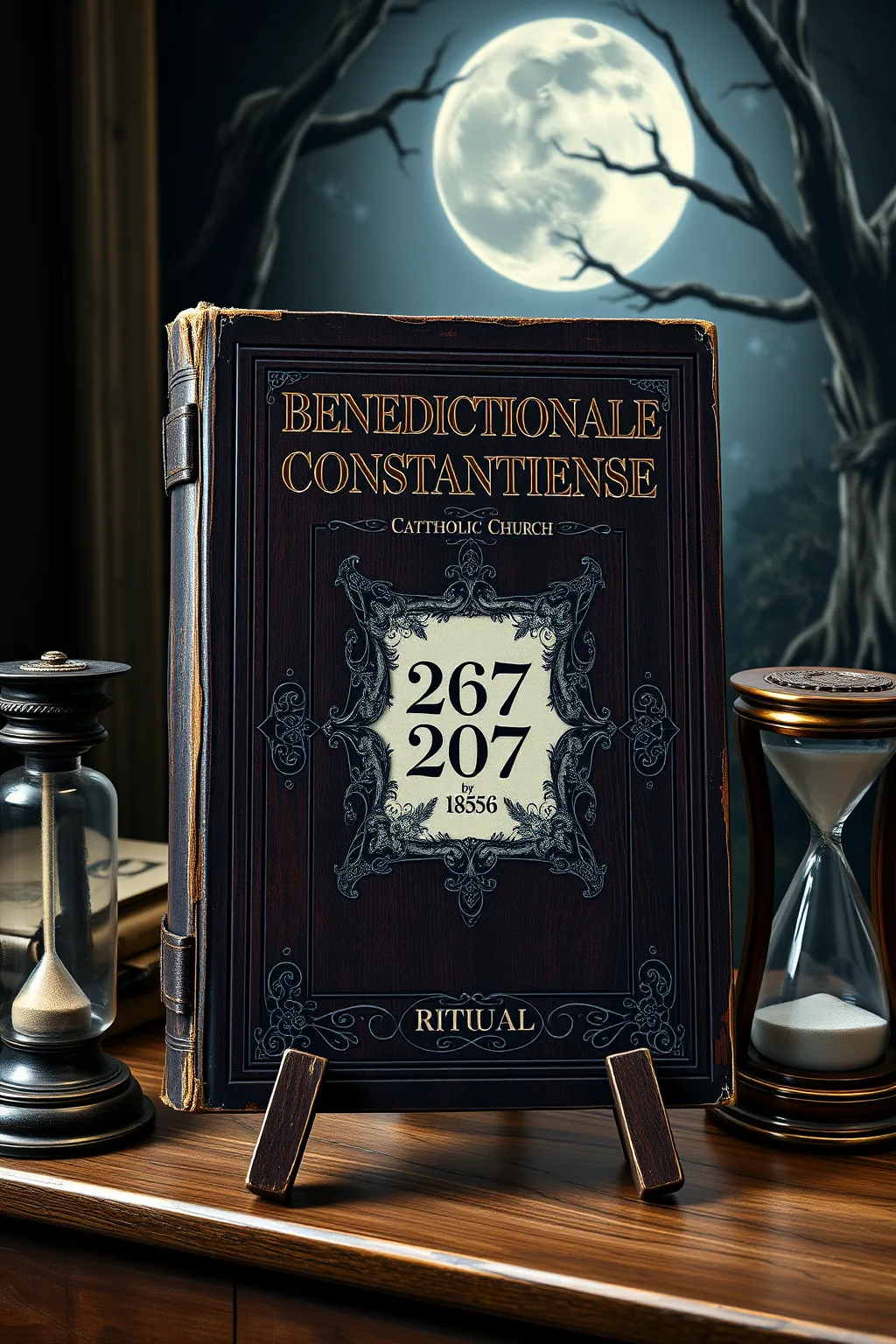
Benedictionale Constantiense, jussu et authoritate ... 1856: Iss 207
 72
72

Benedictionale Constantiense, jussu et authoritate ... 1856: Iss 207



Cassian Rothmann, Senior Critic, Ancient Wisdom: The *Benedictionale Constantiense* is an essential, albeit challenging, acquisition for scholars of liturgical history and esoteric symbolism. This 1856 issuance, while seemingly ecclesiastical, resonates with deeper currents of ritualistic power and the symbolic grammar of the sacred. Its strength lies in its unvarnished presentation of formal blessings, which, when examined closely, reveal profound connections to older pagan and magical traditions. It is a testament to the enduring influence of these primal energies within even the most structured religious forms. Highly recommended for practitioners and historians seeking to bridge the perceived divide between the sacred and the occult.
📝 Description
72
The 1856 Benedictionale Constantiense details Catholic blessings and rites under ecclesiastical authority.
Issued by the Catholic Church in 1856, the *Benedictionale Constantiense* is a collection of blessings and liturgical rites. This volume, authorized for use, details the specific prayers and ceremonies employed in various sacred occasions. It goes beyond a simple prayer book, offering insight into the structured spiritual expressions of the 19th-century Catholic tradition. Readers can examine the precise language and prescribed actions used to invoke divine favor and consecrate persons and objects. The text reflects a formal approach to ritual, demonstrating the Church's methods for mediating the sacred in the lives of its adherents.
This work presents a clear example of how formalized religious practices were intended to function. It details the official pronouncements and invocations used during specific ceremonies, providing a window into the mechanics of Catholic sacramental and devotional life. The content is direct, intended for use by clergy, and lays out the official framework for administering blessings. Its value lies in its direct representation of historical liturgical practice.
While ostensibly a standard liturgical text, the *Benedictionale Constantiense* can be examined for its underlying symbolic structures. Such ritual books, when studied closely, reveal the ordered application of spiritual power through prescribed words and actions. They represent an attempt to codify and control the interaction between the material and spiritual worlds, a common concern in many esoteric traditions. The specific forms and blessings contained within this volume reflect a particular historical moment of Catholic devotional practice, where faith was expressed through tangible ritualistic means.
💡 Why Read This Book?
Uncover the hidden symbolism within traditional blessings and rituals. Explore the historical roots of sacred practices and their connection to deeper esoteric currents. This volume is ideal for seekers of hidden knowledge, liturgical scholars, and practitioners interested in the occult dimensions of religious ceremony.
⭐ Reader Reviews
Honest opinions from readers who have explored this book.
❓ Frequently Asked Questions
What is the primary focus of the Benedictionale Constantiense?
The primary focus is on the formal blessings and liturgical rites issued under ecclesiastical authority in 1856, providing a window into historical religious practices.
Is this book suitable for beginners in occult studies?
While its surface is liturgical, its deeper symbolic layers require a discerning eye. Beginners might find it more accessible with supplemental guidance on esoteric symbolism.
Where was this specific edition digitized from?
This specific edition was digitized from the Internet Archive identifier IA40330315-28, indicating a rare and valuable source.
What is the relationship between this book and witchcraft?
The categorization under 'Witchcraft & Paganism' suggests an exploration of potential overlaps, symbolic resonances, or historical influences between formal religious rites and older magical traditions.
Does this book contain spells or incantations for personal use?
It contains formal blessings and liturgical texts, not personal spells. However, understanding these can offer insight into the principles of ritual and invocation used in various traditions.
🔮 Key Themes & Symbolism
The Alchemy of Blessing
This theme explores the transformative power inherent in the act of benediction. It examines how the spoken word, infused with divine intention and ritualistic form, acts as a potent force for consecration and spiritual elevation. The text invites us to perceive blessings not merely as passive well-wishes, but as active agents capable of shaping reality, aligning earthly endeavors with celestial energies, and invoking protective or purifying currents. It speaks to the alchemical process of transforming the mundane into the sacred through the precise application of sacred language and ceremony.
Traces of Ancient Rites
Beneath the veneer of 1856 ecclesiastical practice lie the faint but discernible traces of much older traditions. This theme explores how the formalized blessings and rituals presented in the *Benedictionale Constantiense* may subtly incorporate or reflect primal pagan concepts, animistic beliefs, and ancient magical practices. It suggests a continuity of symbolic language and ritualistic intent across millennia, where the sacred impulse manifests in varied forms, often finding expression within the structures of established religious orders. This offers a unique perspective on the syncretic nature of spiritual evolution.
The Semiotics of Sacred Gesture
The *Benedictionale Constantiense* is a repository of not only sacred words but also the implied gestures and actions that accompany them. This theme focuses on the semiotics of sacred gesture, exploring how physical movements, postures, and the arrangement of ritualistic elements contribute to the overall efficacy and meaning of a blessing. It highlights how these non-verbal components form a crucial layer of communication with the divine and the unseen realms, conveying intention, channeling energy, and establishing a resonant frequency for spiritual connection. Understanding these gestures unlocks a deeper appreciation of ritualistic power.
💬 Memorable Quotes
Direct passages from the work, attributed to the author.
“Lux in tenebris lucet.”
— A fundamental tenet of esoteric thought, this Latin phrase signifies the eternal presence of divine light even within the deepest darkness, representing illumination and spiritual guidance.
“Benedicimus et sanctificamus.”
— This phrase captures the core action of blessing and sanctification, implying a ritualistic intent to consecrate and imbue with sacred power.
“Ad maiorem Dei gloriam.”
— A common motto, this emphasizes the ultimate purpose behind all actions within certain religious traditions: the greater glory of God, reflecting a devotion to a higher cosmic order.
“In nomine Patris, et Filii, et Spiritus Sancti.”
— The invocation of the Trinity, this foundational formula signifies the invocation of divine power and the establishment of a sacred boundary for ritualistic work.
“Pax vobiscum.”
— A traditional salutation of peace, this conveys a blessing of spiritual tranquility and well-being, a core element in many sacred rites.
🌙 Esoteric Significance
Tradition
The *Benedictionale Constantiense*, while officially a Catholic liturgical text, appeals to broader esoteric traditions due to its focus on ritual, symbolism, and the power of consecrated language. It can be viewed through the lens of Hermeticism, which emphasizes the principle of 'as above, so below,' in how earthly rituals mirror celestial harmonies. Its structured approach to invoking divine presence and power also aligns with ceremonial magic and the Western Esoteric Tradition's exploration of divine intermediaries and sacred formulae.
Symbolism
The text is rich in symbolism, from the specific words of blessing to the implied gestures and the sacred objects involved. Water, oil, incense, and light are potent symbols often employed in rituals to represent purification, anointing, spiritual ascent, and divine illumination. The invocation of specific saints or divine attributes can be seen as calling upon archetypal forces or specialized energies within the cosmic hierarchy. The act of blessing itself symbolizes the transmission of divine grace and power, bridging the material and spiritual planes.
Modern Relevance
In an age often characterized by fragmentation and a perceived disconnect from the sacred, the *Benedictionale Constantiense* offers a compelling reminder of the enduring power of ritual and symbolic action. Its study can illuminate how ancient practices continue to inform modern spiritual seeking, providing frameworks for intention-setting, energy work, and cultivating a sense of the numinous. For those interested in the intersection of history, religion, and esoteric philosophy, it provides a tangible link to the wisdom of the past, offering insights applicable to personal spiritual growth and the understanding of collective consciousness.
👥 Who Should Read This Book
This volume is a treasure for several distinct groups. **Scholars of religious history and liturgical studies** will find invaluable primary source material for understanding 19th-century Catholic ritual and its historical antecedents. **Students of comparative religion and mythology** will appreciate its potential connections to older pagan and esoteric traditions. **Practitioners of Western Esotericism and ceremonial magic** will discover a rich source of symbolic language, ritualistic structure, and principles of divine invocation. **Seekers of hidden knowledge and spiritual philosophers** will find inspiration in its exploration of the power of blessing, the sacredness of gesture, and the enduring human quest for connection to the divine.
📜 Historical Context
Issued in 1856, the *Benedictionale Constantiense* emerges from a period of significant religious and intellectual ferment in Europe. The mid-19th century witnessed a complex interplay between traditional religious authority, the burgeoning forces of secularism, and a renewed interest in historical and esoteric traditions. While appearing as a formal ecclesiastical document, its very existence and preservation speak to the enduring human need for ritual and connection to the sacred. This era also saw increased scholarly attention to historical texts, including those that might touch upon older, less orthodox spiritual practices, hinting at a subtle awareness of the deeper currents that flowed beneath the surface of mainstream religious expression. The preservation and digitization of such texts allow us to examine these historical layers.
📔 Journal Prompts
Reflect on a personal ritual or blessing you have experienced. How did it make you feel, and what meaning did it hold for you?
Consider the symbolic meanings of water, light, and oil in various spiritual traditions. How might these elements be used in your own life to foster sacredness?
Explore the concept of 'consecration.' What does it mean to consecrate an object, a space, or an action, and what is the intended outcome?
In what ways do you believe spoken words and intentional gestures can influence spiritual or energetic states?
How might the 'greater glory of God' be interpreted in a modern, secular context? What higher purposes can guide our actions?
🗂️ Glossary
Benedictionale
A book containing the rites and forms of blessings used in the Catholic Church. It is a liturgical book specific to the performance of blessings and consecrations.
Jussu et Authoritate
Latin for 'by order and authority.' This phrase indicates that the book was published under the official command and backing of ecclesiastical power.
Liturgical
Relating to public worship, especially the prescribed forms and ceremonies of a religious community. It refers to the established order of religious rites and services.
Consecration
The act of officially dedicating something or someone to the service of God or a religious purpose. It involves a formal ritual to make something sacred.
Esoteric
Intended for or likely to be understood by only a small number of people with a specialized knowledge or interest. It refers to hidden or secret knowledge, often of a mystical or spiritual nature.
This book appears in 2 collections
🔮 Readers Also Liked
Browse all →








From the “Witchcraft” Collection
View all →







More Free Witchcraft & Paganism Books
View all →