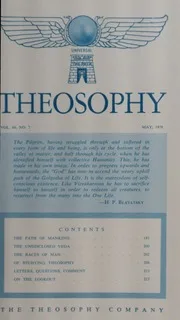
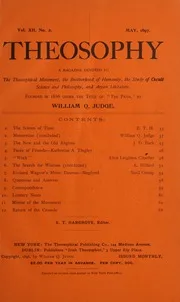
Theosophy Vol-63,No-7,May 1975

 79
79

Theosophy Vol-63,No-7,May 1975


Review by Alaric Kestrel (Metaphysical Studies Reviewer) — This issue of 'Theosophy' from May 1975 stands as a testament to enduring esoteric scholarship. It offers a rich discourse on the timeless principles of Theosophy, presenting complex metaphysical concepts with clarity and depth. The articles delve into arcane symbolism and the subtle architecture of consciousness, providing invaluable insights for those on the path of spiritual evolution. Its strength lies in its ability to bridge ancient wisdom with contemporary understanding, making it essential reading for serious students and practitioners of occult philosophy seeking to expand their gnosis.
📝 Description
79
The May 1975 issue of Theosophy Vol-63, No-7, examines the language of symbolism.
This issue of Theosophy, published in May 1975, presents articles that consider symbolism as a form of communication for the soul. It suggests that symbols reveal how all things are connected. The collection aims to guide readers toward understanding subtle levels of consciousness and the universal principles that shape existence.
Readers will find discussions intended for those seriously interested in spiritual study and practice. The content seeks to connect with enduring truths, offering a path to greater self-awareness and a clearer perception of humanity's role in the cosmos. The articles encourage a look into the hidden aspects of perception, with the goal of expanding the mind and stimulating spiritual insight.
This publication belongs to the Theosophical tradition, which emerged in the late 19th century. Theosophy sought to synthesize Eastern and Western esoteric philosophies, drawing on Hinduism, Buddhism, Hermeticism, and Kabbalah. Key figures like Helena Blavatsky established its core tenets, focusing on universal brotherhood, comparative religion, and the study of latent human powers and the divine in nature. This journal issue likely reflects ongoing discussions within that movement regarding spiritual principles and the nature of reality.
💡 Why Read This Book?
Uncover forgotten wisdom and explore the profound depths of consciousness. This issue offers a unique glimpse into the core tenets of Theosophy, illuminating the path for spiritual seekers, academic scholars of esotericism, and practitioners dedicated to inner transformation. Engage with timeless philosophies that resonate with the soul's deepest aspirations.
⭐ Reader Reviews
Honest opinions from readers who have explored this book.
❓ Frequently Asked Questions
What is Theosophy?
Theosophy, derived from Greek words meaning 'divine wisdom,' is a spiritual philosophy that seeks to understand the underlying unity of all religions, philosophies, and sciences, and to reveal the laws governing the universe and humanity's place within it.
Who was H.P. Blavatsky?
Helena Petrovna Blavatsky was a Russian occultist and spiritual teacher who co-founded the Theosophical Society. She is considered a pivotal figure in modern Western esotericism, authoring influential works like 'The Secret Doctrine'.
What is the significance of the date May 1975?
The date indicates the specific publication period of this issue, placing its content within a particular historical context of Theosophical discourse and its reception during that era.
Are the authors known?
While the specific authors of each article within this issue may not be individually credited in this format, the content reflects the collective knowledge and ongoing dialogue within the Theosophical movement.
Is this journal suitable for beginners?
Yes, while it delves into profound subjects, this issue provides foundational concepts and accessible explanations suitable for newcomers to Theosophy, alongside deeper insights for experienced practitioners.
🔮 Key Themes & Symbolism
The Seven Planes of Consciousness
This theme explores the hierarchical structure of consciousness as understood within Theosophical teachings. It posits that existence operates across multiple subtle and gross planes, from the purely spiritual to the physical. Understanding these planes is crucial for comprehending the journey of the soul, the nature of reincarnation, and the process of spiritual evolution. The articles likely examine the characteristics and inhabitants of each plane, offering a map for reading through the inner cosmos and the subtle energies that permeate reality.
Symbolism in Esoteric Traditions
The issue likely dissects the profound symbolic language that underpins ancient wisdom traditions. From archetypal images to geometric forms and alchemical metaphors, symbolism serves as a direct conduit to higher truths, bypassing the limitations of rational intellect. This theme emphasizes how symbols are not arbitrary signs but living keys that unlock hidden meanings, revealing cosmic laws and the interconnectedness of the macrocosm and microcosm. It's an exploration of how the universe communicates its secrets through a universal symbolic grammar.
The Path of Discipleship
Central to many esoteric paths, the concept of discipleship is likely examined in depth. This theme addresses the rigorous training, ethical development, and inner transformation required to progress on the spiritual path under the guidance of enlightened teachers. It highlights the qualities of the aspiring disciple—dedication, selflessness, and intellectual honesty—and the role of karmic law in shaping one's journey. The articles may offer practical guidance and philosophical reflections on what it means to consciously participate in one's own spiritual evolution.
💬 Memorable Quotes
Direct passages from the work, attributed to the author.
“The universe is a thought in the mind of God.”
— This profound statement suggests a holographic or consciousness-based reality, implying that all existence originates from a supreme, divine consciousness.
“True knowledge begins where the senses end.”
— This highlights the limitations of empirical perception and points towards intuitive, spiritual, or psychic faculties as the gateways to higher, esoteric understanding.
“Karma is the unseen hand of justice.”
— This conveys the immutable law of cause and effect, suggesting that every action has a consequence, shaping future experiences and destinies with perfect, impartial equity.
“The veil of Maya conceals ultimate reality.”
— This refers to the illusionary nature of the material world, suggesting that our ordinary perception is a veil that obscures the true, spiritual nature of existence.
💡 Key Ideas
Editorial paraphrase of the work's core concepts — not direct quotes.
The microcosm reflects the macrocosm.
A fundamental esoteric principle, this quote emphasizes the interconnectedness of humanity (microcosm) with the universe (macrocosm), suggesting that understanding oneself leads to understanding the universe.
🌙 Esoteric Significance
Tradition
This journal issue is deeply rooted in the Theosophical tradition, founded by Helena Blavatsky. It draws upon a synthesis of Eastern (particularly Vedic and Buddhist) and Western esoteric philosophies, including Neoplatonism and Hermeticism. Theosophy aims to uncover the universal, underlying truths behind all religions and philosophies, presenting a comprehensive system of cosmology, anthropology, and soteriology.
Symbolism
The issue is rich with esoteric symbolism, likely featuring discussions on archetypal imagery, sacred geometry, and allegorical narratives. These symbols act as keys to understanding the deeper, non-literal meanings of existence, from the structure of the cosmos to the evolution of consciousness. They are seen as a universal language that bypasses intellectual barriers, directly communicating profound spiritual realities and the interconnectedness of all things.
Modern Relevance
In an age often characterized by fragmentation and a search for meaning, the timeless principles of Theosophy offer profound relevance. Its teachings on universal brotherhood, the interconnectedness of life, and the inherent divinity within each individual provide a framework for ethical living, personal growth, and global harmony. The exploration of consciousness and subtle energies continues to inform modern discussions in psychology, physics, and spirituality.
👥 Who Should Read This Book
This issue is an invaluable resource for dedicated spiritual seekers yearning for a deeper understanding of life's mysteries. Scholars of comparative religion and esoteric traditions will find rich material for academic study. Practitioners of meditation, yoga, and other contemplative disciplines will discover philosophical underpinnings and expanded perspectives on their practice. For those new to Theosophy, it offers an accessible yet profound introduction to its core tenets, while seasoned students will find renewed insights and confirmation of their path.
📜 Historical Context
Published in May 1975, this issue of 'Theosophy' emerges from a period of significant global upheaval and evolving consciousness. The late 20th century witnessed a burgeoning interest in Eastern philosophies, mysticism, and alternative spiritualities, a response to the perceived materialism of the West. Theosophy, with its emphasis on ancient wisdom, universal brotherhood, and the latent potential of humanity, resonated deeply with those seeking meaning beyond conventional structures. This era saw continued scholarly exploration and practical application of Theosophical ideas, influencing New Age movements and fostering a global dialogue on spiritual evolution and cosmic principles. The journal reflects the ongoing discourse and dissemination of these profound teachings.
📔 Journal Prompts
Reflect on a moment you felt a deep connection to something larger than yourself. How might this connect to the concept of universal consciousness?
What personal symbols resonate with you, and what hidden meanings might they hold in your life's journey?
Consider the 'karma' in your life. How have past actions shaped your present circumstances, and how might your current actions influence your future?
In what ways does the 'veil of Maya' affect your daily perception of reality, and what steps can you take to perceive beyond it?
How can the principle of 'microcosm reflecting macrocosm' guide your self-understanding and your relationship with the external world?
🗂️ Glossary
Theosophy
A spiritual philosophy seeking to understand the underlying unity of all religions, philosophies, and sciences, and to reveal the laws governing the universe and humanity's place within it.
Esotericism
Beliefs and practices related to hidden or secret knowledge, often concerning spiritual or mystical truths accessible only to initiates or those with specific understanding.
Macrocosm
The universe considered as a great whole, often contrasted with the microcosm, representing humanity or a smaller system.
Microcosm
The human being or a smaller system considered as a miniature representation of the universe or a larger system.
Maya
In Eastern philosophies, particularly Hinduism and Buddhism, Maya refers to the illusionary nature of the material world and the phenomenal universe, which conceals ultimate reality.
This book appears in 2 collections
🔮 Readers Also Liked
Browse all →




From the “Theosophy” Collection
View all →






More Free Theosophy & Anthroposophy Books
View all →