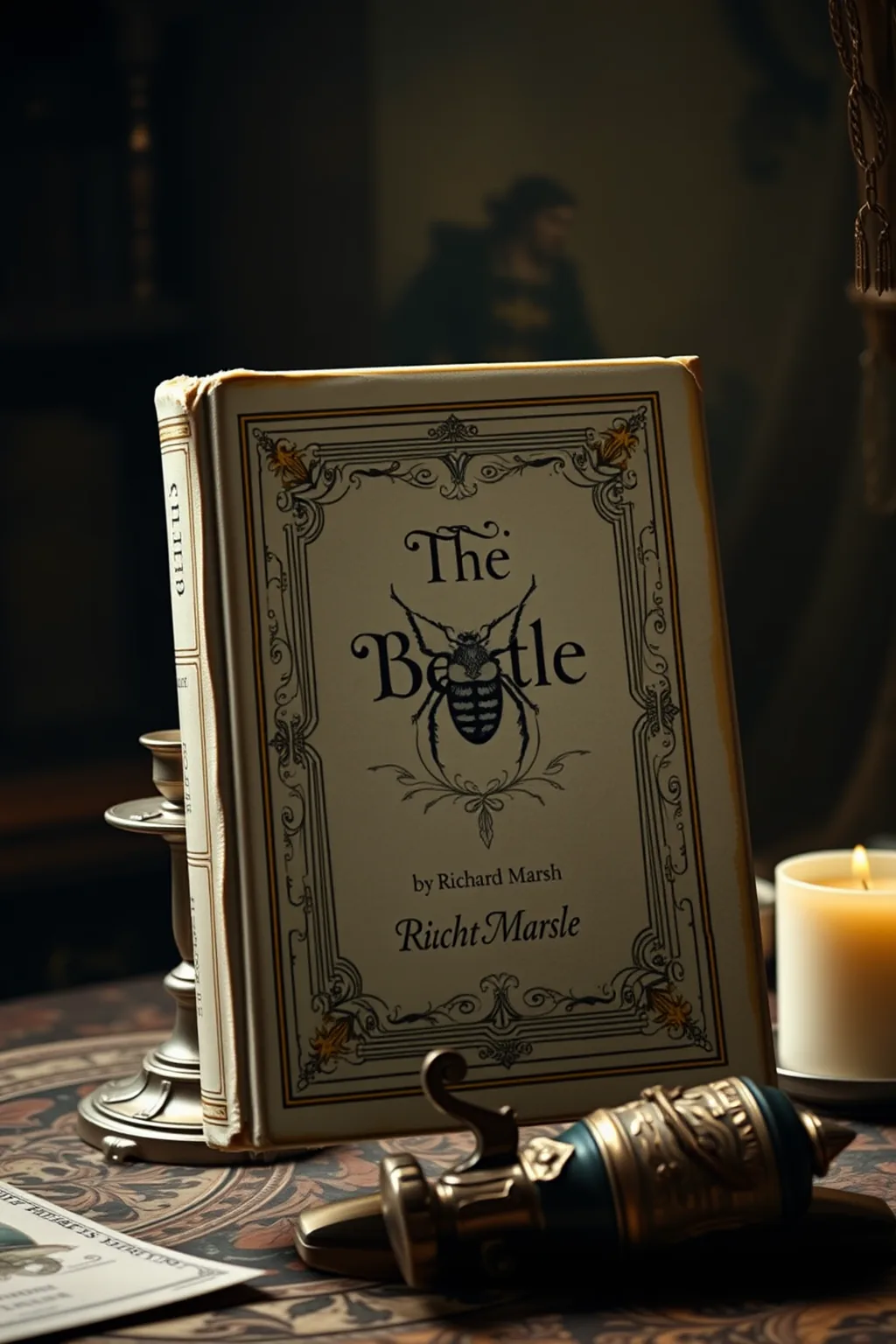
The Beetle
 79
79

The Beetle


Sophia Crane (Associate Editor) — 'The Beetle' stands as a formidable pillar of esoteric horror, a novel whose chilling impact resonates far beyond its sensationalist surface. Richard Marsh crafts a narrative steeped in the occult atmosphere of late Victorian England, subtly exploring themes of possession, transformation, and the fragile boundaries of human identity. The titular entity functions as a potent symbol of ancient, chthonic powers, a force that corrupts and subsumes. This work is essential for readers drawn to the psychological depths of supernatural fiction and those interested in early explorations of existential dread and the occult's shadowy influence. A truly unsettling masterpiece.
📝 Description
79
Richard Marsh's 'The Beetle' was published in 1897, a supernatural horror novel that rivaled Dracula in popularity.
Published in 1897, Richard Marsh's 'The Beetle' is a supernatural horror novel that gained significant attention in its time. It tells the story of an ancient, unknowable entity that disrupts the lives of its human characters. The narrative unfolds in late Victorian London, a setting that reflects the era's societal and spiritual anxieties. Marsh uses the titular creature to explore themes of identity, the fragility of perceived reality, and the darker aspects of the human subconscious.
The novel moves beyond simple ghost stories, incorporating elements of psychological dread and metaphysical unease. The presence of the enigmatic beetle serves as a catalyst, unraveling the characters' sanity and the social order around them. It is a descent into hidden desires and primal fears, which coalesce into a monstrous form. Marsh crafts a chilling experience for readers interested in the unsettling spaces between the known world and the alien.
Marsh's 'The Beetle' taps into fin-de-siècle occult fascinations with forces beyond human comprehension. The novel reflects an era where spiritualism and theosophy were gaining traction, questioning established religious and scientific paradigms. The entity's unknowable nature and its ability to disrupt human consciousness align with esoteric interests in the subconscious mind and its connection to unseen powers. It mirrors a growing unease with the limits of rationalism and a curiosity about hidden dimensions of existence.
✍️ Author
Richard Marsh
Richard Marsh (12 October 1857 – 9 August 1915) was the pseudonym of the English author born Richard Bernard Heldmann. A best-selling and prolific author of the late 19th century and the Edwardian period, Marsh is best known now for his supernatural thrille…
💡 Why Read This Book?
Immerse yourself in a forgotten masterpiece of Gothic horror that rivals 'Dracula' in its chilling power. 'The Beetle' offers a unique exploration of transformation, possession, and the unsettling nature of identity. Ideal for seekers of esoteric lore, scholars of Victorian literature, and practitioners interested in ancient, primal forces depicted through masterful storytelling. Discover a narrative that probes the deepest fears of the human psyche.
⭐ Reader Reviews
Honest opinions from readers who have explored this book.
❓ Frequently Asked Questions
What makes 'The Beetle' a unique supernatural horror novel?
'The Beetle' transcends typical ghost stories by delving into profound psychological horror, exploring themes of identity dissolution, ancient curses, and the unsettling power of an unknown, possibly primordial entity, creating a unique blend of mystery and metaphysical dread.
Who is the mysterious 'Beetle' in the novel?
The 'Beetle' is an enigmatic, shapeshifting entity of immense power, embodying ancient, possibly demonic forces. Its true nature remains shrouded in mystery, representing a primal, corrupting influence that challenges the very essence of human existence and societal order.
What historical anxieties does 'The Beetle' reflect?
Published in 1897, the novel captures the fin-de-siècle anxieties of its era, including fears of degeneration, the occult's resurgence, the perceived breakdown of societal norms, and a growing fascination with the unknown and the hidden forces that might govern human destiny.
How does the novel explore the concept of identity?
Marsh uses the supernatural threat to explore the fragility of identity, suggesting that the self is not immutable. The Beetle's ability to transform and possess characters symbolizes the potential for external forces to fundamentally alter or erase one's sense of self, echoing deeper philosophical questions about consciousness and being.
Is 'The Beetle' suitable for modern readers interested in occult themes?
Absolutely. The novel's exploration of ancient powers, possession, and the psychological impact of the unknown offers a rich, atmospheric experience that remains relevant for modern readers fascinated by the occult, dark fantasy, and the enduring mysteries of the human psyche.
🔮 Key Themes & Symbolism
The Unraveling of Identity
Marsh masterfully dissects the concept of identity, portraying it not as a fixed entity but as a fragile construct susceptible to external corruption and internal dissolution. The Beetle serves as a potent catalyst for this unraveling, embodying forces that can fundamentally alter or erase one's sense of self. This theme resonates deeply with existentialist inquiries into the nature of consciousness, the self, and the terrifying possibility of becoming something utterly alien to one's own being, a core concern for those exploring the metaphysical breakdown of the individual.
Primal and Ancient Powers
At its heart, 'The Beetle' grapples with the concept of ancient, perhaps chthonic, powers that lie dormant beneath the veneer of modern civilization. The titular entity is less a conventional monster and more a manifestation of primordial forces, a conduit for malevolent energies that predate human understanding. For practitioners and scholars of the esoteric, this theme offers a compelling narrative exploration of the 'other' – the vast, unknowable domains of existence that can encroach upon and disrupt the mundane, hinting at forgotten cosmologies and the persistent allure of primal magic.
Fin-de-Siècle Anxieties and the Occult
Richard Marsh's masterpiece is inextricably linked to the cultural zeitgeist of the late 19th century, a period rife with spiritual doubt, societal upheaval, and a fervent fascination with the occult. 'The Beetle' acts as a dark mirror, reflecting anxieties about degeneration, the erosion of traditional morality, and the burgeoning interest in spiritualism and esoteric philosophies. For those examining the history of occultism and its influence on literature, this novel provides invaluable insight into how these concerns were translated into potent, enduring tales of supernatural dread.
💬 Memorable Quotes
Direct passages from the work, attributed to the author.
“It is a most peculiar thing, the beetle.”
— This deceptively simple observation hints at the profound, otherworldly nature of the entity, suggesting it represents something far beyond ordinary comprehension or experience.
“The very air seemed to grow thick and heavy, charged with an unseen menace.”
— Evokes the palpable atmosphere of dread and the encroaching supernatural, illustrating how the presence of the unknown can physically manifest and oppress.
“He felt as though his very soul were being sifted.”
— A powerful metaphor for psychological violation and spiritual scrutiny, suggesting an invasive force that penetrates the deepest layers of one's being.
“The transformation was not merely physical, but spiritual.”
— Highlights the novel's exploration of profound change, indicating that the entity's influence extends beyond the corporeal to corrupt the very essence of a person's soul.
“There are doors in the mind that should remain forever shut.”
— A cautionary aphorism about the dangers of forbidden knowledge and the exploration of the subconscious, warning of the irreversible consequences of confronting hidden truths.
🌙 Esoteric Significance
Tradition
While not explicitly tied to a single codified esoteric tradition, 'The Beetle' draws heavily from Gnostic themes of primal evil, the corruption of the material world, and the struggle against an unknowable, potentially demiurgic force. It also echoes ancient Egyptian mythology, particularly concerning transformations and entities associated with the underworld or primal chaos. The novel's exploration of possession and the dissolution of the self aligns with broader occult concepts of psychic intrusion and the dangers of uncontrolled spiritual energies.
Symbolism
The Beetle itself is a potent symbol, representing ancient, perhaps pre-human, forces of chaos and corruption. Its shapeshifting nature signifies the mutable nature of reality and identity, while its ability to possess others symbolizes the invasive power of malevolent influences or deeply repressed desires. The novel's London setting, a hub of modern civilization, becomes a stage for this ancient evil, highlighting the fragility of societal order and the ever-present potential for the primal to reassert itself. The intricate plot and shifting perspectives further symbolize the labyrinthine nature of truth and the difficulty of discerning reality from illusion.
Modern Relevance
In an age still grappling with existential anxieties, the dissolution of identity in the digital sphere, and the persistent allure of the unknown, 'The Beetle' retains its potent relevance. Its exploration of psychological horror, the corrupting influence of external forces, and the fundamental questions of what constitutes the self speaks to contemporary concerns. For those interested in the ongoing dialogue between literature and esoteric thought, the novel serves as a vital piece, demonstrating how ancient fears and occult fascinations continue to shape our understanding of the human condition and the universe's hidden dimensions.
👥 Who Should Read This Book
This chilling narrative is a must-read for aficionados of classic Gothic horror seeking a deeper, more psychologically resonant experience than typical ghost stories. Scholars of Victorian literature will find a rich text for examining fin-de-siècle anxieties and the occult's influence on popular culture. Esoteric practitioners and seekers of forbidden knowledge will appreciate the novel's potent symbolism of primal forces, possession, and the breakdown of identity, offering a unique literary lens through which to explore these themes. Beginners to the genre will be drawn into a compelling mystery that gradually unfolds into profound metaphysical dread.
📜 Historical Context
Richard Marsh's 'The Beetle,' published in 1897, emerged from the fertile ground of late Victorian England, a society grappling with rapid industrialization, shifting social hierarchies, and a profound spiritual malaise. The era witnessed a resurgence of interest in spiritualism, the occult, and ancient mythologies, fueled by archaeological discoveries and a general questioning of established scientific and religious doctrines. This fin-de-siècle period was marked by a pervasive sense of unease, a feeling that established certainties were crumbling, and that hidden, perhaps terrifying, forces were at play beneath the surface of respectable society. 'The Beetle' perfectly expresses this atmosphere, blending elements of Gothic horror, mystery, and psychological suspense to reflect anxieties about degeneration, the fluidity of identity, and the encroaching darkness of the unknown. Its immense popularity at the time underscores the public's appetite for narratives that explored these deep-seated fears and esoteric curiosities.
📔 Journal Prompts
Consider the nature of 'The Beetle' as a symbol. What primal fears or societal anxieties does it represent in the context of the late Victorian era, and how do these resonate today?
The novel explores the fragility of identity. Reflect on a time when your sense of self felt challenged or threatened. What internal or external factors contributed to this feeling?
Marsh creates a palpable atmosphere of dread. Describe a place or experience that evoked a similar sense of unseen menace or overwhelming presence for you. What elements contributed to this atmosphere?
The concept of possession, both literal and metaphorical, is central to the story. How can external influences or internal obsessions 'possess' an individual in modern life?
If 'The Beetle' represents a force that unravels the mundane, what 'doors in the mind' might be dangerous for individuals or societies to open in the 21st century?
🗂️ Glossary
Fin-de-siècle
A French term meaning 'end of the century,' referring to the cultural, artistic, and intellectual climate of the late 19th century, characterized by decadence, anxiety, and a fascination with the occult and social change.
Gothic Thriller
A genre of fiction that combines elements of Gothic horror, mystery, and suspense, often featuring dark, atmospheric settings, supernatural elements, and psychological tension.
Chthonic
Relating to the underworld or the earth, often referring to ancient, primal deities or forces associated with the subterranean realm and fertility, but also with death and decay.
Metaphysical
Concerned with the fundamental nature of reality, existence, consciousness, and the relationship between mind and matter; often examining philosophical and spiritual inquiries beyond the physical realm.
Esoteric
Intended for or likely to be understood by only a small number of people with a specialized knowledge or interest; often referring to secret doctrines or teachings within mystical, philosophical, or religious traditions.
This book appears in 1 collection
🔮 Readers Also Liked
Browse all →






More by Richard Marsh
All books →
From the “Transcendental Meditation” Collection
View all →








More Free Supernatural & Occult Fiction Books
View all →