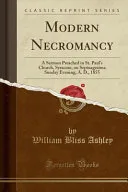
Modern Necromancy
 82
82

Modern Necromancy
William Bliss Ashley’s sermon, "Modern Necromancy," offers a bracingly rationalistic critique of 19th-century spiritualism, delivered with the authority of a pulpit address. The strength of the work lies in its direct confrontation of the era's spiritualist fervor, dissecting alleged mediumistic phenomena with a sharp, analytical scalpel. Ashley doesn't shy away from accusing practitioners of "vile impostures," a bold stance for 1855. However, the sermon's format, while lending it a certain rhetorical power, can also feel constrained, limiting the depth of its investigation compared to a more academic treatise. A particularly striking passage concerns his dismissal of mediums attempting "to make us believe what is false" by exploiting credulity. While perhaps lacking the nuanced psychological exploration of later skeptics, Ashley's work provides an essential, unvarnished snapshot of early rationalist pushback against the supernatural claims that captivated mid-Victorian society. It is a valuable document for understanding the intellectual battles of its time.
📝 Description
82
### What It Is Modern Necromancy is not a grimoire of spellcasting, but rather a searing critique of spiritualist mediums and alleged necromantic practices prevalent in the mid-19th century. William Bliss Ashley, writing in 1855, approaches these phenomena with a skeptical, analytical eye. The work dissects claims of communication with the deceased, questioning the authenticity of the purported intermediaries and the motives behind such performances. It examines the psychological and social conditions that fostered belief in spiritualism, presenting a rationalist counterpoint to the era's fascination with the supernatural.
### Who It's For This text is invaluable for students of 19th-century spiritualism, parapsychology, and the history of skepticism. It offers a primary source perspective from a period of intense spiritualist activity, providing crucial context for understanding the debates surrounding mediums and alleged occult phenomena. Historians of religion and social movements will find Ashley's analysis of public credulity and the mechanics of deception particularly relevant. It is also for anyone interested in the enduring tension between rational inquiry and the allure of the otherworldly.
### Historical Context Published in 1855, Modern Necromancy emerges from a fertile period for spiritualism, spurred by the Fox sisters' reported phenomena in Hydesville, New York, beginning in 1848. The mid-19th century saw a surge in interest in table-turning, séances, and spirit communication, fueled by social upheaval and a public seeking solace or answers beyond conventional religious frameworks. Ashley's work directly engages with this milieu, challenging the burgeoning spiritualist movement. He confronts mediums and their alleged abilities head-on, reflecting a broader intellectual current of scientific rationalism and empiricism that sought to debunk supernatural claims, as exemplified by contemporaries like the chemist Robert Hare, who initially investigated spiritualism but later grew skeptical.
### Key Concepts The central concept is the critical examination of purported necromantic phenomena, specifically mediumship. Ashley focuses on the mechanisms of deception, the psychological susceptibility of the audience, and the potential for fraud among practitioners. He questions the validity of alleged spirit communications, framing them as impostures designed to exploit public credulity. The work explores the societal context that made such claims believable, dissecting the societal hunger for confirmation of an afterlife or connection with the departed. Ashley’s approach is rooted in empirical observation and logical deduction, advocating for rigorous scrutiny of extraordinary claims.
💡 Why Read This Book?
• Gain insight into the 1855 spiritualist movement by examining Ashley's specific critiques of mediums, offering a counter-narrative to the era's widespread fascination. • Understand the historical skepticism towards alleged spirit communication, learning how figures like Ashley dissected claims of séances and mediumistic fraud in the mid-19th century. • Appreciate the rhetorical power of early rationalist arguments by analyzing Ashley's direct confrontation with "impostures" and his appeal to logic against the supernatural.
⭐ Reader Reviews
Honest opinions from readers who have explored this book.
❓ Frequently Asked Questions
What is "Modern Necromancy" by William Bliss Ashley actually about?
Contrary to its title, "Modern Necromancy" is not a guide to occult practices. It's a 1855 sermon by William Bliss Ashley critically examining and debunking the spiritualist mediums and alleged spirit communications popular in the mid-19th century.
When was "Modern Necromancy" first published?
The original publication date for William Bliss Ashley's "Modern Necromancy: A Sermon" was November 22, 2016, though the sermon itself was preached in 1855.
Who was William Bliss Ashley and why did he write this?
William Bliss Ashley was likely a clergyman or public speaker in Syracuse, New York, in 1855. He delivered this sermon to critically address and expose what he believed were fraudulent spiritualist practices and mediums of his time.
Does this book contain actual necromancy spells or rituals?
No, the book does not contain any spells or rituals. The title "Modern Necromancy" is used by Ashley to critically refer to the alleged communication with the dead being practiced by spiritualist mediums.
What historical period does this work relate to?
The work directly relates to the mid-19th century, specifically the 1850s, a peak period for the Spiritualist movement in America and Europe, marked by widespread interest in séances and mediumship.
What is the main argument presented in the sermon?
Ashley's main argument is that the alleged spirit communications and mediumistic performances of his time were largely impostures, designed to deceive and exploit the credulity of the public.
🔮 Key Themes & Symbolism
Skepticism of Mediumship
The core theme is a rigorous skepticism directed at the spiritualist mediums active in the mid-19th century. Ashley dissects their claims of communicating with the deceased, labeling them as "impostures" designed to prey on public gullibility. He scrutinizes the methods and motivations behind these performances, advocating for empirical evidence and logical deduction over unsubstantiated spiritual claims. This theme challenges the widespread belief in séances and spirit communication prevalent during the era, presenting a rationalist counter-argument.
Public Credulity and Deception
Ashley explores the societal conditions that fostered belief in the supernatural, particularly the "credulity" of the public. He posits that mediums exploit a deep-seated human desire for connection with the departed or reassurance about the afterlife. The work delves into the psychology of belief, suggesting that wishful thinking and a lack of critical discernment make individuals susceptible to fraudulent claims. This theme highlights the mechanisms of deception and the societal vulnerabilities that allowed spiritualism to flourish.
Rationalist Counter-Argument
This text stands as a significant example of 19th-century rationalism. Ashley employs logical reasoning and appeals to common sense to debunk the supernatural. His approach represents a scientific and empirical mindset clashing with the burgeoning spiritualist movement. The work serves as a historical document illustrating the intellectual currents of the time, where reason and empirical investigation were increasingly championed as tools to understand the world, challenging older or more mystical modes of thought.
The Nature of "Necromancy"
Ashley redefines "necromancy" not as a practice of magic but as the alleged act of communicating with the dead through mediums. He critiques this modern interpretation, contrasting it with historical notions and exposing the alleged fraudulent nature of contemporary spiritualist practices. The work questions the authenticity of these supposed interactions, suggesting they are performances rather than genuine spiritual connections, thus demystifying the concept and framing it as a social phenomenon.
💬 Memorable Quotes
“If they are impostures; if the persons who attempt, for the sake of upon our credulity; to make us believe what is false...”
— This excerpt directly accuses spiritualist mediums of deliberate deception. Ashley frames their activities as fraudulent schemes aimed at exploiting the public's willingness to believe extraordinary claims, particularly concerning the afterlife.
“investigations have been more extensive than mine, are convinced is the case with a large proportion of them”
— Ashley acknowledges that many others share his skeptical view, suggesting that the prevalence of fraud within spiritualism is widely recognized, even if not universally admitted. This implies a consensus among critical observers.
“A Sermon Preached in St. Paul's Church, Syracuse, on Septuagesima Sunday Evening, A. D., 1855”
— This contextualizes the work not as a book, but as a public address delivered in a specific religious setting and time, highlighting its role as a moral and intellectual intervention within its community.
“as, from what I have recently seen confident is the case with some of them”
— This personal observation lends weight to Ashley's argument, indicating that his skepticism is not purely theoretical but informed by his own experiences or investigations into specific cases of alleged mediumship.
“if, I say, they be vile impost...”
— This is a direct and forceful condemnation of the practitioners Ashley is addressing. The truncated phrase implies a strong moral judgment and reinforces his belief in the malicious intent behind fraudulent spiritualist activities.
🌙 Esoteric Significance
Tradition
While the title references "necromancy," Ashley's work does not align with established esoteric traditions like Hermeticism or Kabbalah. Instead, it operates from a rationalist, empirical perspective, critiquing what it perceives as fraudulent practices masquerading as spiritual communication. It stands apart from esoteric lineages by actively debunking phenomena often explored within occult circles, positioning itself as an external critique rather than an internal tradition.
Symbolism
The primary "symbol" Ashley engages with is the concept of the medium itself, which he frames not as a conduit to the spirit world but as a symbol of deception and exploitation. The "séance" and "spirit communication" function as motifs representing the public's desire for otherworldly contact, which Ashley systematically deconstructs as susceptible to fraud and psychological manipulation.
Modern Relevance
Ashley's critique of spiritualist mediums and public credulity remains relevant for contemporary discussions surrounding misinformation, pseudoscience, and the psychology of belief. Modern thinkers examining the history of paranormal claims, media manipulation, or the enduring appeal of conspiracy theories can find valuable parallels in Ashley's analysis of 19th-century phenomena and audience susceptibility.
👥 Who Should Read This Book
• Students of 19th-century American history and social movements, particularly those interested in the rise and reception of Spiritualism. • Researchers in the history of skepticism and rationalism, examining early critiques of paranormal claims and supernatural phenomena. • Individuals interested in comparative religion and the sociology of belief, understanding how societies grapple with questions of life, death, and the afterlife.
📜 Historical Context
William Bliss Ashley's "Modern Necromancy" sermon, delivered in 1855, emerges from a turbulent period of spiritual and intellectual ferment in America. The mid-19th century was captivated by the Spiritualist movement, ignited by phenomena reported by the Fox sisters in 1848. Mediums and séances became widespread, offering solace and communication with the deceased amidst social change and loss. Ashley's work stands as a prominent voice of rationalist skepticism against this tide. He directly confronts the alleged "impostures" of mediums, reflecting the era's burgeoning scientific inquiry and empirical worldview. While figures like Robert Hare, a chemist, initially explored spiritualism, Ashley represents a more immediate and perhaps less scientifically rigorous, but equally forceful, public critique. His sermon was part of a broader intellectual current challenging the supernatural, emphasizing logic and evidence against the emotionally charged claims of spiritualists, who themselves were often seen as deviating from established religious doctrines.
📔 Journal Prompts
The alleged "impostures" described by Ashley: what modern parallels exist?
Public "credulity" in 1855: how does it compare to contemporary susceptibility to misinformation?
The role of St. Paul's Church, Syracuse: reflect on religious institutions addressing spiritualist claims.
Ashley's analytical approach: how can it be applied to evaluating extraordinary claims today?
The concept of "Modern Necromancy" as critique: what does this redefinition reveal about societal anxieties?
🗂️ Glossary
Necromancy
Historically, a form of magic involving divination by the dead. In Ashley's 1855 context, he uses the term critically to describe the alleged practices of spiritualist mediums who claimed to communicate with spirits.
Spiritualism
A religious movement prominent in the mid-19th century, believing that spirits of the dead could communicate with the living through mediums. Ashley critiques this movement's authenticity.
Medium
An individual believed to be able to mediate communication between the world of spirits and the living. Ashley views these figures primarily as impostors.
Imposture
A fraudulent or deceitful act or pretense. Ashley frequently uses this term to describe the activities of spiritualist mediums he critiques.
Credulity
A tendency to be too ready to believe that something is real or true. Ashley argues that the public's credulity is exploited by fraudulent mediums.
Septuagesima Sunday
The third Sunday before Lent in the Western Christian calendar. Ashley delivered his sermon on this specific religious occasion in 1855.
Empirical
Based on, concerned with, or verifiable by observation or experience rather than theory or logical deduction. Ashley advocates for an empirical approach to claims of the supernatural.