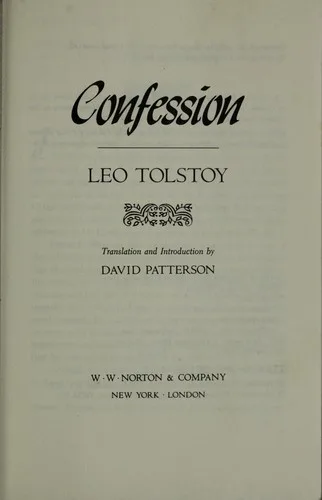
Ispovedʹ
 75
75

Ispovedʹ
Tolstoy’s *Ispovedʹ* lays bare a mid-life reckoning with a ferocity few authors achieve. It’s less a literary work and more a spiritual excavation, charting the author’s disillusionment with his own privileged existence and the societal constructs he once embraced. The raw honesty with which he dissects his past intellectual pursuits—from his literary fame to his philosophical inquiries—is arresting. A particular strength lies in his unflinching examination of death's shadow, which he argues is the ultimate catalyst for confronting life's meaning. However, the narrative occasionally becomes bogged down in repetitive philosophical lamentations, making certain passages feel like protracted internal monologues rather than dynamic prose. Despite this, the book's stark portrayal of existential dread and its subsequent search for a more authentic, faith-based existence remains potent. It’s a vital document for understanding the man behind the monumental novels, revealing the profound spiritual quest that informed his later years.
📝 Description
75
Leo Tolstoy wrote 'Ispovedʹ' in 1879, detailing his profound spiritual crisis after achieving worldly success.
Written in 1879, Leo Tolstoy's 'Ispovedʹ' (Confession) recounts his intense spiritual struggle after years of worldly achievement. He expresses disillusionment with societal expectations, religious doctrine, and the apparent lack of meaning in his life. The text is a direct and honest record of a soul confronting existential dread and the pursuit of genuine truth. Tolstoy examines his life, questioning the value of art, science, and social norms when faced with mortality.
This autobiographical work emerged from Tolstoy's deep dissatisfaction with the Russian Orthodox Church and his personal past. It reflects the intellectual climate of the late 19th century, where scientific reasoning challenged traditional faith. Tolstoy's critique of organized religion and his search for a personal faith offered an alternative to both secularism and rigid dogma. He found a form of authentic understanding in the lives of simple, uneducated people, viewing faith as an intuitive grasp of life's purpose rather than blind adherence.
Tolstoy's 'Ispovedʹ' fits within a tradition of spiritual autobiography where individuals document their personal quests for divine understanding outside established religious structures. It shares common ground with figures who experienced profound disillusionment with societal norms and sought direct, experiential knowledge of truth. This work reflects a turn towards inner authority and intuitive wisdom, often found in mystical traditions, as a counterpoint to external dogma and rationalistic doubt. It highlights a universal human impulse to reconcile worldly existence with ultimate questions.
💡 Why Read This Book?
• Gain insight into Leo Tolstoy's profound spiritual crisis, particularly his grappling with existential dread after achieving literary fame, a pivotal moment occurring in the late 1870s. • Understand Tolstoy's critique of institutionalized religion and his search for a personal, lived faith, moving beyond dogma to find meaning in the lives of ordinary people. • Explore the philosophical tension between societal success and personal fulfillment, as articulated through Tolstoy's intense examination of life's purpose in the face of mortality.
⭐ Reader Reviews
Honest opinions from readers who have explored this book.
❓ Frequently Asked Questions
When was Leo Tolstoy's *Ispovedʹ* (Confession) first published?
Although written in 1879, Leo Tolstoy's *Ispovedʹ* was not published until 1933, many years after his death, due to its controversial and deeply personal spiritual content.
What is the primary subject matter of *Ispovedʹ*?
*Ispovedʹ* details Leo Tolstoy's profound spiritual crisis and existential despair during his mid-life, exploring his rejection of societal norms and religious dogma in search of life's true meaning.
Did Tolstoy write *Ispovedʹ* before or after his major novels like *War and Peace*?
Tolstoy wrote *Ispovedʹ* in 1879, after the completion of his major novels *War and Peace* (1869) and *Anna Karenina* (1877), marking a significant shift in his personal philosophy and creative focus.
What is the meaning of the title *Ispovedʹ*?
*Ispovedʹ* is the Russian word for 'Confession.' The title accurately reflects the book's nature as a deeply personal and often painful account of Leo Tolstoy's spiritual journey and inner turmoil.
How does *Ispovedʹ* relate to Tolstoy's later philosophical and religious views?
*Ispovedʹ* is crucial for understanding Tolstoy's radical spiritual transformation, which led to his development of a personal brand of Christianity emphasizing love, non-violence, and a rejection of church hierarchy.
Is *Ispovedʹ* considered a work of fiction or non-fiction?
*Ispovedʹ* is an autobiographical work, meaning it is non-fiction. It is a direct, personal account of Leo Tolstoy's own spiritual and existential struggles.
🔮 Key Themes & Symbolism
Existential Dread and Meaning
The work plunges into the abyss of existential dread, a state Leo Tolstoy experienced intensely in his late 40s. He felt that his life, despite its outward successes—literary fame, family, social standing—was ultimately meaningless when confronted by the certainty of death. This theme is central, driving his relentless questioning of all established values and his desperate search for an authentic purpose that transcends the ephemeral nature of worldly achievements.
Critique of Institutionalized Religion
Tolstoy's 'Confession' is a scathing indictment of the Russian Orthodox Church and organized religion in general. He found its dogmas and rituals to be empty, disconnected from the genuine spiritual needs of individuals. His personal crisis led him to reject the church's authority, seeking instead a direct, intuitive understanding of faith and God, which he ultimately found not in theological texts but in the lives and simple wisdom of the common people.
The Search for Authentic Faith
Beyond mere doubt, *Ispovedʹ* is a profound exploration of the quest for authentic faith. Tolstoy sought a meaning for life that was not dependent on external validation or intellectual constructs. He contrasts the 'learned' faith of scholars and theologians with the 'unlearned' faith of the masses, concluding that true spiritual understanding comes from an inner, intuitive grasp of life's purpose, often found in labor and simple living.
Death as a Catalyst
The pervasive awareness of mortality serves as the primary catalyst for Tolstoy's spiritual awakening. He asserts that the fear of death strips away all illusions and forces a confrontation with life's ultimate significance. This confrontation, while terrifying, becomes the necessary precursor to finding genuine meaning. Without the shadow of death, he argues, humanity would remain complacent in its pursuits, never truly seeking a higher purpose.
💬 Memorable Quotes
Direct passages from the work, attributed to the author.
“My life, from my earliest childhood, was one of the most intense suffering and despair.”
— This opening sentiment sets the tone for the entire work, indicating that Tolstoy's spiritual crisis was not a sudden event but a deep-seated condition that intensified with age and reflection.
“The knowledge of my inability to live as I ought, and the impossibility of my living otherwise, were a torment to me.”
— This highlights the central paradox of Tolstoy's crisis: his awareness of a better, more meaningful way of life, coupled with his perceived inability to achieve it within his current circumstances.
“The masses live, and are firmly bound to the soil, and they have the whole of life before them, and the kingdom of God within them.”
— This reflects Tolstoy's later reverence for the common people and their 'unlearned' faith, which he contrasted with the intellectual complexities and perceived hollowness of educated society.
“To live is to suffer. To survive is to find some meaning in the suffering.”
— This interpretation expresses the core lesson Tolstoy derived from his crisis: that suffering is an inherent part of existence, and the pursuit of meaning is the essential human response to it.
💡 Key Ideas
Editorial paraphrase of the work's core concepts — not direct quotes.
I looked for a meaning in the sciences, in philosophy, in the lives of the great men of the past.
This paraphrase captures Tolstoy's extensive intellectual exploration as he sought answers to his existential questions, moving through various domains of knowledge and human endeavor.
🌙 Esoteric Significance
Tradition
While not strictly adhering to a specific esoteric lineage like Kabbalah or Hermeticism, *Ispovedʹ* aligns with Gnostic and mystical traditions that emphasize direct inner experience over external dogma. Tolstoy's rejection of institutionalized religion and his pursuit of a personal, intuitive 'faith' carries the Gnostic quest for hidden knowledge and the direct apprehension of the divine, separate from corruptible earthly structures.
Symbolism
The 'simple faith' of the peasant, often contrasted with the intellectual 'faith' of the educated, functions symbolically. It represents an uncorrupted, intuitive connection to life's meaning, a state Tolstoy yearned to reclaim. The motif of death also functions symbolically, not merely as an end but as the ultimate revealer of life's true value and the impetus for spiritual seeking.
Modern Relevance
Tolstoy's raw exploration of existential despair and the search for meaning continues to resonate with contemporary thinkers and spiritual seekers. His critique of materialism and superficial societal values finds echoes in modern critiques of consumerism and the pursuit of external validation. Philosophers and theologians still engage with his ideas on non-violent resistance and the nature of true faith, making *Ispovedʹ* a touchstone for discussions on personal ethics and spiritual authenticity.
👥 Who Should Read This Book
• Individuals questioning established religious or philosophical doctrines: Tolstoy’s candid spiritual autobiography offers a model for examining one's own beliefs and the societal frameworks surrounding them. • Readers interested in existentialism and the human condition: Those grappling with questions of life’s meaning, suffering, and mortality will find profound resonance in Tolstoy’s intense personal narrative. • Students of Leo Tolstoy's life and work: This text provides crucial insight into the profound spiritual shift that informed his later writings and philosophical outlook.
📜 Historical Context
Penned in 1879, *Ispovedʹ* emerged from Leo Tolstoy's intense mid-life spiritual crisis, occurring after the completion of his monumental novels *War and Peace* (1869) and *Anna Karenina* (1877). This period saw a significant intellectual divide in Russia and Europe between burgeoning scientific rationalism, which tended towards atheism or agnosticism, and traditional religious doctrines, particularly the Russian Orthodox Church. Tolstoy's profound disillusionment with the latter, coupled with his rejection of his own privileged past, positioned his work as a radical counterpoint. His search for an authentic, lived faith, accessible through the common people rather than theological dogma, diverged sharply from both the secular philosophies gaining traction and the established religious institutions. The work's posthumous publication in 1933 meant its direct impact on contemporary reception was limited, but its ideas deeply influenced later existentialist thinkers like Albert Camus and Jean-Paul Sartre, who grappled with similar themes of meaning and absurdity.
📔 Journal Prompts
The terror of meaninglessness as described by Tolstoy.
The peasant's 'unlearned faith' versus intellectual belief.
Confronting the certainty of death.
Tolstoy's critique of his own past life and societal conventions.
Defining authentic faith beyond dogma.
🗂️ Glossary
Spiritual Crisis
A period of intense personal turmoil and doubt concerning one's fundamental beliefs about life, death, and the universe, often leading to a re-evaluation of values and a search for new meaning.
Existential Dread
A profound feeling of anxiety and despair arising from the contemplation of life's inherent meaninglessness, freedom, and the inevitability of death.
Dogma
A set of principles laid down by an authority as incontrovertibly true, especially in religion or politics. Tolstoy critiques religious dogma as being detached from lived experience.
Faith (Tolstoyan)
For Tolstoy, 'faith' evolved to mean not blind adherence to doctrine, but an intuitive, direct understanding of life's purpose, often found through simple living and connection with others.
Meaninglessness
The perceived absence of inherent purpose or value in life, a central theme in Tolstoy's crisis, intensified by his awareness of mortality.
The Masses
Tolstoy's term for ordinary, often uneducated, people whose lives and simple faith he came to admire as more authentic than those of the intellectual elite.
Posthumous Publication
The publication of a work after the author's death. *Ispovedʹ* was published in 1933, decades after Leo Tolstoy died in 1910.
🔮 Readers Also Liked
Browse all →









More by Лев Толстой
All books →



More Free Spiritual Development Books
View all →