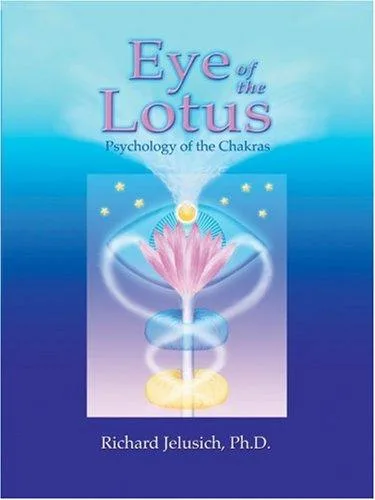
Eye of the Lotus
 78
78

Eye of the Lotus
Richard Jelusich's "Eye of the Lotus" is a commendable effort to codify aspects of esoteric philosophy, a task often mired in vagueness. The strength of the book lies in its systematic approach, particularly its detailed exposition of the "Law of Seven" and its implications for spiritual development. Jelusich doesn't shy away from presenting complex ideas, offering a structured framework that aids comprehension. However, the work's primary limitation is its academic tone, which, while precise, can sometimes feel detached from the lived experience of spiritual practice. A passage discussing the "conscious effort" required to ascend the spiritual planes, while conceptually sound, could benefit from more illustrative examples. Ultimately, "Eye of the Lotus" serves as a valuable, albeit dense, manual for the serious student of esoteric thought.
📝 Description
78
Richard Jelusich's 2004 book, 'Eye of the Lotus,' clarifies esoteric principles.
First published in 2004, 'Eye of the Lotus' by Richard Jelusich examines esoteric principles with a structured approach. Jelusich aims to make complex spiritual ideas accessible, serving as a guide for those new to mysticism and a reference for experienced practitioners. The book uses clear language to explain spiritual mechanics and philosophical ideas.
This text is well-suited for individuals seeking a systematic introduction to esoteric philosophy. It will appeal to students of comparative religion, those pursuing spiritual growth, and anyone interested in the consciousness structures described in various mystical traditions. Readers who prefer methodical explanations over anecdotal accounts will find 'Eye of the Lotus' useful. It is written for the dedicated inquirer ready for detailed discussions.
'Eye of the Lotus' appeared in 2004, a time when interest in spirituality was growing, but Jelusich's work focused on more structured philosophical inquiry. Unlike many spiritual texts of the early 2000s, this book grounds its explorations in specific conceptual frameworks, avoiding generalized sentiments. Its publication preceded the extensive digital spread of spiritual content, offering a more concentrated intellectual experience.
Published in 2004, 'Eye of the Lotus' fits within the Western Esoteric tradition, particularly drawing from Hermeticism and various philosophical interpretations of consciousness. It seeks to synthesize complex metaphysical ideas into a coherent system understandable to a dedicated student. The book contrasts with purely mystical or devotional approaches by emphasizing conceptual clarity and logical progression of ideas related to hidden knowledge.
💡 Why Read This Book?
• Gain a structured understanding of the Law of Seven, a core esoteric principle detailing the mechanics of creation and evolution, as presented in Chapter 3 of "Eye of the Lotus." • Explore Jelusich's perspective on the "conscious effort" required for spiritual ascent, providing a philosophical blueprint for personal growth beyond mere aspiration. • Discover the interconnectedness of consciousness and matter, as articulated through Jelusich's framework, offering a unique lens through which to view everyday reality.
⭐ Reader Reviews
Honest opinions from readers who have explored this book.
❓ Frequently Asked Questions
What is the primary focus of Richard Jelusich's "Eye of the Lotus"?
The book's primary focus is the systematic exploration and explanation of esoteric principles, aiming to provide a structured understanding of spiritual mechanics and consciousness. It was first published in 2004.
Who is Richard Jelusich and what is his background?
Richard Jelusich is an author and lecturer known for his work in esoteric philosophy. While specific biographical details are scarce, his writings, including "Eye of the Lotus" (2004), suggest a deep engagement with comparative mysticism and spiritual science.
What esoteric concepts are explored in "Eye of the Lotus"?
The book delves into concepts such as spiritual evolution, the nature of consciousness, the interconnectedness of existence, and practical applications of esoteric knowledge, notably the Law of Seven.
Is "Eye of the Lotus" suitable for beginners in esoteric studies?
Yes, the book is designed to be accessible to beginners due to its structured approach and clear explanations, while also offering depth for those with prior knowledge. Its publication date is 2004.
What makes "Eye of the Lotus" distinct from other esoteric books published around 2004?
Its distinction lies in its systematic and philosophical approach, providing a detailed conceptual framework rather than relying solely on anecdotal or experiential accounts, differentiating it from more generalized spiritual literature of the era.
Where does the "Eye of the Lotus" title come from?
While the book does not explicitly detail the origin of the title, the lotus flower is a potent symbol across many spiritual traditions, representing purity, enlightenment, and rebirth, themes likely echoed within Jelusich's work.
🔮 Key Themes & Symbolism
Spiritual Evolution Framework
The work meticulously outlines a progression of spiritual development, positing that evolution is not merely biological but a conscious, directed process. Jelusich introduces specific stages and principles, such as the Law of Seven, which governs the unfolding of consciousness and the manifest universe. This framework provides a structured map for understanding one's own journey and the underlying order of existence, moving beyond vague notions of spiritual growth towards a more defined, albeit abstract, understanding of the path.
Consciousness and Its Mechanics
"Eye of the Lotus" examines consciousness not as a passive byproduct of the brain, but as a fundamental force with inherent laws and potential. Jelusich explores how consciousness interacts with the material world and the subtle bodies, detailing the mechanisms by which thought and intention shape reality. This perspective encourages readers to view their own minds as potent tools for transformation, emphasizing the role of conscious effort in spiritual advancement and the understanding of cosmic principles.
The Law of Seven
A central concept explored is the Law of Seven, a fundamental esoteric principle detailing how creation and change occur through a series of seven forces or steps. Jelusich applies this law to various aspects of existence, from cosmic processes to individual psychology. Understanding this law, as presented in the book, offers a key to deciphering patterns in nature and within oneself, providing a practical lens for analyzing phenomena and guiding one's spiritual trajectory.
Interconnectedness of Existence
The book consistently reinforces the idea that all things are fundamentally interconnected, forming a unified whole. This principle of unity is explored through the lens of consciousness, energy, and spiritual laws. Jelusich suggests that recognizing this interconnectedness is crucial for spiritual awakening, fostering a sense of responsibility and empathy. It challenges the perception of separateness, urging readers to see their individual existence as part of a grander cosmic design.
💬 Memorable Quotes
Direct passages from the work, attributed to the author.
“Conscious effort is the primary engine of spiritual ascent.”
— This highlights the book's emphasis on agency. It suggests that spiritual progress isn't passive but requires deliberate action and focused intention from the individual.
“The Law of Seven governs the unfolding of all manifested phenomena.”
— This points to a foundational principle within the work, indicating that the book likely offers a structured explanation of how events and creations occur in a systematic, seven-step process.
“Understanding the mechanics of consciousness unlocks potential for transformation.”
— This suggests the book provides insights into the nature of mind and awareness, positing that knowledge of these 'mechanics' is key to personal change and spiritual growth.
“The lotus flower symbolizes the soul's journey toward enlightenment.”
— This interpretation connects the book's title to its potential symbolic content, suggesting themes of purity, spiritual awakening, and the unfolding of potential within the human psyche.
💡 Key Ideas
Editorial paraphrase of the work's core concepts — not direct quotes.
All existence is interwoven; separateness is an illusion.
This paraphrased concept underscores the theme of unity, a common thread in esoteric literature, suggesting the book promotes a holistic worldview where individual entities are part of a larger whole.
🌙 Esoteric Significance
Tradition
The work is rooted in the Western Esoteric Tradition, drawing heavily from Hermetic and Neoplatonic philosophies, with elements of Gnostic thought concerning the nature of consciousness and spiritual ascent. It aligns with the spiritual science movements of the late 19th and early 20th centuries, which sought to integrate scientific inquiry with mystical understanding. Jelusich's approach emphasizes a structured, almost mathematical, understanding of esoteric principles, fitting within a lineage that values systematic exposition over purely intuitive or ecstatic revelation.
Symbolism
The prominent "Lotus" in the title is a universal symbol of spiritual awakening, purity, and transcendence over material conditions, blooming from muddy waters. Within the book's context, it likely represents the unfolding consciousness and the soul's journey toward enlightenment. Other potential symbols, though not explicitly detailed without the text, could include geometric forms or cosmic diagrams, reflecting the Law of Seven and the structured nature of reality Jelusich explores, symbolizing order and divine proportion.
Modern Relevance
Contemporary practitioners of comparative mysticism and students of spiritual psychology find value in Jelusich's systematic approach to consciousness. His work on the Law of Seven, for instance, continues to be referenced by those seeking a structured framework for understanding universal processes. Modern spiritual teachers who emphasize the disciplined cultivation of awareness and the practical application of esoteric principles often echo the sentiments found in "Eye of the Lotus," demonstrating its enduring relevance for those seeking a philosophical underpinning for their spiritual practices.
👥 Who Should Read This Book
• Aspiring practitioners of esoteric philosophy seeking a structured introduction to core concepts like the Law of Seven. • Students of comparative religion and mysticism interested in systematic frameworks for understanding spiritual development. • Individuals engaged in self-inquiry who desire a philosophical map to guide their personal growth and understanding of consciousness.
📜 Historical Context
Published in 2004, "Eye of the Lotus" emerged in a spiritual landscape increasingly shaped by the internet, offering a more structured alternative to the flood of ephemeral online content. The early 2000s saw a continued interest in perennial philosophy and comparative mysticism, building on foundations laid by figures like Helena Blavatsky in the late 19th century. However, Jelusich's work distinguished itself by its systematic approach, moving beyond the more romanticized or purely experiential accounts prevalent in some New Age circles. It engaged with a tradition that valued intellectual rigor alongside spiritual insight, a lineage traceable to Hermeticism and Gnosticism. While not directly engaging with specific contemporary authors in its text, its publication occurred during a period when scholars like Wouter J. Hanegraaff were critically examining the history and discourse of Western esotericism, providing an academic counterpoint to the proliferation of popular spiritual texts.
📔 Journal Prompts
The Law of Seven as a framework for understanding personal challenges.
Reflecting on the role of conscious effort in achieving goals.
The concept of interconnectedness and its impact on daily interactions.
Mechanics of consciousness: identifying personal thought patterns.
Interpreting the symbolism of the lotus in personal spiritual journey.
🗂️ Glossary
Esoteric
Pertaining to hidden or secret knowledge, typically concerning spiritual or mystical subjects, intended for a select group of initiates or those with specialized understanding.
Consciousness
The state of being aware of and responsive to one's surroundings; in esoteric contexts, often viewed as a fundamental principle of the universe, not limited to human awareness.
Spiritual Evolution
The process by which an individual or consciousness progresses through various stages of development towards higher states of being, understanding, or enlightenment.
Law of Seven
An esoteric principle describing the process of creation and change as occurring through a series of seven forces or steps, influencing cosmic and psychological phenomena.
Subtle Bodies
Non-physical or energetic aspects of a being, often described in esoteric traditions as distinct from the physical body, such as the etheric, astral, or mental bodies.
Perennial Philosophy
The view that all religions and spiritual traditions share a common, underlying truth or source, often associated with mystical or esoteric insights.
Hermeticism
A philosophical and religious tradition based on the purported teachings of Hermes Trismegistus, emphasizing divine knowledge, cosmic order, and the interconnectedness of macrocosm and microcosm.
🔮 Readers Also Liked
Browse all →









More by Richard Jelusich
All books →
More Free Spiritual Development Books
View all →