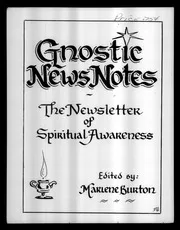
Gnostic News Notes
 80
80

Gnostic News Notes



Sophia Crane (Associate Editor) — 'Gnostic News Notes' is an indispensable resource for anyone serious about Gnostic studies. This digitized collection, meticulously preserved, unveils fragments of profound spiritual inquiry, revealing the enduring quest for divine knowledge. The 'Unknown' author(s) present a compelling exploration of core Gnostic tenets, offering insights into liberation and the hidden architecture of reality. Its strength lies in its raw, unvarnished presentation of ideas, making it a valuable primary source for scholars and a compelling read for spiritual seekers. Highly recommended for its direct access to the Gnostic mindset.
📝 Description
80
Gnostic News Notes collects obscure texts on creation myths and the divine spark.
'Gnostic News Notes' compiles lesser-known Gnostic writings, offering direct access to the ideas of early adherents. The collection addresses fundamental Gnostic concepts such as the flawed creator figure, often called the Demiurge, and the inherent divine light present within individuals. It examines the cosmology of Gnosticism, detailing the complex spiritual hierarchies and the perceived entrapment of souls in the material world.
The texts within this compendium focus on the pursuit of gnosis, a salvific knowledge that promises liberation from ignorance and illusion. Readers will find discussions of hidden symbolism and forgotten traditions that illuminate the path toward spiritual awakening. This work is intended for those seriously studying Gnostic traditions or seeking a deeper understanding of esoteric philosophies outside mainstream thought.
This collection falls within the Gnostic tradition, a diverse set of religious ideas and systems that flourished in the first centuries CE. Gnosticism posits a radical dualism between a transcendent, supreme God and a lesser, often ignorant or malevolent creator of the material universe. Central to Gnostic thought is the concept of gnosis, a special, intuitive knowledge that allows the divine spark within humans to recognize its true origin and escape the material cosmos.
💡 Why Read This Book?
Uncover the hidden spiritual truths of Gnosticism. 'Gnostic News Notes' offers direct access to ancient esoteric thought, illuminating the path to inner liberation and understanding the cosmos. Ideal for seekers of profound wisdom, scholars of mysticism, and practitioners of ancient spiritual disciplines who wish to engage with foundational Gnostic texts.
⭐ Reader Reviews
Honest opinions from readers who have explored this book.
❓ Frequently Asked Questions
What is Gnosticism?
Gnosticism is a diverse set of religious and philosophical movements that emphasize spiritual knowledge (gnosis) as the key to salvation. Gnostics often viewed the material world as flawed or evil, created by a lesser deity (the Demiurge), and sought escape through divine enlightenment.
Who were the Gnostics?
The Gnostics were adherents of various early Christian and pre-Christian spiritual traditions that flourished from the 1st to the 4th century CE. They comprised diverse groups, often with distinct interpretations of cosmology, scripture, and the nature of the divine.
What is 'gnosis'?
Gnosis, a Greek word meaning 'knowledge,' refers to a special, intuitive, and salvific knowledge of the divine. It is not intellectual understanding but a direct, experiential apprehension of spiritual truths that leads to liberation.
What is the significance of the Demiurge in Gnosticism?
The Demiurge is a figure in Gnostic cosmology, often depicted as a flawed or ignorant creator god responsible for the material universe. Gnostics typically contrasted the Demiurge with the true, supreme, unknowable God.
Is this book suitable for beginners?
While the texts can be complex, 'Gnostic News Notes' offers a foundational glimpse into Gnostic thought. Beginners may find it challenging but rewarding, especially when approached with an open mind and a willingness to explore profound philosophical and spiritual concepts.
🔮 Key Themes & Symbolism
The Quest for Gnosis
This theme explores the central Gnostic pursuit of 'gnosis' – a direct, intuitive, and salvific knowledge of the divine. It looks at the belief that true liberation from the material world and its illusions is achieved not through faith or works, but through this profound, inner knowing. The texts herein illuminate the various paths and methods, both meditative and intellectual, that Gnostics believed led to this ultimate enlightenment, revealing the transformative power of awakened consciousness.
Cosmology and the Divine Spark
The collection looks at the intricate and often complex Gnostic cosmologies, exploring the creation of the material universe and its relationship to the higher, spiritual realms. It examines the concept of the 'divine spark' – the fragment of the true God that resides within humanity, trapped within the material form. The texts articulate the Gnostic worldview that sees the cosmos as a cosmic drama of descent and ascent, where the soul's journey is a return to its divine origin.
Symbolism and Esoteric Interpretation
A significant thread woven through these notes is the collection of Gnostic symbolism. The texts offer insights into the multilayered meanings embedded within myths, figures, and narratives, revealing a sophisticated system of esoteric interpretation. Readers will encounter the symbolic representations of deities, cosmic principles, and spiritual states, understanding how these symbols serve as keys to unlocking deeper truths about existence and the human condition, bridging the gap between the visible and the invisible.
💬 Memorable Quotes
Direct passages from the work, attributed to the author.
“The Kingdom of Heaven is within.”
— This profound statement emphasizes the Gnostic belief that salvation and divine connection are not external but are found through inner exploration and awakening of one's own spiritual potential.
“Ignorance is the chain that binds the soul.”
— This speaks to the Gnostic understanding that the material world and its perceived limitations are a result of a lack of true spiritual knowledge, and that gnosis is the key to breaking these bonds.
“Awaken, sleeper, and remember your true home.”
— This is a direct exhortation to the soul, urging it to rise from its slumber of material existence and recall its divine origin and true spiritual nature.
💡 Key Ideas
Editorial paraphrase of the work's core concepts — not direct quotes.
Seek not the world, but the light beyond it.
A core Gnostic tenet, this quote highlights the rejection of material pursuits and worldly distractions in favor of spiritual attainment and the realization of a higher, transcendent reality.
The true God is not the maker of this prison.
A direct challenge to conventional creation narratives, this quote articulates the Gnostic view of the Demiurge as a flawed creator, distinct from the supreme, benevolent deity.
🌙 Esoteric Significance
Tradition
The primary esoteric tradition explored here is Gnosticism, a complex spiritual and philosophical movement that flourished in the ancient world. Its core tenets revolve around the belief in a transcendent God, a flawed creator of the material world (the Demiurge), and the concept of divine sparks trapped within humanity. Gnosticism emphasizes direct spiritual knowledge (gnosis) as the path to liberation from the material realm and a return to the divine Pleroma.
Symbolism
The symbolism within Gnostic texts is rich and complex, often drawing from a synthesis of Platonic philosophy, Jewish mysticism, and early Christian imagery. Key symbols include the Pleroma (the fullness of the divine), the Archons (rulers of the material cosmos), the Serpent (often a symbol of wisdom or gnosis), and the divine Child or Aeons. These symbols represent cosmic principles, spiritual states, and the journey of the soul towards liberation, requiring careful interpretation to unlock their profound meaning.
Modern Relevance
Gnostic thought continues to resonate deeply in the modern era, particularly among those who question established doctrines and seek a more personal, experiential approach to spirituality. Its emphasis on the inner divine spark, the critique of materialistic societal structures, and the pursuit of self-knowledge offers a powerful framework for understanding personal liberation and challenging perceived limitations. The Gnostic worldview provides a compelling lens through which to examine contemporary issues of consciousness, freedom, and the search for authentic meaning.
👥 Who Should Read This Book
This collection is a treasure for the dedicated student of esoteric wisdom, particularly those drawn to the mysteries of Gnosticism. Scholars of comparative religion and ancient philosophy will find valuable source material. Spiritual seekers yearning for a deeper understanding of the soul's journey and the nature of reality will be profoundly enriched. Practitioners of meditation and contemplative disciplines may discover new insights into unlocking inner gnosis and transcending material limitations. Beginners to Gnosticism may find it a challenging but ultimately informative introduction to this profound spiritual path.
📜 Historical Context
Emerging in the early centuries of the Common Era, Gnosticism represented a complex and diverse array of spiritual movements that flourished alongside nascent Christianity and other Hellenistic philosophical traditions. These groups often offered a radical reinterpretation of existing religious narratives, emphasizing personal mystical experience and the attainment of salvific knowledge (gnosis) as paramount. Gnostic thought presented a dualistic worldview, often positing a flawed creator deity (the Demiurge) responsible for the material world, contrasting with a transcendent, unknowable Supreme Being. This perspective challenged prevailing orthodoxies, leading to significant theological debates and, in many cases, persecution by emerging Christian authorities. The 'Gnostic News Notes,' as a later compilation or dissemination of such ideas, serves as a vital bridge, preserving fragments of this ancient wisdom and allowing modern seekers to engage with a tradition that profoundly influenced mystical and esoteric thought throughout history.
📔 Journal Prompts
Reflect on a time you felt a disconnect between your true self and the external world. How does this relate to Gnostic concepts?
What does the concept of 'gnosis' mean to you personally? Describe your own experiences or aspirations for spiritual knowledge.
Explore the symbolism of a 'prison' in your own life. What are the 'chains' that bind you, and how might you seek liberation?
Consider the idea of a flawed creator. How does this concept challenge or resonate with your understanding of the universe and its origins?
Write about a personal 'divine spark' or inner light. How do you nurture and connect with this aspect of your being?
🗂️ Glossary
Gnosis
A Greek term meaning 'knowledge,' referring to a special, intuitive, and salvific understanding of the divine and spiritual realities, central to Gnostic salvation.
Demiurge
In Gnostic cosmology, the lesser creator deity responsible for the material universe, often depicted as ignorant or malevolent, distinct from the supreme, unknowable God.
Pleroma
The spiritual field of fullness and perfection in Gnostic cosmology, inhabited by the Supreme Being and divine emanations (Aeons).
Aeons
Divine beings or emanations from the Supreme God, forming the Pleroma and participating in the divine order. They are often depicted in pairs (syzygies).
Archons
Rulers or powers within the material cosmos, often seen as servants of the Demiurge, who seek to keep humanity ignorant and bound to the material world.
This book appears in 2 collections
🔮 Readers Also Liked
Browse all →
![The Byrhtferth's Manuscript (MS 17) † Saint John’s College † Oxford † [1111]](/img/thumb/the-byrhtferth-s-manuscript-ms-17-saint-john-s-college-oxford-1111-the-monk-byrhtferth.webp)








From the “Gnosticism” Collection
View all →
![Serrano Miguel Adolf Hitler The Ultimate Avatar [ 2000]](/img/thumb/serrano-miguel-adolf-hitler-the-ultimate-avatar-2000.webp)


More Free Sacred Texts & Gnosticism Books
View all →