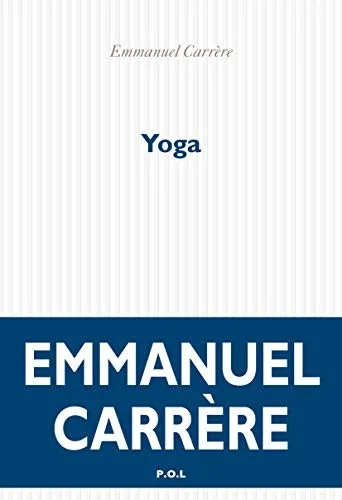
Yoga
 72
72

Yoga
Carrère's "Yoga" is less about the practice itself and more about the author's persistent, often anxious, search for equilibrium. He uses yoga not as a solution, but as a lens through which to dissect his own life, anxieties, and the very nature of seeking solace. One particularly compelling thread is his examination of the disconnect between the ideal of mental stillness and the reality of a mind constantly in flux, a struggle many practitioners will recognize. The book's strength lies in its unflinching honesty and intellectual curiosity, even when it circles back to familiar existential quandaries. However, at times, the narrative can feel excessively self-absorbed, with the external world serving primarily as a backdrop to Carrère's internal landscape. The true value emerges when he allows the practice of yoga to illuminate broader truths about human vulnerability. It’s a literary meditation on the imperfect pursuit of peace.
📝 Description
72
Emmanuel Carrère's 2020 book "Yoga" uses the practice as a lens for personal and philosophical inquiry.
Emmanuel Carrère's "Yoga," published in 2020, is not a manual for physical postures but a literary examination of broader human concerns. The author uses his own experiences with yoga as a starting point to question well-being, suffering, and the search for inner peace. Carrère combines memoir, essay, and philosophical reflection, turning his sharp observational focus both inward and outward.
The book engages with the idea of authenticity, both in spiritual practice and in daily life. It questions whether genuine peace can truly be achieved through external disciplines. Carrère also explores the connection between physical sensations and mental states, considering how bodily experiences shape our understanding of consciousness and pain. The work touches on the inherent paradoxes found in seeking tranquility.
Published in 2020, "Yoga" arrives in a period where Eastern spiritual practices are widely adopted and often commercialized in the West. Carrère's work offers a more personal and critical perspective, standing apart from simplistic or commodified narratives surrounding yoga. It can be seen as part of a long tradition of Western intellectuals engaging with Eastern philosophies, a trend that saw significant growth in the late 19th and early 20th centuries, though Carrère's approach is distinctly secular and introspective.
💡 Why Read This Book?
• Gain a nuanced perspective on the philosophy behind yoga, moving beyond asanas to explore its impact on consciousness, as discussed through Carrère's personal reflections on seeking inner calm. • Understand the tension between intellectual seeking and embodied practice, illustrated by Carrère's grappling with the disconnect between his mind's desires and his body's experience. • Explore existential themes of suffering and authenticity, as Carrère uses his engagement with yoga to question the nature of self and the pursuit of well-being in the modern era.
⭐ Reader Reviews
Honest opinions from readers who have explored this book.
❓ Frequently Asked Questions
What is Emmanuel Carrère's "Yoga" about?
Emmanuel Carrère's "Yoga" is a philosophical memoir that uses the practice of yoga as a starting point to explore themes of suffering, consciousness, and the search for inner peace, rather than a guide to physical poses.
When was Emmanuel Carrère's "Yoga" first published?
Emmanuel Carrère's "Yoga" was first published in 2020, reflecting contemporary discussions on wellness and spirituality.
Is "Yoga" by Carrère a practical guide to yoga?
No, "Yoga" by Emmanuel Carrère is not a practical guide. It is a literary and philosophical work that uses the concept of yoga to examine personal and existential issues.
What are the main themes in Carrère's "Yoga"?
The main themes include the nature of suffering, the pursuit of inner peace, the relationship between mind and body, and the search for authenticity in practice and life.
Who would enjoy reading Emmanuel Carrère's "Yoga"?
Readers who appreciate introspective, philosophical, and autobiographical writing, particularly those interested in the deeper meanings of spiritual or meditative practices, will likely enjoy this book.
Does the book discuss specific yoga traditions or gurus?
While it engages with the general concept of yoga and its pursuit of tranquility, the book focuses more on Carrère's personal philosophical and existential reflections rather than detailing specific lineages or teachers.
🔮 Key Themes & Symbolism
The Paradox of Peace
Carrère investigates the human drive to attain a state of inner peace, often through disciplines like yoga, only to find that the very act of striving can create internal conflict. He questions whether external practices can truly quiet an internally turbulent mind or if peace is a state that must be understood differently, perhaps even embraced within the chaos of existence. The book explores the inherent tension between control and surrender in the pursuit of well-being.
Mind-Body Disconnect
A central concern is the often-cited ideal of a harmonious mind and body, contrasted with the lived reality of their frequent dissonance. Carrère examines how physical sensations, pain, or even the simple act of holding a yoga pose can trigger complex psychological responses. This theme probes the nature of consciousness and selfhood, questioning the extent to which our mental states are dictated by our physical experiences or vice versa.
Authenticity and Performance
The book studies the idea of authenticity, particularly in the context of spiritual or wellness practices. Carrère scrutinizes whether one can truly be 'present' or 'authentic' when engaging in a discipline that might feel performative or when the motivations for practice are complex and perhaps less than pure. This exploration extends to broader questions of self-deception and the performance of well-being in contemporary society.
Suffering as a Constant
Instead of offering yoga as an escape from suffering, Carrère confronts it as an intrinsic part of the human condition. He uses his personal experiences and philosophical reflections to suggest that understanding and integrating suffering, rather than eradicating it, might be a more attainable path. The practice of yoga becomes a tool not for avoidance, but for confronting discomfort with greater awareness.
💬 Memorable Quotes
Direct passages from the work, attributed to the author.
“The mind is a place of perpetual movement.”
— This highlights Carrère's observation that achieving a truly still mind is an arduous, perhaps impossible, task, contrasting with the ideal often presented in wellness narratives.
“Is peace found in quietude, or in acknowledging the noise?”
— This question expresses the book's central inquiry into whether true tranquility lies in suppressing internal chaos or in developing a more accepting relationship with it.
“The body remembers what the mind forgets.”
— This phrase points to the profound, often subconscious, connection between physical experience and psychological states, suggesting that somatic awareness holds keys to understanding oneself.
“We seek control, but are often subject to forces beyond our grasp.”
— Carrère reflects on the human desire for agency and inner order, juxtaposed against the reality of life's unpredictability and the limits of our influence over our own minds and circumstances.
“Yoga as a mirror, not a mask.”
— This suggests that the practice should reveal truths about the self, rather than serve as a superficial facade to hide imperfections or anxieties.
🌙 Esoteric Significance
Tradition
While not strictly adhering to a single esoteric lineage, "Yoga" engages with the Western reception and interpretation of Hatha Yoga and broader yogic philosophies. It touches upon concepts of mind-body unity and the pursuit of transcendence or inner peace, which have roots in various contemplative traditions, including Hermeticism's focus on correspondence between macrocosm and microcosm, and Gnosticism's quest for inner knowledge to escape worldly suffering.
Symbolism
The practice of *asana* (posture) itself can be seen as a symbol of the body as a vehicle for consciousness and a site of disciplined inquiry. The breath (*pranayama*) symbolizes the vital life force (prana) and the connection between the physical and subtle energetic bodies. The concept of *dhyana* (meditation) represents the inward turn of consciousness, the attempt to still the mind's incessant chatter and achieve a state of focused awareness.
Modern Relevance
Carrère's work is highly relevant to contemporary thinkers and practitioners grappling with the secularization of spiritual practices and the 'wellness industry.' It speaks to modern mindfulness movements, therapeutic approaches that integrate somatic experience, and philosophical inquiries into consciousness and well-being that seek depth beyond superficial self-help trends.
👥 Who Should Read This Book
• Readers interested in philosophical memoirs who appreciate introspective explorations of life's challenges, particularly those who have engaged with yoga or meditation. • Individuals curious about the intellectual and existential dimensions of spiritual practices, seeking to understand the 'why' behind disciplines like yoga beyond the physical aspects. • Students of comparative religion and philosophy who examine how Eastern practices are adopted and interpreted within Western cultural contexts.
📜 Historical Context
Emmanuel Carrère's "Yoga," published in 2020, emerged during a period of intense global introspection, amplified by the COVID-19 pandemic, and a concurrent explosion in the wellness industry. The book positions itself against the prevailing, often commodified, discourse surrounding yoga in the West. Its introspective and critical stance echoes a longer tradition of Western intellectuals engaging with Eastern philosophies, a trend that gained significant traction in the late 19th and early 20th centuries with figures like Swami Vivekananda, who lectured in the US in 1893, and the Theosophical Society founded by Helena Blavatsky. However, Carrère's approach is distinctly secular and personal, less concerned with establishing a new spiritual doctrine and more with interrogating the very possibility of achieving inner peace through disciplined practice in a chaotic modern life. Unlike the more utopian or dogmatic spiritual movements of the past, "Yoga" offers a deeply human, often anxious, meditation on the limitations and paradoxes of such pursuits.
📔 Journal Prompts
Reflect on the tension between seeking inner peace and the constant movement of the mind.
Consider the body's role in holding and processing emotional experiences that the mind may overlook.
Analyze the concept of authenticity in personal practices versus societal expectations.
Explore the idea of accepting suffering as an intrinsic part of life, rather than something to be eliminated.
What does the metaphor of yoga as a mirror, rather than a mask, reveal about self-perception?
🗂️ Glossary
Asana
Refers to the physical postures practiced in yoga. In Carrère's context, it represents the embodied aspect of the practice and a site for exploring physical and mental states.
Pranayama
Breathing techniques in yoga. It signifies the control and direction of vital life force (prana), linking the physical body to subtle energetic processes and mental states.
Dhyana
Meditation or contemplation. It represents the practice of sustained, focused attention aimed at quieting the mind and achieving deeper self-awareness.
Inner Peace
A state of mental and emotional calm, often sought through spiritual or meditative practices. Carrère critically examines the pursuit and attainment of this state.
Authenticity
The quality of being genuine and true to oneself. In the book, this is questioned in relation to practicing disciplines like yoga and presenting oneself in society.
Suffering
The state of undergoing pain, distress, or hardship. Carrère confronts suffering not as an anomaly to be escaped, but as a fundamental aspect of human existence.
Mind-Body Connection
The interconnectedness of mental processes and bodily functions. The book explores how physical experiences influence psychological states and vice versa.
🔮 Readers Also Liked
Browse all →







More by Emmanuel Carrère
All books →
More Free Occult Philosophy Books
View all →