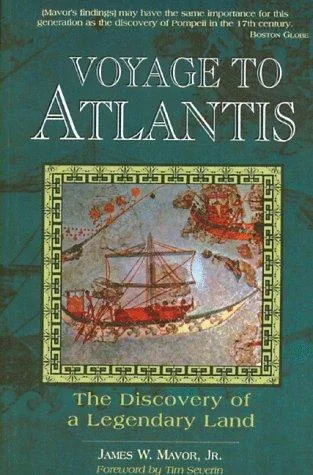
Voyage to Atlantis

 79
79

Voyage to Atlantis
James W. Mavor's "Voyage to Atlantis" is a serious attempt to anchor the Atlantean myth in plausible history, a welcome departure from purely speculative or sensationalist accounts. Mavor’s strength lies in his methodical approach, dissecting Plato’s original account in the Timaeus and Critias with a geologist’s eye and an anthropologist’s curiosity. He meticulously considers seismic activity and continental drift as potential mechanisms for a cataclysmic event, grounding the legend in physical possibility. A notable limitation, however, is the inherent difficulty in definitively proving or disproving such ancient hypotheses. The section where Mavor discusses the Minoan civilization and the Thera eruption as a potential parallel or inspiration for the Atlantis story is particularly compelling, illustrating the blend of myth and possible historical memory. Ultimately, the book serves as a rigorous exploration, offering a well-reasoned case for Atlantis as more than mere fantasy.
📝 Description
79
### What It Is Voyage to Atlantis presents a scholarly examination of the Atlantean legend, moving beyond mere myth to explore historical and archaeological possibilities. James W. Mavor, in his 1969 work, compiles various theories and evidence, considering the geological and anthropological implications of a sunken continent. The book engages with the scientific discourse surrounding Atlantis, assessing claims made by proponents and critics alike.
### Who It's For This text is intended for readers interested in the historical and scientific inquiry into legendary lost civilizations, specifically Atlantis. It appeals to amateur archaeologists, historians of ancient cultures, and those fascinated by theories of prehistory that challenge conventional timelines. Readers seeking a rational, evidence-based approach to myth will find Mavor's analysis valuable.
### Historical Context The book emerges from a period of renewed interest in Atlantis, following figures like Ignatius Donnelly in the late 19th century and later, the influence of Theosophy. Published in 1969, Mavor's work engages with geological discoveries of the era and anthropological debates about early human migration and civilization. It sits within a broader discourse of speculative history and the academic consideration of myths as potential echoes of forgotten realities.
### Key Concepts Mavor explores the geographical plausibility of Atlantis, often referencing Plato's dialogues as the primary source while critically evaluating subsequent interpretations. He considers geological evidence such as plate tectonics and sea-level changes to frame potential scenarios for a lost landmass. The work also touches upon the cultural diffusion theories that often accompany Atlantean narratives, examining how such a civilization might have influenced global societies.
💡 Why Read This Book?
• Gain a critical understanding of how geological theories from the mid-20th century, such as the emerging concept of plate tectonics, were applied to ancient legends like Atlantis, moving beyond pure fantasy. • Examine the specific textual analysis of Plato's dialogues, particularly the Timaeus and Critias, to see how scholars in 1969 approached foundational mythological sources critically. • Appreciate the comparative approach to myth and history, learning how events like the Thera eruption are considered as potential factual kernels within grander legendary narratives.
⭐ Reader Reviews
Honest opinions from readers who have explored this book.
❓ Frequently Asked Questions
What is James W. Mavor's original publication year for Voyage to Atlantis?
The original publication year for James W. Mavor's "Voyage to Atlantis" is 1969. This date places the book within a specific era of geological and anthropological research.
Does Voyage to Atlantis provide definitive proof of Atlantis?
No, "Voyage to Atlantis" does not claim definitive proof. Instead, it presents a scholarly examination of the legend, exploring plausible historical and geological scenarios based on evidence available in 1969.
What historical sources does Mavor primarily rely on?
Mavor primarily relies on Plato's dialogues, specifically the Timaeus and Critias, as the foundational textual source for the Atlantean legend. He then cross-references these with contemporary scientific theories.
What scientific fields are discussed in relation to Atlantis in Mavor's book?
The book discusses geology, particularly concerning continental drift and seismic activity, as well as anthropology and theories of early human civilization and migration.
Is Voyage to Atlantis a work of fiction or non-fiction?
"Voyage to Atlantis" is a work of non-fiction. It is a scholarly investigation into the historical and scientific underpinnings of the Atlantean myth, rather than a fictional narrative.
What is the general tone of Mavor's analysis?
Mavor's tone is analytical and scholarly. He approaches the subject with critical inquiry, aiming to reconcile the myth with potential historical realities using evidence and reasoned argument.
🔮 Key Themes & Symbolism
Geological Plausibility
Mavor critically assesses how geological processes, particularly those understood around 1969 such as continental drift and seismic events, could potentially account for the sudden disappearance of a landmass like Atlantis. He examines sea-level changes and underwater topography as discussed in scientific circles of his time, seeking to connect geological phenomena with the ancient legend. The work engages with the scientific discourse on Earth's dynamic nature to frame the possibility of a submerged continent.
Plato's Account as Source
The book places significant emphasis on Plato's dialogues, Timaeus and Critias, as the primary textual origin of the Atlantis myth. Mavor dissects Plato's narrative, distinguishing between potential historical accounts and philosophical allegory. He analyzes the details provided by Plato regarding Atlantis's geography, society, and its conflict with Athens, treating these descriptions as crucial data points for historical investigation.
Myth as Echo of History
A central theme is the exploration of whether ancient myths, including the Atlantis legend, might contain kernels of historical truth distorted by time and oral tradition. Mavor considers how real-world events, such as catastrophic natural disasters or lost civilizations, could be remembered and transmuted into epic narratives. This approach seeks to bridge the gap between folklore and verifiable history.
Comparative Civilizations
Mavor touches upon the idea of Atlantean influence on subsequent ancient cultures. The book considers theories that suggest a highly advanced Atlantean civilization could have seeded knowledge or cultural practices across the globe. This involves examining parallels drawn between Atlantean descriptions and the characteristics of early known civilizations, evaluating the possibility of cultural diffusion from a lost source.
💬 Memorable Quotes
“The dialogue of Plato is the sole source of our knowledge of Atlantis.”
— This statement underscores the foundational importance of Plato's writings, Timaeus and Critias, as the exclusive origin point for the Atlantis narrative. It highlights the need for careful textual analysis when investigating the legend.
“Geological evidence suggests the Earth's crust has undergone significant transformations.”
— This paraphrase reflects Mavor's use of contemporary geological understanding, such as plate tectonics, to provide a scientific framework for considering the physical possibility of submerged landmasses and dramatic geographical changes.
“The Thera eruption offers a model for catastrophic civilizational loss.”
— This interpretation points to Mavor's examination of real-world disasters, like the Minoan civilization's collapse following the Thera volcanic event, as potential historical parallels for the scale of destruction implied in the Atlantis myth.
“Ancient myths may preserve memories of forgotten historical epochs.”
— This paraphrased concept captures the book's approach to interpreting mythology not just as fantasy, but as potential fragmented records or cultural memories of actual past events or societies.
“The concept of a sunken continent challenges conventional historical timelines.”
— This statement reflects the book's engagement with theories that propose advanced civilizations existing far earlier than commonly accepted, suggesting a need to reconsider established historical chronologies.
🌙 Esoteric Significance
Tradition
While not strictly aligned with a single esoteric lineage like Hermeticism or Kabbalah, Mavor's work engages with the broader tradition of Western esotericism that seeks hidden knowledge and alternative histories. It intersects with the speculative historical inquiries found in Theosophy and related movements, which often posit advanced ancient civilizations as sources of spiritual wisdom. Mavor's rational approach, however, attempts to ground these esoteric interests in scientific plausibility, distinguishing it from purely mystical interpretations.
Symbolism
The primary symbol is Atlantis itself, representing a lost golden age, advanced knowledge, and a cautionary tale of hubris and cataclysm. Plato’s description of Atlantis as a circular city with concentric rings of land and water symbolizes order, power, and isolation. The conflict between Atlantis and ancient Athens symbolizes the clash between material power and spiritual/philosophical ideals, a recurring theme in esoteric thought.
Modern Relevance
Mavor's work remains relevant for contemporary researchers and enthusiasts interested in the intersection of myth, geology, and speculative history. Thinkers exploring ancient astronaut theories, alternative archaeology, and the potential for pre-diluvian civilizations often reference or build upon the questions Mavor raised. His analytical approach to Plato and geological possibilities continues to inform discussions about the origins of civilization and the scientific study of legendary places.
👥 Who Should Read This Book
• Students of comparative mythology and ancient legends, seeking to understand how scholars in the mid-20th century scientifically investigated foundational myths like Atlantis. • Amateur archaeologists and historians interested in theories of lost civilizations and prehistory, who appreciate a grounded, evidence-based examination rather than pure speculation. • Readers fascinated by the geological sciences and their potential to explain dramatic historical or legendary events, particularly concerning catastrophic phenomena and continental change.
📜 Historical Context
Published in 1969, "Voyage to Atlantis" arrived during a period of intense interest in esoteric subjects and speculative history, fueled by the counterculture movement and a questioning of established scientific and historical narratives. The era saw continued exploration of Atlantis following earlier popularizers like Ignatius Donnelly and the Theosophical Society's espousal of Atlantean lore. Mavor’s work engaged with contemporary geological theories, including the developing understanding of plate tectonics, which offered new frameworks for considering cataclysmic geological events. While figures like J. Robert Oppenheimer had shown an interest in Plato's Atlantis, Mavor’s approach was more specifically geological and anthropological. The book navigated a landscape where mythological studies were beginning to gain more academic traction, but Atlantis remained largely on the fringes of mainstream archaeology, often debated alongside other lost continent theories.
📔 Journal Prompts
The textual analysis of Plato's Timaeus and Critias.
Geological theories proposed by Mavor in the 1960s.
The symbolic representation of Atlantis as a lost civilization.
Potential connections between the Thera eruption and the Atlantis myth.
The concept of myth as a distorted echo of historical events.
🗂️ Glossary
Timaeus and Critias
Two of Plato's dialogues that are the primary source for the legend of Atlantis. They describe the island's geography, society, and its war against ancient Athens before its destruction.
Continental Drift
A geological theory, gaining prominence in the mid-20th century, proposing that Earth's continents have moved over geologic time relative to each other, thus appearing to have 'drifted' across the ocean bed.
Plate Tectonics
The scientific theory that describes the large-scale motion of seven large plates and the movements of numerous smaller plates of the Earth's lithosphere. It explains phenomena like earthquakes and volcanic activity.
Thera Eruption
A massive volcanic eruption on the island of Thera (modern Santorini) around 1600 BCE, which caused widespread destruction and is sometimes proposed as a possible inspiration for the Atlantis legend due to its catastrophic impact.
Minoan Civilization
A Bronze Age civilization that flourished on Crete and other Aegean islands, known for its advanced culture and palaces. Its decline is often linked to the Thera eruption.
Cultural Diffusion
The spread of cultural beliefs, social activities, and ideas from one group of people to another. In the context of Atlantis, it refers to theories about its influence on other ancient cultures.
Catastrophism
The theory that Earth's geological features are the result of sudden, violent catastrophes, as opposed to gradual processes. This idea was often invoked to explain large-scale geological changes relevant to lost continents.