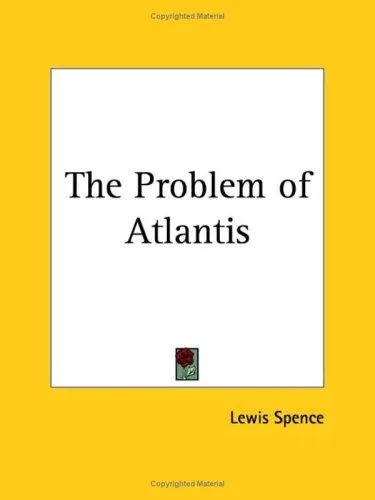
The problem of Atlantis
 73
73

The problem of Atlantis
Lewis Spence approaches the Atlantis myth not as a simple fairy tale, but as a complex historical and anthropological problem. His deep dive into primary sources, particularly Plato's dialogues, is commendable. Spence's strength lies in his methodical approach, sifting through centuries of speculation. However, the book occasionally feels like a product of its time, with some theories now considered superseded by later archaeological or geological findings. A particularly striking section is his analysis of potential flood myths across cultures, suggesting a possible kernel of truth or widespread archetypal memory. Despite its age, "The Problem of Atlantis" remains a valuable resource for understanding the historical discourse surrounding the lost continent.
📝 Description
73
### What It Is Lewis Spence's "The Problem of Atlantis" is a scholarly investigation into the legend of the lost continent. First published in 2002, it synthesizes various historical, mythological, and geological theories surrounding the Atlantean narrative. The work examines ancient texts and modern hypotheses, seeking to establish the origins and potential veracity of Plato's account.
### Who It's For This book is essential for students of comparative mythology, ancient history, and esoteric traditions. It appeals to readers interested in the origins of civilization, submerged lands, and the enduring power of myth. Those curious about the intersection of archaeology, legend, and speculative history will find it particularly engaging.
### Historical Context Spence's work emerged within a continued fascination with Atlantis, a topic popularized in the late 19th and early 20th centuries by figures like Ignatius Donnelly. While Atlantis was often relegated to pseudoscience, Spence approached it with a critical, though open-minded, academic rigor. The book engages with theories prevalent during the early 20th century, a period marked by significant exploration in archaeology and anthropology, as well as a burgeoning interest in occult and esoteric ideas.
### Key Concepts The central concept is the examination of Plato's dialogues, specifically the *Timaeus* and *Critias*, as primary sources. Spence analyzes interpretations of these texts, exploring potential geographical locations, the nature of Atlantean civilization, and the catastrophic events described. The work also touches upon theories linking Atlantis to pre-diluvian cultures and prehistoric migrations, assessing the plausibility of each.
💡 Why Read This Book?
• Understand the foundational texts of the Atlantis legend, specifically Plato's *Timaeus* and *Critias*, and how Spence meticulously analyzes their historical context. • Gain insight into early 20th-century theories about lost continents and their potential links to prehistoric human migration, as explored through Spence's comparative mythological approach. • Evaluate the academic and speculative arguments surrounding Atlantis's existence, learning to distinguish between textual analysis and later, often unverified, hypotheses.
⭐ Reader Reviews
Honest opinions from readers who have explored this book.
❓ Frequently Asked Questions
When was Lewis Spence's "The Problem of Atlantis" first published?
Lewis Spence's "The Problem of Atlantis" was first published in 2002, although it draws upon research and ideas developed much earlier in his career.
What are the main sources Lewis Spence uses to discuss Atlantis?
Spence primarily relies on Plato's dialogues, the *Timaeus* and *Critias*, as the foundational source for the Atlantis narrative. He also incorporates mythological accounts from various cultures and geological theories.
Does Spence believe Atlantis was a real place?
Spence presents a balanced argument, exploring the possibility of a historical basis for the Atlantis myth while also acknowledging the allegorical and mythological dimensions as described by Plato.
What historical period does "The Problem of Atlantis" engage with?
The book engages with ancient Greek accounts, particularly Plato's writings from around 360 BCE, and also examines theories prevalent in the early 20th century regarding prehistoric civilizations.
What other lost continent theories does Spence mention?
Spence's work often touches upon or contrasts the Atlantis narrative with other theories of lost lands or ancient advanced civilizations, examining commonalities and divergences in global myths.
Is this book suitable for beginners interested in Atlantis?
Yes, the book provides a comprehensive overview and historical context, making it suitable for those new to the topic who seek an academically grounded perspective.
🔮 Key Themes & Symbolism
Plato's Dialogues as Source
The book meticulously dissects Plato's *Timaeus* and *Critias*, treating them not merely as fiction but as potential repositories of ancient memory or allegorical truth. Spence scrutinizes the detailed descriptions of Atlantean society, its geography, and its downfall, seeking rational explanations or symbolic interpretations. He considers the philosophical and political context in which Plato wrote, questioning whether the story served a specific didactic purpose or reflected forgotten historical events. This focus on the primary source text is central to understanding Spence's approach to the problem of Atlantis, aiming to peel back layers of interpretation to reach a potential original kernel of truth.
Comparative Mythology and Flood Narratives
A significant aspect of Spence's research involves comparing the Atlantean cataclysm with flood myths found across diverse global cultures. He draws parallels between Plato's account of a submerged continent and widespread legends of deluges, suggesting a possible shared origin or a collective archetypal memory of a great environmental disaster. This comparative approach seeks to place the Atlantis story within a broader context of human experience and symbolic expression, exploring how different societies have grappled with themes of destruction, renewal, and lost golden ages.
Geological and Geographical Speculation
Spence explores various theories regarding the potential physical location and geological underpinnings of Atlantis. He examines hypotheses that suggested Atlantis might have been a real landmass, possibly in the Atlantic Ocean or elsewhere, which succumbed to natural disasters like earthquakes or floods. The book engages with speculative geography and early geological ideas of continental shifts or submerged land bridges. While not strictly adhering to modern scientific consensus, Spence considers these physical possibilities as part of the ongoing quest to understand the factual basis behind the enduring legend.
The Nature of Esoteric Knowledge
Beyond a purely historical or mythological analysis, "The Problem of Atlantis" touches upon the esoteric dimension of the legend. Spence considers how Atlantis has been interpreted within occult and mystical traditions as a symbol of a lost higher civilization or a source of ancient wisdom. The book implicitly addresses the human desire to uncover hidden histories and forgotten truths, reflecting a broader esoteric interest in uncovering the secrets of the past and their relevance to the present. It acknowledges the enduring allure of Atlantis as a metaphor for lost paradises and initiatory knowledge.
💬 Memorable Quotes
“Plato's account of Atlantis has inspired countless speculations concerning its geographical position and the nature of its civilization.”
— This statement highlights the enduring fascination with Atlantis, stemming directly from Plato's detailed descriptions, and sets the stage for Spence's own exploration of these varied theories.
“The recurrence of flood myths across disparate cultures suggests a common ancestral memory or a universal response to cataclysm.”
— This paraphrased concept points to Spence's comparative method, linking the destruction of Atlantis to a broader pattern of global deluge narratives and ancient catastrophes.
“While often dismissed, the possibility of a historical nucleus to the Atlantis legend warrants careful examination of ancient texts.”
— This captures Spence's scholarly yet open-minded stance, advocating for serious consideration of the Atlantis myth's potential origins, rather than outright dismissal.
“The Atlantean narrative serves as a potent symbol for lost knowledge and a vanished golden age.”
— This interpretation reflects the symbolic weight of Atlantis, suggesting its significance extends beyond a mere geographical location to represent an idealized, lost past.
“Interpreting Plato requires understanding both his philosophical aims and the historical context of his time.”
— This emphasizes Spence's approach to textual analysis, acknowledging that Plato's dialogues are complex works influenced by his era and philosophical project.
🌙 Esoteric Significance
Tradition
Spence's work aligns with the broader tradition of comparative mythology and esoteric history, which often seeks to uncover hidden connections between ancient myths and lost civilizations. While not strictly part of a single lineage like Hermeticism or Kabbalah, it draws from the same impulse to find underlying truths in ancient narratives, often associated with Theosophical or occult investigations into prehistory. His approach bridges academic inquiry with a willingness to entertain extraordinary possibilities about humanity's distant past.
Symbolism
The primary symbol is Atlantis itself, representing a lost utopian civilization, advanced knowledge, and a catastrophic fall from grace. The cataclysmic destruction by 'earthquakes and floods' symbolizes the cyclical nature of creation and destruction inherent in many esoteric cosmologies, and the potential for divine or natural forces to erase entire epochs. The continent's submergence can also symbolize hidden or forgotten wisdom, buried beneath the surface of conventional history and consciousness.
Modern Relevance
Contemporary thinkers and practitioners interested in ancient mysteries, lost civilizations, and the psychological archetypes of myth continue to draw from Spence's synthesis. His work remains relevant for those exploring alternative historical narratives, theosophical interpretations of prehistory, and the enduring power of the Atlantis myth in popular culture and esoteric thought, influencing discussions on subjects like ancient astronaut theories and deep history.
👥 Who Should Read This Book
• Researchers of comparative mythology and ancient legends: They will find Spence's cross-cultural analysis of flood myths and his examination of Plato's texts invaluable for understanding the genesis of such stories. • Students of esoteric history and occultism: Those interested in the historical development of ideas about lost civilizations and ancient wisdom will appreciate Spence's engagement with early 20th-century theories. • Readers fascinated by the Atlantis legend: Individuals seeking a comprehensive, academically-informed yet open-minded exploration of the Atlantis myth will gain a solid foundation for further study.
📜 Historical Context
Lewis Spence's "The Problem of Atlantis," first published in 2002, engages with a topic that saw significant popularization in the late 19th and early 20th centuries, particularly through Ignatius Donnelly's 1882 work "Atlantis: The Antediluvian World." Spence's research operates within a continuing tradition of speculative history and comparative mythology, a field that also included figures like Helena Blavatsky and later, writers influenced by the Theosophical Society. While Spence applied a more critical, academic lens than many of his predecessors, the intellectual currents of the time, marked by both archaeological discoveries and a fascination with occultism, undoubtedly shaped his perspective. The reception of Atlantis theories has often been polarized, with mainstream archaeology largely dismissing them, yet they persisted in esoteric circles and popular imagination, occasionally being revisited by scholars seeking to understand the myth's origins and influence.
📔 Journal Prompts
The description of Atlantis in Plato's dialogues and its subsequent interpretations.
The recurring motif of cataclysmic destruction in global flood narratives.
Lewis Spence's method of analyzing primary texts versus speculative theories.
The symbolic meaning of a lost, advanced civilization.
Connections between the Atlantis legend and other ancient myths of origin or destruction.
🗂️ Glossary
Timaeus and Critias
Two philosophical dialogues written by Plato around 360 BCE, which are the primary ancient source for the legend of Atlantis, describing its geography, history, and downfall.
Antediluvian
Literally 'before the flood,' referring to the period before a great deluge, often associated with biblical narratives but also used in theories about prehistoric cataclysms and lost civilizations.
Comparative Mythology
The study and comparison of myths from different cultures and societies to identify common themes, archetypes, and potential historical or psychological origins.
Esoteric
Relating to or accessible only by a select group of people possessing special knowledge or initiation; often pertaining to mystical or occult subjects.
Plato
Ancient Greek philosopher (c. 428–348 BCE) whose dialogues, particularly the Timaeus and Critias, introduced the legend of Atlantis to Western thought.
Cataclysm
A violent natural event, such as a flood, earthquake, or volcanic eruption, that causes great destruction and damage; often used in discussions of prehistoric events.
Lost Continent
A hypothetical landmass that was once above sea level but has since sunk or disappeared, such as the mythical continent of Atlantis.