The Messianic secret
 77
77

The Messianic secret
C. M. Tuckett's The Messianic Secret offers a meticulously researched exploration of a critical hypothesis within Gospel studies. The author's strength lies in their rigorous engagement with primary biblical texts, dissecting passages with an eye for narrative intent and historical possibility. Tuckett systematically presents the arguments for and against the Messianic secret, providing a balanced academic perspective rather than a polemic. One particularly illuminating section is the detailed analysis of Markan redaction, where the author scrutinizes how the evangelist might have employed or even constructed the secrecy motif. However, the book's dense academic prose, while precise, can make it challenging for readers not already familiar with biblical scholarship. It demands a dedicated reader willing to follow intricate textual exegesis. Despite this, the work remains a significant contribution to understanding early Christian self-perception. Tuckett's study is a sober, scholarly account that invites careful consideration of the Gospel narratives.
📝 Description
77
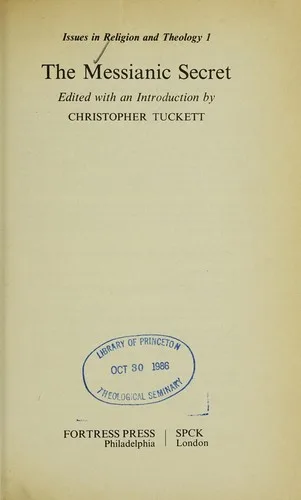
C. M. Tuckett's 1983 book examines Jesus's possible efforts to conceal his divine identity.
Published in 1983, The Messianic Secret offers a scholarly look at the idea that Jesus may have deliberately hidden his identity and mission. Tuckett analyzes the Gospel narratives, searching for signs of Jesus attempting to avoid public acclaim and instructing his followers to keep quiet. The book considers why such secrecy might have been employed and how early Christian communities might have shaped the stories about Jesus's life.
Tuckett's work engages with the ongoing academic discussion about the historical Jesus. It places the concept of the "Messianic secret" within the context of critical biblical scholarship that was active at the time of its publication. The book asks readers to consider the possibility that Jesus's divine nature was not openly declared during his earthly ministry, and that this secrecy was a key element in how his story was understood and transmitted.
This study engages with the historical and theological debates surrounding the figure of Jesus, specifically the hypothesis of the 'Messianic secret.' While not strictly an esoteric text itself, it addresses questions about the interpretation of sacred texts and the potential for hidden meanings or historical circumstances that shaped early Christian understanding of Jesus's divine mission. It contributes to critical scholarship that seeks to understand the origins of religious belief through textual analysis and historical context.
💡 Why Read This Book?
• Gain a nuanced understanding of the "Messianic secret" hypothesis, a central interpretive lens for the Gospel of Mark, as presented through Tuckett's critical textual analysis. • Grasp the historical context of biblical scholarship in the late 20th century, specifically how scholars like Tuckett engaged with debates surrounding the historical Jesus and Gospel origins, referencing the 1983 publication date. • Appreciate the intricate scholarly debate concerning Jesus's self-understanding and public presentation, by examining Tuckett's detailed exegesis of specific Gospel passages and their potential implications.
⭐ Reader Reviews
Honest opinions from readers who have explored this book.
❓ Frequently Asked Questions
What is the core argument of C. M. Tuckett's The Messianic Secret?
The book examines the hypothesis that Jesus intentionally concealed his Messianic identity during his earthly ministry, analyzing Gospel narratives for evidence of this secrecy and its potential implications for early Christian belief.
When was The Messianic Secret first published?
The Messianic Secret by C. M. Tuckett was first published in 1983.
Which New Testament book is most associated with the Messianic Secret theory?
The Gospel of Mark is most frequently cited in discussions of the Messianic secret, due to its narrative structure and apparent emphasis on Jesus's commands for silence.
Who is C. M. Tuckett in the context of biblical studies?
C. M. Tuckett is an author and scholar whose work, including The Messianic Secret (1983), contributes to critical biblical studies and the historical analysis of early Christianity.
What does the term 'Messianic secret' refer to in biblical scholarship?
It refers to the scholarly idea that Jesus sought to prevent widespread recognition of his identity as the Messiah, a concept explored through analysis of Gospel accounts.
Is The Messianic Secret by Tuckett a theological interpretation or historical analysis?
Tuckett's work is primarily a historical and textual analysis, critically examining Gospel accounts to understand the historical context and narrative construction of Jesus's ministry and identity.
🔮 Key Themes & Symbolism
Jesus's Self-Concealment
The core of Tuckett's work revolves around the deliberate or circumstantial concealment of Jesus's Messianic identity. This theme explores instances within the Gospels where Jesus appears to actively discourage public pronouncements of his role, such as his interactions with healed individuals or his instructions to the disciples. The book questions the origins and motivations behind this perceived secrecy, considering whether it reflects Jesus's own intentions or later editorial choices by the Gospel writers to shape their theological message for specific communities.
Markan Authorship and Theology
A significant portion of the analysis focuses on the Gospel of Mark, often considered the earliest of the canonical Gospels. Tuckett scrutinizes Mark's narrative techniques and theological agenda, suggesting that the "Messianic secret" might be a literary device employed by the author to construct a particular understanding of Jesus's mission. This involves examining how Mark presents Jesus's power and authority, often followed by commands for silence, and interpreting these moments within the broader context of 1st-century Jewish expectations of a Messiah.
Historical Jesus vs. Christ of Faith
The Messianic secret hypothesis directly engages with the 'quest for the historical Jesus' by attempting to discern what might have been the actual events and Jesus's own awareness, as opposed to the later theological interpretations developed by the early church. Tuckett's work probes the tension between the human figure of Jesus and the divine Christ presented in later dogma, examining how the secrecy narrative might bridge or highlight this gap for the believing community.
Gospel Interpretation and Redaction
This theme delves into the methodology of biblical criticism, particularly redaction criticism, which studies how editors (redactors) shaped existing traditions and sources into the final form of the Gospels. Tuckett applies these critical tools to identify potential layers of composition and to understand the editorial choices made by the Gospel writers. The book examines how the concept of secrecy could have been a theological tool used by redactors to explain perceived inconsistencies or to emphasize specific aspects of Jesus's life and ministry.
💬 Memorable Quotes
“The hypothesis of a Messianic secret.”
— This phrase encapsulates the central thesis of Tuckett's work, highlighting the academic concept that Jesus may have actively concealed his Messianic identity, a notion explored through detailed textual analysis of the Gospels.
“Mark's peculiar reticence.”
— This refers to the perceived tendency in the Gospel of Mark for Jesus to instruct individuals and disciples to remain silent about his identity and miracles, a key piece of evidence Tuckett examines for the Messianic secret theory.
“Jesus's commands for silence.”
— These are the specific injunctions found within Gospel narratives where Jesus tells others not to reveal who he is or what he has done. Tuckett analyzes these instances to understand their possible historical basis or theological purpose.
“The historical Jesus and his self-understanding.”
— This points to the scholarly endeavor to reconstruct the life and consciousness of Jesus of Nazareth apart from later theological embellishments, with the Messianic secret being a crucial element in understanding his potential self-perception.
“Theological implications for the early church.”
— This suggests that the narrative of a hidden Messianic identity had profound consequences for how the nascent Christian communities understood Jesus, his mission, and the nature of his kingdom, as interpreted by Tuckett.
🌙 Esoteric Significance
Tradition
While not explicitly aligned with a specific esoteric lineage like Gnosticism or Kabbalah, Tuckett's work on the Messianic secret resonates with traditions that explore hidden knowledge and initiatory paths. Many esoteric schools, particularly those influenced by Hermeticism or certain interpretations of Christian mysticism, emphasize a distinction between exoteric (public) and esoteric (private, inner) teachings. The idea that Jesus's true nature or mission was veiled, accessible only to a select few or understood through deeper insight, aligns with this esoteric principle of concealed wisdom.
Symbolism
The primary symbol at play is 'secrecy' itself, representing hidden truth, inner knowledge, and the veiled divine. Other related motifs include the 'disciples' as those privy to deeper understanding, and the 'crowds' who often misunderstand or fail to grasp Jesus's true identity. The concept of 'silence' also functions symbolically, indicating a state of inner contemplation or the deliberate withholding of revelation until the appropriate time or level of readiness is achieved.
Modern Relevance
Contemporary movements interested in the 'Jesus Seminar' and historical Jesus studies, as well as certain schools of Christian contemplative practice and esoteric Christianity, continue to engage with the questions Tuckett raised. Thinkers exploring the philosophical implications of Jesus's teachings and the historical development of Christology often reference the Messianic secret. Its relevance lies in its contribution to understanding the complex relationship between historical events, narrative construction, and the evolving theological understanding of the divine in human form.
👥 Who Should Read This Book
• Students of comparative religion and New Testament studies seeking to understand critical academic approaches to Jesus's life and teachings. • Scholars of biblical hermeneutics interested in the methodological debates surrounding Gospel interpretation, particularly redaction criticism. • Individuals exploring the historical development of Christology and the early Christian understanding of Jesus's divine and human nature.
📜 Historical Context
Published in 1983, C. M. Tuckett's The Messianic Secret emerged during a period of intense scholarly engagement with the historical Jesus and the formation of early Christian theology. The work built upon and responded to decades of critical biblical scholarship, including the form criticism and redaction criticism pioneered by figures like Rudolf Bultmann and Hans Conzelmann. These methodologies sought to uncover the layers of tradition and editorial shaping within the Gospels. Tuckett's book entered a conversation already deeply influenced by the debate over Jesus's self-awareness and the origins of Christology. While not a direct polemic, it implicitly engaged with the prevailing academic consensus that the "Messianic secret" was a plausible, though debated, interpretive framework for understanding the Synoptic Gospels, particularly Mark. The reception of such works within academia was generally robust, contributing to ongoing discussions rather than facing significant external censorship, though internal scholarly critique remained active.
📔 Journal Prompts
The implications of Jesus's commands for silence.
The tension between public perception and private revelation.
The role of narrative in shaping religious understanding.
How does the 'Messianic secret' hypothesis alter your reading of Mark's Gospel?
The distinction between the historical Jesus and the Christ of faith.
🗂️ Glossary
Messianic Secret
A scholarly hypothesis suggesting that Jesus intentionally concealed his identity as the Messiah, or that this aspect of his identity was not widely recognized or proclaimed during his earthly ministry, as explored in Tuckett's analysis.
Redaction Criticism
A method of biblical analysis that examines how editors (redactors) shaped and arranged existing source materials and traditions to produce the final form of a text, often to convey a specific theological message.
Historical Jesus
The figure of Jesus of Nazareth as he can be understood through historical and critical-scientific methods, distinct from the Christ of faith as interpreted through theological doctrines and creeds.
Christology
The branch of Christian theology concerned with the nature, person, and work of Jesus Christ, particularly his divinity and his role as Messiah and Savior.
Synoptic Gospels
The Gospels of Matthew, Mark, and Luke, which share significant similarities in content, order, and wording, suggesting a literary relationship between them. Mark is often considered the earliest.
Exegesis
Critical explanation or interpretation of a text, especially of the Bible. Tuckett's work involves extensive exegesis of Gospel passages.
Gospel of Mark
The second canonical Gospel, often considered the earliest, which plays a central role in discussions of the Messianic secret due to its narrative structure and emphasis on secrecy.